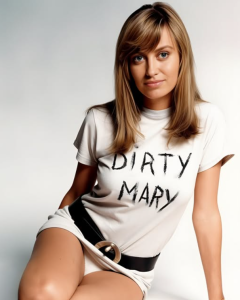
NAME THE BRITISH 70s STAR IN THIS CULT CAR-CHASE CLASSIC!
The actress is Susan George, and the 1974 film is Dirty Mary, Crazy Larry.
Few British actresses of the 1970s possessed the striking combination of innocence, unpredictability and fearless screen presence that Susan George brought to her roles. Whether she was appearing in gritty British dramas, controversial psychological thrillers or high-octane American action films, George had an unmistakable intensity that made audiences pay attention. With her expressive blue eyes, distinctive blonde hair and willingness to take on challenging material, she became one of the defining faces of early-1970s cinema.
Celebrating her 76th birthday, Susan George remains one of Britain’s most memorable screen stars, remembered not only for her beauty but also for performances that mixed vulnerability with fierce determination.
Born in London on 26 July 1950, George developed an interest in performing at a remarkably young age. She trained at the prestigious Corona Stage Academy, where many successful British actors learned their craft. Even as a child she displayed remarkable confidence before the camera, quickly finding work in television commercials and small acting roles.
Her early television appearances included popular British series that gave her valuable experience while she was still in her teens. Producers immediately noticed that she had something special—a combination of youthful charm and emotional honesty that made her performances believable.
By the late 1960s she was already transitioning into feature films, proving she was capable of much more than simply playing pretty young women.
Her major breakthrough came in 1971 with Straw Dogs, directed by Sam Peckinpah. Starring opposite Dustin Hoffman, George delivered one of the most talked-about performances of the decade.
The controversial thriller divided critics because of its graphic violence and disturbing themes, yet George’s fearless portrayal demonstrated enormous courage for such a young actress. While debates about the film continue today, it undeniably established Susan George as an actress willing to tackle demanding and emotionally difficult material.
Hollywood quickly took notice.
Unlike many British actresses who remained associated with costume dramas or romantic roles, George embraced contemporary characters filled with energy, rebellion and unpredictability. That willingness to take risks made her especially attractive to American filmmakers searching for fresh talent during the 1970s.
One of the finest examples arrived in 1974 with Dirty Mary, Crazy Larry.
In the film, George plays Mary Coombs, the impulsive and unforgettable third member of a criminal trio led by Peter Fonda’s Larry and Adam Roarke’s Deke. What begins as a robbery quickly turns into one of cinema’s greatest high-speed pursuits, featuring powerful American muscle cars, determined police officers and spectacular chase sequences across the California countryside.
Mary is far from a passive passenger.
She insists on joining the getaway, refuses to be ignored and continually complicates the plans of her male companions. Susan George gives the character warmth, humour, unpredictability and emotional depth, ensuring Mary never becomes merely comic relief.
Her chemistry with Peter Fonda is one of the film’s greatest strengths. While Larry is driven by dreams of racing glory and Deke concentrates on practical survival, Mary injects spontaneity into every scene. She often appears carefree, yet George subtly reveals a woman desperate to belong and unwilling to be left behind.
That complexity helped elevate the movie beyond a standard car-chase thriller.
Today, Dirty Mary, Crazy Larry enjoys genuine cult status among fans of classic action cinema. Car enthusiasts celebrate its thrilling driving sequences, while movie lovers appreciate its cynical ending and uniquely 1970s atmosphere.
Susan George’s performance remains central to its enduring appeal.
Throughout the decade she continued building an impressive résumé with films that covered an extraordinary range of genres.
She appeared in the supernatural horror Mandingo, thrillers, dramas and action pictures, proving she was remarkably versatile. Unlike many actresses whose careers became confined to one style of film, George comfortably moved between psychological drama, horror, romance and exploitation cinema.
This versatility helped establish her as an international star.
She worked alongside many of the era’s biggest names, including Dustin Hoffman, Peter Fonda, James Mason, Charles Bronson and Kirk Douglas. Directors appreciated her professionalism and willingness to fully commit to difficult roles.
What made Susan George particularly distinctive was her screen personality.
She could appear vulnerable one moment and fiercely independent the next. Audiences never quite knew how her characters would react, making her performances exciting to watch.
Her expressive face conveyed enormous emotional range without excessive dialogue. A glance, smile or worried expression often communicated more than pages of script.
That subtle acting style made her equally effective in intimate dramatic scenes and larger-than-life genre productions.
Although she enjoyed considerable success in America, George never abandoned her British roots. She frequently returned to work in British television and film, maintaining strong ties to the industry where her career began.
As the decades passed, she increasingly shifted toward producing and managing creative projects.
One of the most significant chapters of her later life involved her marriage to actor and producer Simon MacCorkindale. Together they became respected figures within British entertainment, supporting theatre productions and later managing the historic Goddards House and Gardens in Essex.
Following MacCorkindale’s death in 2010, George continued preserving both his legacy and her own remarkable contribution to British cinema.
Her influence extends well beyond the films themselves.
Modern audiences continue discovering her work through streaming services, Blu-ray restorations and classic movie festivals. Younger viewers who first encounter Straw Dogs or Dirty Mary, Crazy Larry often find themselves surprised by how contemporary her performances still feel.
Unlike many stars whose popularity fades with changing fashions, Susan George possesses a timeless screen quality.
Film historians frequently describe her as one of the defining actresses of Britain’s contribution to 1970s international cinema. During a decade known for experimentation, antiheroes and unconventional storytelling, she perfectly embodied the era’s spirit.
She was glamorous without seeming artificial.
She was fearless without losing vulnerability.
She embraced controversial projects without sacrificing emotional authenticity.
These qualities helped distinguish her from many contemporaries.
Even today, Dirty Mary, Crazy Larry remains a favourite among enthusiasts of classic American car movies. While audiences naturally remember the roaring Dodge Charger, spectacular stunts and relentless pursuit, Susan George’s Mary provides the film with its emotional heartbeat and unpredictable energy.
Without her spirited performance, the movie would lose much of its personality.
More than fifty years after its release, the film continues attracting new fans who appreciate practical stunt work, charismatic performances and the gritty realism that characterized so many memorable 1970s action films.
Susan George remains one of the era’s unforgettable faces—a gifted British actress whose career crossed continents and genres with remarkable confidence. Whether confronting psychological terror, racing across America in a muscle car, or bringing emotional complexity to challenging dramatic roles, she consistently proved that she possessed far more than movie-star looks.
Her legacy is one of courage, versatility and unforgettable screen presence.
And for lovers of cult cinema, she’ll always be remembered as the unforgettable Mary in Dirty Mary, Crazy Larry, one of the greatest car-chase classics ever made.