BREAKING: Israel Finishes Major Military Operation as Tensions With Iran and the U.S. Remain High
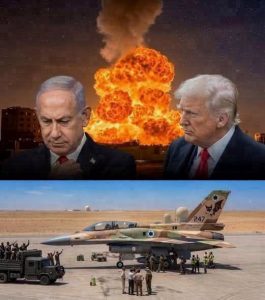
A dramatic image circulating online shows Israeli Prime Minister Benjamin Netanyahu and U.S. President Donald Trump standing in front of a huge explosion, alongside an Israeli fighter jet. The image strongly suggests a major military escalation, but it is important to distinguish the graphic from independently verified reporting. The photograph appears to be a composite or illustrative image rather than evidence that the explosion shown actually occurred.
Nevertheless, the underlying situation in the Middle East remains extremely serious. As of September 22, 2026, Israel, the United States and Iran remain locked in a dangerous confrontation, while diplomatic efforts are taking place at the United Nations in New York. (Reuters)
What Does “Israel Finishes” Actually Mean?
The phrase “Israel finishes” can be misleading when used without the rest of a headline. It could refer to the completion of a particular military strike, an operation, a phase of an air campaign, or an operational objective. It does not, based on the current reporting available, establish that Israel has “finished” the broader conflict with Iran.
The Israeli military has described its 2026 campaign against Iran as Operation Roaring Lion, launched jointly with U.S. forces on February 28. According to the Israel Defense Forces, the operation has targeted Iranian military infrastructure, missile capabilities, air-defense systems and senior leadership. (IDF)
The IDF has also published figures describing the scale of the campaign, including thousands of targets struck and hundreds of Israeli Air Force sorties during the early phase of the operation. Those figures are Israeli military claims and should be understood as such. (IDF)
That history helps explain why any new report about Israel completing a military operation can quickly generate intense attention.
The Fighter Jet in the Image
The lower portion of the circulating image shows an Israeli fighter aircraft on a military airfield. The aircraft appears to be an F-16, a type that has long formed an important part of Israel’s air power.
Israel’s air force has extensive experience conducting long-range operations and using intelligence, aerial refueling, electronic warfare and precision-guided weapons. These capabilities have played an important role in Israel’s military operations against Iranian targets.
However, the presence of an Israeli fighter jet in a social-media graphic does not prove that a particular strike took place at the time claimed by the post.
This distinction is especially important during fast-moving conflicts. Images are frequently reused, digitally edited or combined with unrelated photographs to create dramatic breaking-news graphics.
Netanyahu and Trump Remain Central to the Story
The image also features Netanyahu and Trump because the relationship between Israel and the United States remains one of the central factors in the regional conflict.
Trump addressed the United Nations General Assembly on September 22 and used the speech to defend the U.S. position on Iran. Reuters reported that Trump argued the war had prevented Iran from obtaining a nuclear weapon and warned that he could take further military action if a peace agreement was not reached. (Reuters)
At the same time, Trump has spoken about economic pressure and isolation as tools for forcing Tehran toward negotiations.
Iran, however, has presented a different approach. A senior Iranian official told Reuters that Tehran was prepared to reopen the strategically important Strait of Hormuz within a week if Washington reduced military pressure and lifted its blockade of Iranian ports. (Reuters)
That offer illustrates the complicated situation facing diplomats: military pressure continues, but both sides are also discussing conditions under which the confrontation could be reduced.
The Strait of Hormuz Adds Another Dimension
The conflict is not limited to missiles and aircraft.
The Strait of Hormuz is one of the world’s most important energy corridors. A substantial share of global oil and gas shipments normally passes through the waterway, making disruptions there capable of affecting energy prices far beyond the Middle East.
Reuters reported on September 22 that oil prices declined as markets reacted to signs that supplies could improve. Iran’s proposal concerning the Strait of Hormuz contributed to expectations that shipping conditions might eventually stabilize. (Reuters)
But the situation remains fragile.
Any renewed attack on commercial vessels, an escalation involving naval forces, or a breakdown in negotiations could quickly change the outlook for shipping and energy markets.
For ordinary people around the world, that means a military development thousands of miles away can eventually affect fuel prices, transportation costs, inflation and the broader economy.
Israel’s Military Campaign Has Been Extensive
According to the IDF, Operation Roaring Lion has involved operations across multiple areas and has sought to damage Iran’s military capabilities.
The Israeli military says its forces have attacked missile production facilities, air-defense systems and other military targets. It has also reported strikes against senior Iranian military figures. (IDF)
These claims come from the Israeli side, and information from active combat zones is difficult to independently verify in real time.
That is why headlines announcing that Israel has “finished” a particular operation should be read carefully. Completing a military mission does not necessarily mean the underlying conflict has ended.
A strike can be completed while tensions remain extremely high.
Iran’s Response
Iran has repeatedly warned that further American or Israeli military action could produce retaliation.
On September 21, Iran’s Revolutionary Guard warned that its military strategy and targets could change if the conflict escalated further. The same period also saw continued instability around the Strait of Hormuz and elsewhere in the region. (AP News)
The danger is that one military action can trigger another.
A missile launch can lead to an air-defense response. A strike on a military facility can produce retaliation. A naval incident can affect commercial shipping. And an attack involving an ally or proxy force can widen the geographic scope of the conflict.
That is one reason international officials continue to focus on preventing escalation.
Diplomacy Is Still on the Table
Despite the military confrontation, diplomacy has not disappeared.
The United Nations General Assembly is providing an unusually important setting for discussions involving the United States, Iran, Israel and Gulf countries.
Reuters reported that Iran has indicated a willingness to negotiate under certain conditions, while Trump has maintained that a future agreement must address Washington’s concerns. (Reuters)
Other countries are also attempting to influence the situation.
Gulf governments have strong reasons to seek stability because regional warfare threatens their populations, infrastructure, shipping routes and economies.
The United States is likewise facing pressure from the consequences of a prolonged conflict, particularly because the fighting affects energy markets and American military forces deployed throughout the region.
Netanyahu’s Upcoming United Nations Speech
Netanyahu is expected to address the United Nations later this week.
Reuters reported that Netanyahu plans to defend Israel’s military actions and respond to international criticism. (Reuters)
His visit comes at a particularly sensitive moment.
The war with Iran remains a major international issue, while Israel’s operations against Hamas and its broader regional military activity continue to attract intense international scrutiny.
According to the Jerusalem Post, Netanyahu’s current U.S. schedule is unusually short and does not include a planned meeting with Trump. (Jerusalem Post)
That does not by itself establish a major diplomatic break between the two leaders, but it is another development being watched closely as governments consider their next steps.
What Happens Next?
The immediate future remains uncertain.
There are several major questions:
Will Israel conduct additional strikes?
Even if a specific Israeli operation has concluded, that does not necessarily mean military activity is over. Israel has repeatedly stated that it will respond to threats against its territory.
Will Iran accept negotiations?
Iran has signaled that it could make concessions concerning the Strait of Hormuz under particular conditions, but disagreements with Washington remain substantial. (Reuters)
Will the United States continue military operations?
Trump’s September 22 UN speech made clear that Washington is maintaining significant pressure on Tehran. (Reuters)
Could the conflict spread?
The continuing involvement of groups aligned with Iran, including the Houthis in Yemen, adds another potential avenue for escalation. The G7 has called on Iran to stop supporting the Houthis and urged an end to attacks affecting civilian shipping. (Reuters)
A Dramatic Image Does Not Tell the Whole Story
The viral graphic may look like a scene from a war movie, but the reality behind the headline is considerably more complicated.
There is no reliable basis for treating the giant explosion in the image as proof of a nuclear detonation or a specific event that occurred “one hour ago.” The image should therefore be viewed as an illustration rather than confirmation of breaking events.
What is confirmed is that the Middle East remains in a period of severe military and diplomatic tension. Israel’s military campaign against Iran has been extensive, the United States remains deeply involved, Iran continues to threaten retaliation, and diplomats are simultaneously exploring possible paths toward de-escalation. (IDF)
The most important development may ultimately not be another dramatic photograph or viral headline, but whether governments can turn military pressure into negotiations that reduce the risk of a much wider conflict.
For now, the situation remains fluid. A reported completion of one operation should not be confused with the end of the larger confrontation. The next statements from Israel, Iran and the United States—and the diplomatic activity surrounding the United Nations—will be closely watched as the region enters another critical phase.