🚨 BREAKING: Israel Carries Out Fresh Strikes as Tensions Escalate Across the Region
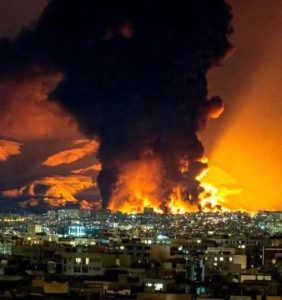
A dramatic image showing a massive fire and towering column of dark smoke over a city is circulating online alongside urgent claims that “Israel finishes…” a major military operation. The photograph is striking, but the image itself does not establish when or where it was taken, so it should not be treated as proof of a new event without independent verification.
What can be confirmed, however, is that Israeli military activity in Gaza continued on September 23, 2026, with reports of new airstrikes and casualties. Reuters reported that Israeli airstrikes killed at least four Palestinians in Gaza on Wednesday, according to local health officials. Israel said one of the strikes targeted a Hamas finance official. (Reuters)
The latest developments come against the backdrop of an already fragile ceasefire and continuing disagreements over Hamas disarmament, Israeli troop withdrawals and the future security arrangement in Gaza. The result is an environment in which even a single new strike can quickly trigger fears of a broader escalation.
A dramatic image—and an important warning
The photograph accompanying the viral headline shows what appears to be an urban area illuminated by a huge orange glow, with an enormous plume of black smoke rising into the night sky.
Such photographs can be emotionally powerful, particularly when paired with phrases such as “BREAKING,” “just minutes ago,” or “Israel finishes.” But photographs shared on social media can be old, taken in another location, or reused to illustrate a completely different event.
That distinction matters.
The current reporting available for September 23 concerns Israeli strikes in Gaza, but it does not establish that the uploaded photograph depicts those particular attacks. A responsible account should therefore separate the verified news from the unverified caption.
New Israeli strikes reported in Gaza
According to Reuters, Israeli aircraft struck a vehicle in western Khan Younis on Wednesday. Local medics said two Palestinians were killed and two others wounded. The Israeli military confirmed that it had carried out the strike and said it targeted a militant, with additional information expected later. (Investing.com)
Later reporting put the number of Palestinians killed in Israeli strikes across Gaza at at least four that day. Reuters reported that Israel said one of the attacks targeted Mohammad Abu Elwan, whom Israeli officials described as a senior Hamas financial official. (Reuters)
The developments demonstrate how unstable the situation remains even after the ceasefire arrangements that were intended to reduce large-scale fighting.
Rather than producing a complete end to violence, the ceasefire has been accompanied by continuing allegations of violations, military operations and disputes over what comes next.
Why the latest strikes matter
Every new military operation carries consequences beyond the immediate target.
For Palestinians living in Gaza, continued strikes mean renewed fears about safety, displacement and access to essential services. For Israel, military officials continue to argue that operations are necessary to address armed groups and threats to Israeli security.
These competing realities make the conflict exceptionally difficult to resolve.
The Israeli government has continued to emphasize its objective of preventing Hamas from maintaining the military capabilities it says could be used against Israel. Palestinian officials and humanitarian organizations, meanwhile, have repeatedly raised concerns about civilian casualties and the humanitarian consequences of military operations.
The latest strikes therefore arrive at a moment when diplomatic efforts remain extremely important.
The humanitarian cost
More than two years of war have transformed Gaza’s physical and humanitarian landscape.
Large sections of the territory have suffered extensive destruction, while millions of people have experienced displacement during the conflict. Hospitals, residential neighborhoods, roads and other essential infrastructure have repeatedly been affected.
Recent reporting continues to document deaths and injuries despite the ceasefire framework.
Reuters reported that Palestinian health officials said more than 73,000 Palestinians had been killed since the beginning of Israel’s assault on Gaza following the Hamas-led attack of October 2023. Those figures are supplied by Gaza’s health authorities and do not necessarily distinguish between combatants and civilians. (Investing.com)
That distinction is important when discussing casualty figures because different parties to the conflict provide different information and methodologies.
Israel’s position
Israeli officials have consistently said that military operations are directed against Hamas and other armed threats rather than Palestinian civilians.
In the latest incident, the Israeli military said the Khan Younis strike targeted a militant. Israeli officials have also maintained that Hamas’s military and financial networks remain security threats.
Israeli Prime Minister Benjamin Netanyahu has continued to defend his government’s military policy. Reuters reported on September 22 that Netanyahu planned to use his address to the United Nations General Assembly to defend Israel’s actions and challenge international criticism. (Reuters)
That diplomatic confrontation is occurring at the same time as fighting and political negotiations continue on the ground.
Palestinian concerns
Palestinian officials and medical workers have provided a different perspective, emphasizing civilian deaths and the continuing danger faced by residents.
Reports on September 23 described casualties in several parts of Gaza. Shafaq News reported that strikes affected areas including Khan Younis and Gaza City and that an incident occurred near Al-Wafa Hospital. (شفق نيوز..)
Medical facilities are particularly sensitive locations during wartime because damage to hospitals can have consequences far beyond the immediate casualties.
A strike near a medical facility can complicate emergency treatment, disrupt ambulance access and increase pressure on an already damaged health system.
A wider regional picture
The Gaza conflict cannot be viewed entirely in isolation from the broader Middle East crisis.
The region has experienced repeated military confrontations involving Israel, Iran, Hezbollah, the Houthis, the United States and other actors.
Recent reporting has included developments involving Iran and the Strait of Hormuz, while other reports have described military activity in southern Iran and continuing tensions between Washington and Tehran. (The Jerusalem Post)
This wider environment explains why dramatic images of explosions can spread so rapidly online. Viewers may see a photograph of a burning city and immediately assume it represents the newest attack.
But that assumption can be dangerous.
An image can be real while the caption attached to it is false.
What does “Israel finishes” actually mean?
The headline circulating with the photograph appears incomplete: “BREAKING just a few minutes ago Israel finishes…”
Without the rest of the original statement, it is impossible to determine whether the claim refers to a military operation, a specific strike, a weapons campaign or something else.
There is currently no reliable basis for completing that sentence with a dramatic claim simply because it appears alongside the photograph.
That is particularly important with breaking-news content.
During conflicts, social media accounts frequently use urgent language designed to generate clicks and shares. Words such as “finished,” “destroyed,” “historic,” “unprecedented” and “just minutes ago” can create the impression that an event has been independently confirmed when it has not.
Readers should look for a specific location, date, official statement and reporting from established news organizations before accepting such claims.
Why verification is essential
The easiest way to evaluate a breaking military story is to ask several basic questions:
Where did the event happen?
When did it happen?
Who reported it first?
Has an official source confirmed it?
Are independent news organizations reporting the same event?
Does the photograph actually correspond to the reported incident?
Those questions can prevent an old photograph from becoming “new” simply because someone reposted it with a fresh caption.
In this case, the latest independently reported developments confirm new Israeli strikes in Gaza on September 23, but they do not independently verify that the supplied photograph was taken during those attacks. (Reuters)
The possibility of further escalation
The greatest concern surrounding every new strike is whether it remains an isolated military incident or becomes part of a wider escalation.
The Middle East has repeatedly demonstrated how quickly local incidents can produce broader political and military consequences.
An attack can lead to retaliation. Retaliation can lead to additional strikes. Diplomatic negotiations can then become more difficult as each side faces pressure to respond.
That is why international attention remains focused not only on individual attacks but also on negotiations surrounding Gaza’s future.
The central questions include whether Hamas will disarm, whether Israeli forces will withdraw from agreed areas, how Gaza will be governed, and how reconstruction can proceed.
What happens next?
For now, the most important development is that violence has not completely disappeared despite the ceasefire framework.
Israeli officials continue to describe their military actions as necessary for security, while Palestinian authorities continue reporting deaths and injuries resulting from Israeli operations.
At the diplomatic level, international leaders are pressing for a longer-term political settlement and humanitarian relief.
At the same time, the United Nations and governments around the world remain under pressure to address the enormous humanitarian consequences of the conflict.
The coming days could therefore be significant.
But dramatic predictions should not replace confirmed information.
Final thoughts
The photograph circulating online is undeniably dramatic, showing a huge fireball and column of smoke over an illuminated urban landscape. Yet the image alone cannot tell us when or where the event occurred.
What is confirmed as of September 23, 2026, is that Israeli strikes in Gaza have continued, with Palestinian medical officials reporting multiple deaths and injuries. Israel says at least one of the latest strikes targeted a Hamas financial official. (Reuters)
The larger story remains one of an extremely fragile security situation, continuing military activity and unresolved diplomatic questions.
For anyone following the breaking news, the most responsible approach is to distinguish confirmed events from viral claims—and to remember that an emotionally powerful photograph is not, by itself, evidence of a particular event.
As new information emerges from Gaza and other parts of the region, the situation will continue to require careful attention to verified reporting, official statements and independent confirmation.