For Izaiah Rizzo, Even a Simple Family Outing Can Require Extraordinary Planning
For many families, a trip to the beach can be as simple as packing a few towels, some snacks, sunscreen, and a change of clothes.
For Will and Yeni Rizzo, taking their son Izaiah on an outing can require something much more complicated: medical equipment, accessibility planning, specialized supplies, careful transportation arrangements, and the willingness to adapt when ordinary paths are not designed for their family.
That is what makes the Rizzo family’s story so meaningful.
Izaiah lives with WOREE syndrome, an exceptionally rare genetic neurological disorder associated with changes in the WWOX gene. His condition has involved serious seizures, developmental challenges and complex medical needs. His family has shared that he requires extensive daily care, including specialized respiratory and feeding support. (Givebutter)
Yet his parents have made a conscious effort to give him opportunities to experience the world outside the routines of medical care.
Through their family project, Found Nomads, the Rizzos have documented their travels and experiences with Izaiah, showing both the beautiful moments and the enormous amount of preparation behind them.
A family vacation looks different for the Rizzos
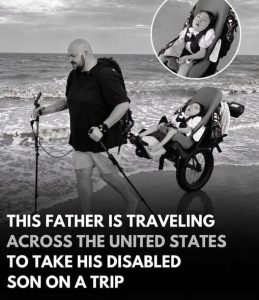
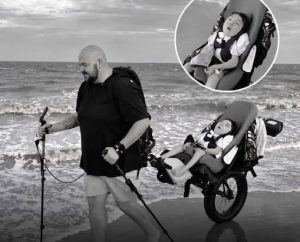
The photograph circulating online captures a particularly powerful scene.
Will is walking along a beach while pulling Izaiah in an adaptive wheelchair designed to handle outdoor terrain. The ocean stretches behind them, and Izaiah appears to be enjoying the experience.
At first glance, it looks like an ordinary father-and-son moment.
But there is nothing ordinary about the amount of planning required to make that moment possible.
A wheelchair designed for everyday indoor or paved environments can struggle dramatically in loose sand. Getting from a parking area to the water can become a major physical and logistical challenge.
For the Rizzo family, accessibility is not simply about whether a destination has a ramp.
It is about whether Izaiah can actually participate once the family arrives.
Can his wheelchair move across the surface?
Is there enough room for his equipment?
Can his parents provide the medical care he needs?
Is there a safe place to rest?
What happens if his condition suddenly changes?
These are questions that most families never have to consider before taking a day trip.
For the Rizzos, they are part of everyday planning.
Izaiah’s diagnosis changed the family’s routine
According to information shared by Izaiah’s family through the WWOX Foundation, he began experiencing seizures when he was only about a month old. Genetic testing eventually revealed a mutation involving the WWOX gene. (Givebutter)
His medical journey has included serious complications.
The family’s account describes an especially frightening episode in January 2022, when Izaiah experienced a medical emergency while in his car seat. His parents responded immediately, and he was subsequently hospitalized. His condition later became complicated by pneumonia and significant respiratory problems. (Givebutter)
Experiences like these naturally changed the way the family approaches everyday life.
Leaving the house is no longer simply a matter of grabbing keys and walking out the door.
Medical supplies and equipment have to be considered.
Transportation has to be planned.
Unexpected emergencies have to be anticipated.
And every destination has to be evaluated from Izaiah’s perspective.
But his parents did not want his world to become smaller
One of the most striking elements of the Rizzo family’s story is that they have not allowed medical complexity to completely determine where their family can go.
Their approach has been to find ways to make experiences possible.
That philosophy eventually became part of Found Nomads, the family’s travel project.
The Rizzos have traveled through numerous parts of the United States with Izaiah, including trips involving beaches and national parks. Recent accounts of their journey say they have traveled through 23 states. (Advice for Life by Bird Advice)
That is an extraordinary undertaking for any family.
For a family traveling with a child who has complex medical needs, the logistical challenge is even greater.
Their journey demonstrates that accessible travel does not always mean finding a perfectly accessible destination.
Sometimes it means adapting the way the family gets there.
Sometimes it means bringing additional equipment.
Sometimes it means a parent physically helping move a wheelchair across terrain.
And sometimes it means changing the itinerary entirely.
The hidden work behind a photograph
Social media photographs tend to show the finished moment.
They show the sunset.
The beach.
The smile.
The family standing together.
They rarely show the hours of preparation that came before the camera was turned on.
For Izaiah’s family, a trip can involve respiratory equipment, suction equipment, feeding supplies and emergency medical items. Reports about the family’s travels describe these supplies as an important part of their preparation. (Advice for Life by Bird Advice)
That means a family outing can become a carefully coordinated operation.
Something as simple as traveling to a different state requires consideration of where medical care is available, how equipment will be transported and whether accommodations can meet Izaiah’s needs.
There is also the physical challenge.
His parents may need to maneuver equipment through areas where ordinary wheelchairs would have difficulty.
A beautiful trail may be inaccessible.
A sandy beach may be nearly impossible to cross.
A historic building may have stairs instead of ramps.
A restaurant may not have enough room for specialized equipment.
Each obstacle creates another decision.
The beach photograph tells only part of the story
The viral image is powerful precisely because it reduces a complicated story to one recognizable moment.
A father is pulling his son toward the ocean.
There is water.
There is open sky.
There is freedom.
But behind that image is an important message about accessibility.
A destination can technically be open to the public without being genuinely accessible to everyone.
That distinction matters.
Accessibility isn’t simply a legal requirement or a ramp at an entrance. It can involve transportation, terrain, bathrooms, seating, pathways, medical facilities and the ability to safely participate in an activity.
The Rizzos’ travels illustrate how families sometimes have to solve these problems themselves.
Building a future around accessibility
The family’s transportation needs eventually became an important part of their fundraising efforts.
In 2025, Yeni Rizzo launched a GoFundMe campaign seeking funds for a specially adapted vehicle. The campaign described the family’s desire for a vehicle with enough room for Izaiah’s equipment and the needs of the entire family. The stated goal was $85,000 for purchasing and modifying a Sprinter van. (GoFundMe)
The campaign explains that an appropriate vehicle could provide additional space for medical equipment, make medical appointments easier and allow the family to continue traveling.
This is an important part of their story because transportation can become one of the largest barriers for families caring for someone with complex disabilities.
A conventional family vehicle may simply not have enough space.
There may be a wheelchair.
There may be medical equipment.
There may be emergency supplies.
There are also other family members and ordinary belongings.
What looks like a large vehicle from the outside can become surprisingly crowded once everything necessary for a medically complex child is loaded inside.
Travel becomes a form of family time
Despite the challenges, the Rizzos’ goal isn’t simply to accumulate miles.
It is to create memories.
For a family dealing with significant medical challenges, everyday life can easily become dominated by appointments, medications, therapy, equipment and medical concerns.
Travel creates a different kind of experience.
A beach is not a hospital.
A national park is not a clinic.
A scenic overlook is not a doctor’s office.
Those environments give families an opportunity to experience their loved one outside the context of illness and treatment.
That does not mean the medical condition disappears.
It means there can be room for something else, too.
There can be a sunset.
A family photograph.
The sound of waves.
A new landscape.
A shared memory.
Izaiah’s story is also about his parents
It is easy to focus entirely on the child in a story like this.
But there is another story unfolding beside him.
It is the story of his parents.
Will and Yeni have had to learn how to provide care under circumstances that can be unpredictable and physically demanding. They have also had to become planners, advocates and problem-solvers.
Their travel plans require them to think ahead in ways that many parents never have to.
The decision to travel does not mean they underestimate the challenges.
In many ways, it means they understand them extremely well.
They know that the road will not always be smooth.
They know that some destinations will be difficult.
They know that equipment can fail, weather can change and plans can go wrong.
Yet they continue searching for ways to give their family experiences together.
A different definition of adventure
The word “adventure” often brings to mind hiking, climbing, camping or long-distance travel.
For Izaiah’s family, adventure can mean something different.
It can mean successfully getting from the vehicle to the beach.
It can mean finding a wheelchair-friendly path.
It can mean discovering a national park that the whole family can enjoy.
It can mean spending an afternoon somewhere beautiful without having to turn around because accessibility becomes impossible.
And sometimes adventure is simply getting out the front door.
That perspective is one reason the family’s journey has resonated with so many people online.
The importance of accessible travel
The Rizzos’ experience also raises a broader question about tourism and public spaces.
How many destinations are truly designed for people with significant mobility or medical needs?
A location can advertise itself as accessible while still presenting serious challenges to a family like the Rizzos.
Accessibility has to be considered throughout the entire experience.
Parking.
Transportation.
Entrances.
Paths.
Restrooms.
Seating.
Outdoor surfaces.
Emergency access.
Accommodation.
When even one part of the journey becomes inaccessible, the entire outing can become difficult.
Families shouldn’t have to choose between seeing beautiful places and keeping a loved one safe.
Yet many families continue to encounter exactly that dilemma.
More than an inspirational photograph
It can be tempting to look at a photograph like this and simply call it inspirational.
But Izaiah’s story is more complicated than a single inspirational message.
His medical condition is real.
His parents’ responsibilities are real.
The physical barriers are real.
The financial costs are real.
And the work required to travel safely is real.
The value of the story comes partly from acknowledging those realities rather than pretending they don’t exist.
The photograph becomes meaningful because of what it represents: a family making space for joy despite circumstances that require extraordinary preparation.
Creating memories one trip at a time
The Rizzo family has shown that travel does not have to look the same for everyone.
For some people, adventure begins with a suitcase.
For others, it begins with a medical checklist.
For some families, reaching the water takes only a few minutes.
For the Rizzos, it may require specialized equipment and a father’s determination to keep moving forward.
But when they finally reach the beach, they have something that cannot be measured in miles.
They have a memory.
They have experienced something together.
And Izaiah has been given another opportunity to see a part of the world beyond the boundaries created by his medical condition.
The story of Izaiah Rizzo is therefore not simply about a father taking his disabled son on a trip.
It is about a family refusing to let extraordinary circumstances erase ordinary dreams.
It is about parents who understand that their son’s care must come first while still believing that he deserves experiences, exploration and family adventures.
And it is about the countless small decisions that make one beautiful photograph possible.
The ocean in the background may look effortless.
The moment may look simple.
But for this family, getting there represents planning, equipment, patience, physical effort and an enormous commitment to making family memories together.
Sometimes the greatest journeys aren’t measured by how far someone travels.
They are measured by how much determination it takes to get there. (Advice for Life by Bird Advice)