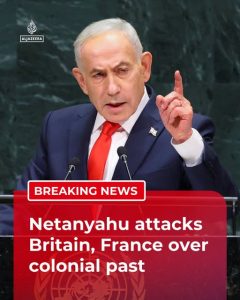
Netanyahu Clashes With Britain and France at the UN Over Colonialism Accusations
Israeli Prime Minister Benjamin Netanyahu delivered a sharply worded response to Britain and France during his address to the United Nations General Assembly on September 24, 2026, turning criticism of Israel’s policies into a broader argument about the history of European colonialism.
Speaking in New York, Netanyahu challenged countries that accuse Israel of colonialism, specifically pointing to Britain and France and their former overseas empires. He questioned what he described as the irony of countries with extensive colonial histories now criticizing Israel on the issue. According to reports from the UN speech, Netanyahu said that Britain and France had essentially “invented” the concept of colonialism and emphasized that their former colonies once extended across much of the world. (Le Monde.fr)
The remarks came at a particularly tense moment in Israel’s relations with several European governments. Britain and France have recently increased pressure on Israel over settlement expansion in the occupied West Bank, while also reaffirming support for a two-state solution involving Israel and a future Palestinian state. (elysee.fr)
A confrontation rooted in history
Netanyahu’s argument relied heavily on historical comparison.
Britain and France were among the world’s major colonial powers during the 19th and 20th centuries. Their empires extended across Africa, Asia, the Middle East, the Caribbean and other regions. Britain controlled territories through the British Empire, while France governed large areas through its own colonial system.
Netanyahu invoked that history to challenge the credibility of contemporary European criticism.
His argument was essentially that governments whose predecessors exercised imperial control over vast territories should be cautious about accusing another country of colonialism. He presented Israel as a comparatively small country facing security threats rather than as a traditional colonial power.
The comparison, however, does not settle the underlying dispute. The British and French governments are making contemporary arguments about Israeli settlements based on their interpretation of international law and the Israeli-Palestinian conflict. Their colonial histories are a separate historical issue.
That distinction is central to understanding why Netanyahu’s remarks generated attention.
Why Britain and France are criticizing Israel
The dispute did not emerge in isolation.
On September 8, Britain, France and Canada issued a joint statement emphasizing their support for a two-state solution. They said that continued settlement expansion in the West Bank, including the E1 project, posed a serious threat to that objective. They also said that settlement expansion and increased settler violence were worsening conditions on the ground. (elysee.fr)
A broader group of European governments subsequently announced that they intended to introduce, support or consider restrictions on trade involving Israeli settlements. The countries included France and the United Kingdom as well as Canada, Denmark, Finland, Iceland, Ireland, Norway, Poland, Portugal, Spain and Sweden. (France Diplomatie)
France has separately stated that its measures are directed specifically at settlement-related activity rather than at Israel’s internationally recognized territory as a whole. French officials have also stressed that Israel remains an economic partner. (France Diplomatie)
This distinction is important because the European governments describe their policies as responses to settlement activity and international-law concerns, rather than as a rejection of Israel itself.
Israel rejects the criticism
The Israeli government has strongly rejected the European approach.
Israeli officials argue that international pressure frequently ignores the country’s security environment and the threats Israel faces from armed groups and hostile governments.
Netanyahu’s UN address placed that security argument at the center of his broader defense of Israel.
He also referenced previous conflicts and argued that Israel had faced threats of destruction even before it controlled territories captured during the 1967 Six-Day War. According to Israeli reporting on the speech, Netanyahu pointed to 1967 as evidence that Israel’s security problems cannot simply be attributed to its presence in the West Bank or Gaza. (ynet)
That argument reflects a long-standing Israeli position: that the country’s security concerns existed before the settlement issue became the focus of international criticism.
Critics of Israeli policy, however, distinguish between Israel’s right to security and questions concerning its control and settlement policies in territories captured in 1967.
The settlement question
At the heart of the dispute is the West Bank.
Israel captured the West Bank from Jordan during the 1967 war. Since then, Israeli settlements have been established and expanded in the territory.
Israel disputes various international interpretations surrounding the settlements and emphasizes historical, religious and security considerations. Many governments and international institutions, meanwhile, regard the settlements as contrary to international law.
France, Britain and other governments have repeatedly stated that Israeli settlement expansion threatens the possibility of establishing a viable Palestinian state alongside Israel.
Their September statement specifically highlighted the E1 settlement project, which they said could divide the West Bank and undermine territorial continuity for a future Palestinian state. (elysee.fr)
The dispute is therefore about more than terminology. It concerns territory, sovereignty, security, Palestinian statehood and the future political structure of the region.
Britain and Israel’s increasingly tense relationship
Netanyahu’s confrontation with Britain comes after months of increasingly strained relations.
In August, Netanyahu sharply criticized Britain and referred to it as the “Islamic Republic of Britain,” comments that drew criticism in the UK. A British government spokesperson described those remarks as unacceptable. (Al Jazeera)
Relations deteriorated further in September after Britain and France introduced measures concerning goods originating from Israeli settlements.
Israel responded by announcing the closure of Britain’s consulate in East Jerusalem and imposing entry restrictions on certain British nationals. Reuters reported that the Israeli government described the European measures as interference in Israeli affairs. (Reuters)
The latest UN confrontation therefore represents another chapter in an already difficult diplomatic relationship.
France takes a similar position
France has also become increasingly outspoken about Israeli settlement policy.
French officials have said that settlement expansion and settler violence threaten the two-state solution. France has emphasized that its restrictions are aimed at settlement activity rather than at Israel’s economy as a whole. (France Diplomatie)
That position puts Paris increasingly at odds with Netanyahu’s government.
The French government says its approach is based on international law and the objective of preserving the possibility of two states. Israel argues that European pressure is unfair and insufficiently attentive to Israeli security concerns.
Both sides therefore frame the dispute around different priorities.
For France and Britain, the central issue is the preservation of a negotiated political solution. For Netanyahu’s government, security, Israeli sovereignty and opposition to international pressure are major themes.
Netanyahu’s broader UN strategy
Netanyahu’s remarks about Britain and France were part of a larger effort to use the UN platform to defend Israel.
Before the speech, Netanyahu said he intended to use the United Nations to present Israel’s position and counter what Israeli officials describe as misinformation about the country’s military campaign and policies. Reuters reported that he also planned to confront criticism from New York City Mayor Zohran Mamdani. (Reuters)
The UN provides Netanyahu with a particularly visible international stage.
For Israel, the General Assembly is also a place where criticism of Israeli policy is often intense. Netanyahu has repeatedly used international speeches to argue that Israel faces double standards and that other countries fail to acknowledge the threats confronting Israelis.
His latest remarks fit that established pattern.
Why the colonialism argument is controversial
The historical comparison Netanyahu made raises an important question: does a country’s colonial past affect its ability to criticize another country today?
Supporters of Netanyahu’s argument can point to the enormous scale of the British and French empires and argue that European governments should acknowledge their own historical record when discussing territorial control and colonialism.
Critics can respond that a government’s current position is not automatically invalid because its predecessors committed colonial acts.
The two arguments address different questions.
One concerns historical responsibility.
The other concerns present-day international law and political policy.
That distinction explains why the colonial history of Britain and France does not, by itself, resolve the current disagreement over Israeli settlements.
A wider diplomatic divide
The confrontation also illustrates how dramatically the diplomatic environment surrounding Israel has changed.
Britain and France have historically maintained close relationships with Israel while also supporting Palestinian statehood and negotiations toward a two-state solution.
Today, those governments are increasingly willing to use economic and diplomatic measures to express opposition to settlement expansion.
At the same time, they continue to emphasize support for Israel’s security.
The September 8 joint declaration explicitly stated that Britain, France and Canada supported a secure Israel living alongside a secure Palestine. (elysee.fr)
That combination—support for Israel’s security while opposing settlement expansion—is becoming an increasingly important feature of Western European policy.
What happens next?
Netanyahu’s UN remarks are unlikely to end the disagreement.
Britain and France have already established their positions regarding settlements and the two-state solution. Israel has made clear that it rejects the pressure and intends to defend its policies.
The consequences could extend beyond rhetoric.
Trade restrictions, diplomatic measures and disagreements over settlement activity could place additional strain on Israel’s relationships with European governments.
At the same time, Israel’s government is likely to continue arguing that international criticism fails to adequately account for security threats and Israel’s historical connection to the region.
The disagreement is therefore unlikely to be resolved by a single speech.
The larger significance
Netanyahu’s clash with Britain and France at the United Nations reflects a much larger argument over history, territory and international law.
His decision to invoke European colonial history was not simply a reference to the past. It was part of a broader effort to challenge the legitimacy of criticism directed at Israel.
Britain and France, meanwhile, are presenting their current policies as efforts to preserve the possibility of a two-state settlement and to respond to settlement expansion that they say violates international law.
The two positions remain fundamentally different.
For Netanyahu, the colonialism accusation is itself deeply questionable when made by former colonial powers. For Britain, France and other governments, their historical record does not remove their ability to take positions on present-day international disputes.
The exchange at the UN consequently highlights one of the central challenges of the Israeli-Palestinian conflict: almost every contemporary argument is connected to competing interpretations of history.
As diplomatic tensions continue, the debate will likely remain focused on several unresolved questions—whether settlement expansion can be reconciled with a future Palestinian state, how Israel’s security concerns should be addressed, what international law requires, and whether diplomatic pressure can influence policy without further damaging relations.
Netanyahu’s latest remarks ensure that those questions will remain at the center of international attention.