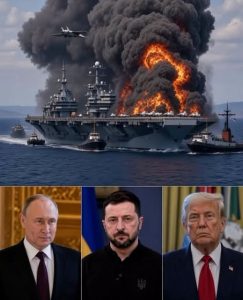
BREAKING? The Truth Behind Claims That a Russian Su-57 Destroyed a U.S. Aircraft Carrier Carrying 700 People
A dramatic headline claiming that a Russian Su-57 fighter pilot destroyed a U.S. aircraft carrier carrying hundreds of people has circulated online, raising questions about a potential military confrontation between Russia and the United States.
The headline is alarming, suggesting that a single fighter aircraft carried out an attack capable of destroying one of the most heavily defended warships in the world. But before accepting such a claim as breaking news, it is essential to examine what has actually been reported and whether credible evidence supports it.
The key finding is that the claim has not been established as a real event. A webpage published on September 15, 2026, carrying virtually the same headline explicitly labels its story a fictional scenario, not real news.
News Today
Here is what readers should understand about the aircraft, the carrier, the alleged attack, and the importance of verifying military claims before sharing them.
1. What Does the Viral Headline Claim?
The headline alleges that a Russian Su-57 pilot destroyed an American aircraft carrier carrying approximately 700 people.
The language is designed to create urgency. Words such as “BREAKING” and “30 minutes ago” suggest that the event has just happened and that readers are witnessing a developing international crisis.
However, a headline cannot establish that an attack occurred.
To verify a claim of this magnitude, journalists and researchers would need evidence such as official military statements, independently verified photographs or videos, credible reporting from established news organizations, and information identifying the location and time of the alleged incident.
The specific headline has appeared on a website that describes the story as fictional. That is a crucial distinction: a dramatic military scenario written in the style of a news report is not evidence of an actual military operation.
News Today
There is therefore no sound basis for reporting that a U.S. aircraft carrier was destroyed in this alleged incident.
2. What Is Russia’s Su-57 Fighter?

The Su-57 is a Russian multirole fighter aircraft developed by Sukhoi. It is designed to perform air-to-air and air-to-ground missions, with an emphasis on maneuverability, advanced sensors, and reduced radar visibility.
The aircraft is part of Russia’s effort to develop modern combat aviation capabilities.
Its design incorporates features intended to make detection more difficult, although reduced radar visibility does not make an aircraft invisible or invulnerable. Detection depends on multiple factors, including radar systems, operating conditions, distance, and the characteristics of the aircraft.
Like other advanced military aircraft, the Su-57 must operate within a wider system involving pilots, ground-based command, intelligence, communications, and weapons.
Its capabilities are a legitimate subject of military analysis. But the existence of an advanced fighter does not prove that it has successfully attacked an American carrier.
A claim about a specific combat success requires evidence of that event, not merely descriptions of the aircraft’s design.
3. Why Is an Aircraft Carrier Such a Significant Target?

American aircraft carriers are among the most complex military platforms in the world.
A carrier provides a mobile base for aircraft, allowing the United States Navy to conduct air operations far from land-based airfields. Depending on the vessel and mission, its air wing can support surveillance, air defense, reconnaissance, and other military operations.
A carrier also operates as part of a larger formation. Escort ships, aircraft, sensors, and other assets contribute to protecting the vessel and maintaining awareness of potential threats.
This does not mean an aircraft carrier is impossible to damage. No military platform is invulnerable. Modern warfare involves complex interactions between offensive weapons, defensive systems, intelligence, and operational circumstances.
Nevertheless, destroying a carrier would be a major military event requiring substantial evidence.
A report claiming that such a vessel had been destroyed would need to establish which carrier was involved, where the incident occurred, what damage was sustained, and whether the vessel was actually lost.
The viral headline provides no independently verified evidence establishing those facts.
4. Could One Fighter Destroy a U.S. Aircraft Carrier?
The question deserves a careful answer.
Modern fighter aircraft can carry weapons designed for different combat missions, and naval forces must take potential air and missile threats seriously. However, the outcome of a real engagement depends on numerous variables, including the weapons involved, the distance to the target, detection, defensive responses, and the operational environment.
It would be misleading to conclude that a Su-57 could automatically destroy a carrier simply because it is a sophisticated aircraft.
It would also be misleading to claim that such an outcome is categorically impossible under every conceivable circumstance.
Military capabilities are not the same as verified combat results. To establish that a particular aircraft destroyed a particular warship, investigators would need evidence showing that the engagement actually took place and that the ship was destroyed as a result.
In this case, the available source describing the matching headline identifies the scenario as fictional rather than documenting a real engagement.
News Today
5. Why Are These Stories Appearing Online?
Military headlines attract attention because they involve national security, advanced technology, and the possibility of international escalation.
A claim involving Russia and the United States can spread particularly quickly because both countries possess powerful armed forces and have a long history of strategic competition.
There is also a financial incentive for some online publishers to produce sensational headlines. Dramatic language can encourage people to click, watch a video, comment, and share a post before checking its accuracy.
Some military-themed videos are also created using simulation games rather than real combat footage.
For example, a YouTube video published on March 3, 2026, used a very similar headline about a Russian Su-57 destroying a U.S. aircraft carrier. Its description explicitly states that the video was created using the military simulation game Arma 3 and does not depict real events.
YouTube
This illustrates why viewers should distinguish between a realistic-looking simulation and documentary evidence.
A video can show explosions, aircraft, ships, and emergency responses without depicting an actual military incident.
6. What Would Happen if Such an Attack Were Confirmed?
A genuine attack that destroyed a U.S. aircraft carrier would be an exceptionally serious international development.
The immediate priorities would likely include determining the condition of the crew, conducting rescue operations where necessary, establishing the circumstances of the incident, and assessing the threat of further attacks.
Military and civilian leaders would also need to establish responsibility and consider their responses.
However, it would be premature to predict a particular military or diplomatic outcome. The consequences would depend on the circumstances, the evidence available, the number of casualties, and decisions made by the governments involved.
It is especially important not to confuse hypothetical consequences with events that have actually occurred.
Discussing what might happen in a fictional scenario can be useful, but the scenario must be clearly identified as hypothetical.
7. How Can Readers Check Whether Breaking Military News Is Real?
Before sharing a headline claiming that a warship has been destroyed, readers can take several practical steps.
- Look for independent reporting. Check whether established news organizations are reporting the same event with verifiable details.
- Check official statements. Look for relevant announcements from the U.S. Department of Defense, the U.S. Navy, or other appropriate authorities.
- Read beyond the headline. A story may contain a disclaimer identifying it as fictional, simulated, or intended for entertainment.
- Examine the original video. Check its publication date, source, description, and whether it uses footage from a simulation or an older event.
- Be cautious about precise numbers. A claim that hundreds of people are aboard a damaged ship should be supported by reliable information, not repeated simply because it appears in a headline.
These checks are particularly important when a post claims that a major military incident happened only minutes earlier.
The absence of immediate confirmation does not, by itself, prove that an event never occurred. But it does mean readers should avoid presenting the claim as established fact.
8. What Do We Actually Know?
The distinction between verified information and speculation is essential.
The available evidence supports three points:
First, the Su-57 is a real Russian fighter aircraft.
Second, the United States operates aircraft carriers that serve as important components of its naval forces.
Third, a website published a story with the same sensational claim on September 15, 2026, while explicitly labeling the account fictional. A separate military simulation video used a similar headline and disclosed that it was made with Arma 3.
News Today
+1
These facts do not establish that a Russian fighter destroyed an American carrier.
The claim should therefore not be presented as confirmed breaking news.
Conclusion: A Dramatic Headline Is Not Proof of a Military Attack
The suggestion that a Russian Su-57 pilot destroyed a U.S. aircraft carrier carrying 700 people is an alarming claim, but the available evidence does not substantiate it as a real event.
The matching September 2026 webpage labels its story fictional, and a similar video explicitly identifies itself as a military simulation.
News Today
+1
The distinction matters. False reports about military attacks can create unnecessary fear, spread misinformation, and distort public understanding of international security.
The responsible approach is to wait for reliable, independently verifiable reporting before concluding that an aircraft carrier has been destroyed or that a major confrontation has taken place.
Bottom line: The headline describes an alleged attack, not a verified military event. Until credible evidence establishes otherwise, readers should treat the claim with caution rather than share it as confirmed news.