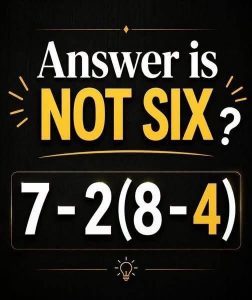
Why the Internet Is Arguing Over This Simple Math Problem: Can You Solve 7 − 2(8 − 4)?
A simple mathematical expression has once again sparked a lively debate online, leaving people divided over what appears to be an elementary arithmetic question. The problem is short enough to fit on a small graphic, yet it has generated thousands of discussions, competing answers, and passionate explanations about the rules of mathematics.
The question is:
7 − 2(8 − 4) = ?
At first glance, this expression may seem easy. It contains only subtraction, multiplication, and parentheses. However, when people attempt to solve it mentally, they sometimes arrive at different answers. Some confidently say the result is negative one, while others argue that the answer should be twenty.
So, which answer is correct? More importantly, why does this small calculation create so much confusion?
The answer comes down to one essential mathematical principle: the order of operations.
The Correct Answer Is −1
THE CORRECT SOLUTION
7 − 2(8 − 4) = −1
Step 1: Parentheses
8 − 4 = 4
Step 2: Multiplication
2 × 4 = 8
Step 3: Subtraction
7 − 8 = −1
The correct answer, following standard mathematical conventions, is −1.
To understand why, we need to break the expression into smaller steps rather than trying to calculate everything at once.
The original expression is:
7−2(8−4)7-2(8-4)7−2(8−4)
First, solve the expression inside the parentheses. Parentheses indicate that the enclosed operation must be evaluated before the surrounding operations.
Therefore:
8−4=48-4=48−4=4
Replacing the parentheses with the result gives us:
7−2(4)7-2(4)7−2(4)
Next, we evaluate the multiplication. When a number appears directly beside parentheses, multiplication is implied. In this case, 2(4)2(4)2(4) means 2×42\times42×4.
Thus:
2×4=82\times4=82×4=8
The expression now becomes:
7−87-87−8
Finally, subtract eight from seven.
7−8=−17-8=-17−8=−1
That is how we arrive at the answer: negative one.
Although the calculation is straightforward when performed step by step, the disagreement often begins when people try to solve it using a different sequence of operations.
Why Do Some People Get 20?
The alternative answer of twenty usually comes from a particular mistake.
Someone might look at the expression and reason that seven minus two equals five. They then multiply five by the result of the parentheses, which is four.
Their calculation looks like this:
(7−2)(8−4)(7-2)(8-4)(7−2)(8−4)
5×4=205\times4=205×4=20
The arithmetic in the second line is correct. Five multiplied by four certainly equals twenty. The problem is that the person has changed the original expression by introducing parentheses around 7−27-27−2.
Those parentheses were not present in the original question.
In the original expression, multiplication must be performed before the subtraction outside the parentheses. The expression does not instruct us to subtract two from seven first and then multiply the result by four.
This is an important distinction: getting the individual arithmetic operations right does not guarantee the final answer will be correct. The operations must also be performed in the correct order.
Understanding the Order of Operations
The order of operations is a set of conventions that helps people interpret mathematical expressions consistently.
Without these conventions, the same written expression could be interpreted in several different ways. Mathematics would become much harder to communicate because readers might calculate the same expression using different sequences.
In the United States, students commonly learn the acronym PEMDAS.
P
Parentheses
Evaluate expressions inside grouping symbols first.
E
Exponents
Evaluate powers and roots as appropriate.
MD
Multiplication and Division
Work from left to right.
AS
Addition and Subtraction
Work from left to right.
Some people remember the same rules through BODMAS or BIDMAS, depending on the country and educational system. These acronyms refer to brackets, orders or indices, division, multiplication, addition, and subtraction.
However, there is a common misunderstanding about what these acronyms mean.
PEMDAS does not mean multiplication must always come before division. Similarly, addition does not always have to come before subtraction.
Multiplication and division share the same level of precedence. Addition and subtraction also share the same level. When operations have equal precedence, they are evaluated from left to right.
For the expression in this puzzle, that distinction does not change the answer. After evaluating the parentheses, multiplication is the next operation, followed by subtraction.
Why the Parentheses Matter So Much
Parentheses are among the most important features of this problem.
Consider the expression:
7−2(8−4)7-2(8-4)7−2(8−4)
The parentheses group 8−48-48−4 together, making it the first calculation.
Now compare it with a different expression:
(7−2)(8−4)(7-2)(8-4)(7−2)(8−4)
These expressions look similar, but they are not equivalent.
In the second expression, the parentheses around 7−27-27−2 explicitly require that subtraction to be performed first. The two resulting values are then multiplied.
The results are different:
7−2(8−4)=−17-2(8-4)=-17−2(8−4)=−1
But:
(7−2)(8−4)=20(7-2)(8-4)=20(7−2)(8−4)=20
This demonstrates why even a small change in mathematical notation can significantly change the result.
Parentheses are not decorative symbols. They communicate which parts of an expression belong together and which calculations should take priority.
Is There Any Ambiguity in the Problem?
Some online discussions argue that the expression is ambiguous because multiplication is indicated by placing the number two directly beside the parentheses rather than using a multiplication symbol.
For example, the expression uses:
2(8−4)2(8-4)2(8−4)
instead of:
2×(8−4)2\times(8-4)2×(8−4)
In standard arithmetic notation, both forms indicate multiplication. Therefore, under the usual rules of arithmetic, the expression has a clear answer: −1.
There are mathematical expressions in which missing parentheses, unusual formatting, or unclear division notation can cause genuine ambiguity. In those cases, rewriting the expression with additional grouping symbols can help eliminate uncertainty.
But this particular expression is not normally considered ambiguous when interpreted according to standard order-of-operations rules.
The fact that some people disagree does not automatically mean that several answers are equally valid. A disagreement can also arise because people have learned a rule incorrectly or are applying operations in an inconsistent order.
Why Does This Puzzle Spread So Easily Online?
The popularity of simple math puzzles has a lot to do with how people interact on social media.
A complicated mathematical proof might require several minutes of concentration, specialized knowledge, or a lengthy explanation. A short expression, on the other hand, can be understood almost immediately.
People can look at the problem, make a quick calculation, and post an answer within seconds.
The simplicity also makes the puzzle ideal for generating discussion. Someone who gets −1 may wonder how another person arrived at 20. Someone who gets 20 may feel confident until another commenter explains the order of operations.
These conflicting answers encourage people to respond, debate, share the image, and challenge their friends.
There is also a psychological element. When people answer a question quickly, they may become attached to their initial result. Discovering that others disagree can make them more determined to defend their calculation.
Instead of checking the original expression carefully, they may focus on proving that their mental steps were reasonable.
This is one reason mathematical puzzles can produce surprisingly emotional arguments. Even when the problem is small, people may interpret a disagreement as a challenge to their knowledge or intelligence.
However, making a mistake on an arithmetic problem does not mean someone is unintelligent. It simply provides an opportunity to revisit a rule and understand it more clearly.
How Can You Avoid Making the Same Mistake?
The easiest way to solve expressions like this is to slow down and follow a consistent process.
First, identify any parentheses and calculate what is inside them.
Second, look for exponents, multiplication, and division, following the appropriate precedence rules.
Finally, complete addition and subtraction, working from left to right when they have equal precedence.
For this puzzle, the process is especially simple:
- Calculate 8−48-48−4, which equals 444.
- Multiply 2×42\times42×4, which equals 888.
- Calculate 7−87-87−8, which equals −1-1−1.
You can also check the answer by rewriting the expression with an explicit multiplication symbol:
7−2×(8−4)2×(8−4)7-2times(8−4)2\\times(8-4)7−2×(8−4)2×(8−4)
The square brackets simply make the grouping easier to see. The calculation remains unchanged.
This habit is useful not only for school exercises but also for algebra, spreadsheets, programming, scientific calculations, and everyday situations involving numbers.
What This Debate Teaches Us About Mathematics
At its heart, this puzzle is about more than reaching the correct numerical result. It demonstrates the importance of following shared rules when interpreting information.
Mathematics depends on precision. Symbols communicate specific meanings, and changing the order in which operations are performed can change the result.
The puzzle also reminds us that confidence and correctness are not the same thing. A person can feel certain about an answer and still benefit from checking the reasoning behind it.
When faced with a disagreement, the most useful response is not simply to insist that one answer is correct. It is to examine the expression, explain the steps, and determine which interpretation follows the established rules.
That approach makes mathematical discussions more productive and helps everyone learn.
Final Answer: −1
The expression 7−2(8−4)7-2(8-4)7−2(8−4) evaluates to −1, because the parentheses must be solved first, multiplication comes next, and subtraction is performed last.
The answer of 20 results from treating 7−27-27−2 as though it were grouped together, even though the original expression contains no such parentheses.
So, the next time you see a simple math problem circulating online, take a moment before posting your answer. Follow the order of operations, write out each step, and check the original expression carefully.
Now it’s your turn: What answer did you get the first time you saw this problem — −1 or 20? Did you solve it mentally, or did you work through each step?
Share your answer and explanation in the comments. You might discover that the most interesting part of this puzzle is not the calculation itself, but how differently people approach the same question.