You Can Choose Only One: Time or Money? The Life-Changing Decision That Shapes Your Future
In life, everyone faces choices. Some decisions seem small, while others can completely change the direction of our future. One of the most important questions we must ask ourselves is this: If you could choose only one, would you choose time or money?
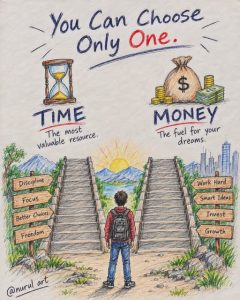
The illustration presents a powerful message. At the top, the words “You Can Choose Only One” remind us that our choices matter. On one side, an hourglass represents time, described as the most valuable resource. On the other side, a bag of money represents wealth, the fuel for our dreams. In the center, a young person stands before two stairways, each leading toward a different future.
One path is marked by discipline, focus, better choices, and freedom. The other is marked by hard work, smart ideas, investment, and growth. Both paths offer opportunities, but each teaches us something important about success, happiness, and the way we live our lives.
So, which one should we choose: time or money?
1. Time: The Most Valuable Resource in Life
Time is one of the few things in life that money cannot buy back. Once a second passes, it becomes part of the past. We can earn more money, purchase new possessions, and rebuild our careers, but we cannot return to yesterday and live it again.
Every person receives the same twenty-four hours each day. The difference between people is often how they use those hours. Some spend their time learning new skills, building meaningful relationships, improving their health, and working toward their goals. Others allow their days to disappear through endless distractions, procrastination, and activities that bring little value to their lives.
This does not mean that every moment must be productive. Rest, entertainment, friendship, and family time are also important. The real lesson is to use our time intentionally rather than allowing it to pass without purpose.
Imagine two people who want to build a better future. One spends an hour every day learning a valuable skill, while the other spends that hour scrolling through social media without a clear purpose. After a year, the first person may have developed knowledge, confidence, and opportunities that did not exist before.
Small actions repeated consistently can create remarkable changes.
Time also gives us opportunities to appreciate the people we love. A successful career means little if we never have time to enjoy our achievements with family and friends. A large bank account cannot replace a meaningful conversation with a loved one or bring back a moment we missed.
That is why time is so precious. It is not merely something we spend; it is the foundation upon which we build our entire lives.
2. Money: The Fuel for Your Dreams
Although time is priceless, money is also an essential part of modern life. It helps us meet our basic needs, support our families, access education, receive healthcare, and create opportunities for ourselves and others.
Money can reduce certain kinds of stress. It can provide a safe home, reliable transportation, better access to resources, and greater freedom to make decisions. For someone struggling to pay bills, earn enough to support a family, or escape financial insecurity, money can make a tremendous difference.
The image describes money as “the fuel for your dreams.” This is an important idea because many dreams require resources to become reality.
Someone who wants to start a business may need money for equipment, supplies, and marketing. A student may need funds for education. A family may need savings to purchase a home or prepare for unexpected emergencies.
Money can also create opportunities to help others. Financial stability may allow a person to support their parents, provide for their children, donate to meaningful causes, or invest in a community.
However, money itself is not the final destination. It is a tool that helps us achieve our goals.
The danger begins when people spend their entire lives chasing wealth without considering what they are sacrificing along the way. They may work constantly, neglect their health, miss important family moments, and postpone happiness until some distant future.
They tell themselves they will relax when they become rich, spend time with family after reaching their goals, or enjoy life once they have accumulated enough money.
But there is no guarantee that tomorrow will provide the opportunities we expect.
Financial success matters, but it should serve our lives rather than control them.
3. The Two Stairways: Two Different Approaches to Success
The illustration shows a young person standing between two stairways. Each staircase symbolizes a different approach to building a successful life.
The first staircase highlights discipline, focus, better choices, and freedom. These qualities remind us that personal growth begins with our daily habits.
Discipline helps us continue working even when motivation disappears. Focus allows us to concentrate on what truly matters instead of becoming distracted by every new opportunity. Better choices help us avoid unnecessary mistakes, while freedom represents the ability to make decisions without being controlled by fear, pressure, or financial desperation.
The second staircase represents hard work, smart ideas, investment, and growth. These qualities remind us that building wealth often requires effort, planning, creativity, and patience.
Hard work helps us develop experience and produce results. Smart ideas help us solve problems and discover opportunities. Investment allows us to put resources toward future benefits, while growth represents the gradual improvement of our financial position and personal abilities.
Neither staircase is automatically the wrong choice. In reality, the strongest approach combines the lessons from both.
Discipline can help us save money. Focus can help us build a valuable career. Smart ideas can help us work more efficiently. Investment can help us prepare for the future. Better choices can protect our time, while financial stability can give us more control over how we spend it.
The young person in the illustration represents anyone who is standing at a crossroads. We cannot always control the circumstances we face, but we can often influence the direction in which we move.
The important question is not simply which staircase looks easier. It is which choices will help us create a life that is both meaningful and sustainable.
4. Why Time and Money Are Connected
At first, time and money may seem like two completely different things. One cannot be touched, while the other can be counted, saved, and exchanged for goods and services.
Yet they are deeply connected.
Most people exchange some portion of their time for money through work. Employees receive salaries, freelancers charge for their services, and business owners invest their time in building organizations.
This exchange is necessary, but it also creates an important question: Are we using our time in a way that provides enough value in return?
Working harder does not always mean earning more. Sometimes, developing a skill, improving a process, or learning to solve a valuable problem can produce better results without requiring more hours.
For example, a person who learns a specialized skill may eventually qualify for better-paying work. Someone who builds an efficient business system may be able to serve more customers without working every hour of the day.
These improvements can create a better balance between time and money.
However, not everyone has the same opportunities. Many people work long hours because their responsibilities leave them with few alternatives. It is important not to judge people for their financial circumstances or assume that success depends only on effort.
Access to education, family responsibilities, economic conditions, health, and luck can all influence a person’s choices.
The goal is not to pretend that everyone has unlimited freedom. The goal is to recognize the opportunities available to us and use them as wisely as possible.
5. What Is More Important: Time or Money?
If I had to choose only one, I would choose time, because time is the resource that makes every other part of life possible.
Money can sometimes be earned again after a financial loss. Skills can be developed, businesses can be rebuilt, and new opportunities can emerge. But the time that has already passed cannot be recovered.
Every birthday reminds us that another year has gone by. Every conversation with someone we love becomes part of our shared history. Every opportunity we accept or reject shapes the direction of our lives.
Choosing time does not mean ignoring money. Financial responsibility is important, and earning enough to meet our needs should be a priority whenever possible.
Instead, choosing time means understanding why we want money in the first place.
Do we want money to provide security? To care for our families? To travel? To pursue our passions? To gain independence? To help people who need support?
If these are our goals, then money should help us create a better life, not become the reason we never enjoy one.
Imagine reaching old age with a large fortune but regretting the relationships you neglected and the experiences you postponed. Now imagine reaching that same age knowing you worked responsibly, supported your loved ones, and made room for meaningful experiences along the way.
The second life may not be perfect, but it offers a different kind of wealth—one measured in memories, relationships, personal growth, and peace of mind.
Ultimately, money can improve many aspects of life, but time gives us the opportunity to experience them.
6. How to Use Your Time and Money Wisely
We do not have to choose between financial success and a meaningful life. We can build habits that support both.
First, define your priorities. Decide what matters most to you. Your priorities might include family, health, education, financial stability, independence, or personal development. Clear priorities make it easier to decide how to use your time and money.
Second, create a realistic financial plan. Track your spending, try to save regularly when possible, reduce unnecessary expenses, and prepare for unexpected costs. A simple budget can help you understand where your money goes.
Third, invest in your abilities. Learning new skills can improve your opportunities over time. Reading, taking courses, practicing communication, and developing professional knowledge can all help you make better decisions.
Fourth, protect your time. Set boundaries around unnecessary distractions. Avoid saying yes to every request when doing so prevents you from fulfilling your important responsibilities. Make time for rest, relationships, and activities that bring genuine value to your life.
Fifth, think long-term. Not every reward needs to be immediate. Saving for the future, developing a career, and building healthy habits often require patience. Small, consistent actions can produce meaningful results over time.
Finally, remember that success does not look the same for everyone. Some people dream of building a large company, while others want a peaceful home, a stable income, and more time with their children. Both visions can be valuable.
Your life does not need to look impressive to other people to be meaningful to you.
7. The Real Meaning of Wealth
We often measure wealth through salaries, properties, cars, businesses, and bank balances. These things can be useful indicators of financial progress, but they do not tell the complete story.
True wealth can also mean having the freedom to make choices, the health to enjoy your days, the knowledge to solve problems, and the relationships that make life worthwhile.
A wealthy person who is constantly exhausted may lack the time to enjoy their achievements. A person with plenty of free time but no reliable way to meet basic needs may experience considerable stress.
That is why a balanced approach matters.
Financial security can protect our future, while thoughtful use of time can improve our present. Together, they can help us create a life in which we are not simply surviving or chasing the next achievement, but also appreciating what we already have.
The greatest success may not be having everything we desire. It may be understanding what we truly need and building a life around those things.
Conclusion: Choose Wisely, Because Time Never Stops
“You Can Choose Only One” is more than a message about time and money. It is a reminder that our decisions determine how we experience our lives.
Time teaches us that every day is valuable. Money teaches us the importance of planning, responsibility, and opportunity. Discipline helps us remain consistent, focus keeps us moving forward, smart ideas help us improve, and investment prepares us for tomorrow.
The most important lesson is to avoid sacrificing everything meaningful in the pursuit of success.
Work hard, but remember why you are working. Save money, but do not forget to live. Pursue your dreams, but make room for the people and experiences that give those dreams meaning.
If you must choose only one, choose time—not because money is unimportant, but because time is the foundation of every opportunity, every relationship, and every memory you will ever create.
Money can help you build a better life, but time is what allows you to live it.
You cannot stop the clock, and you cannot return to yesterday. What you can do is make today’s choices count.
So ask yourself one final question: If you continue living exactly as you do today, will your future self thank you for how you used your time?
The answer begins with the choices you make right now.