Erika Kirk Bikini Photo Is a Feast for Eyeballs, Try Not to Gasp!
Erika Kirk has become a familiar name in American public life, attracting attention for her leadership, public appearances, personal style, and connection to the world of politics. But beyond the headlines surrounding her professional responsibilities, interest in her earlier life has also resurfaced online, including photographs from her beauty pageant days that have prompted renewed curiosity about her background.
The headline “Erika Kirk Bikini Photo Is a Feast for Eyeballs, Try Not to Gasp!” captures the attention-grabbing style of celebrity entertainment websites. Yet the story behind the interest is more nuanced than a sensational caption might suggest. Erika’s participation in beauty pageants is a documented part of her past, while individual images circulating online still need to be examined carefully before their authenticity or context can be established.
Erika Kirk’s Journey From Beauty Pageants to the Public Spotlight
Before becoming one of the most closely watched figures associated with Turning Point USA, Erika Kirk, formerly known as Erika Frantzve, participated in the beauty pageant world. In 2012, she was crowned Miss Arizona USA and went on to represent Arizona at the Miss USA competition.
That experience placed her in an environment where presentation, confidence, fashion, and public speaking were important elements of the competition. Beauty pageants commonly feature formal gowns, interviews, and swimwear presentations, meaning contestants may appear in a variety of outfits as part of the event.
Her pageant background has become relevant again as online audiences revisit photographs from earlier stages of her life. Images that once appeared in a specific competition setting can attract a different level of attention when the person pictured later becomes a prominent public figure.
For readers discovering these photographs for the first time, the important distinction is that pageant images belong to a particular moment in someone’s personal history. They do not necessarily reflect that person’s current activities, priorities, or public image.
Why Bikini Photographs Can Attract So Much Attention
Celebrity photographs often generate discussion because they offer audiences a glimpse into a public figure’s life outside formal interviews, speeches, and professional events. Swimwear photographs can receive particularly strong reactions because they differ from the carefully selected clothing typically seen at political gatherings or official appearances.
In Erika’s case, her pageant participation provides context for why swimwear-related photographs may be associated with her earlier public appearances. Her appearance in a competition was part of an established event format, rather than evidence of a newly revealed private moment.
That distinction matters when evaluating headlines that suggest a photograph has suddenly surfaced or that a public figure has unexpectedly revealed something about herself.
An older image can be genuine without being new. A photograph can also be authentic while being presented with a misleading caption. And an image that resembles a real person may be digitally altered or generated entirely with artificial intelligence.
Readers who encounter dramatic headlines should therefore consider whether the article identifies the original event, provides a reliable publication source, or offers enough information to establish when and where the photograph was taken.
A Public Figure Whose Style Continues to Draw Discussion
Erika Kirk’s public appearance has become a topic of commentary alongside her growing responsibilities in conservative politics. Her clothing choices, accessories, and presentation at public events have attracted attention from both supporters and critics.
Fashion coverage can be an entertaining part of celebrity journalism, but it can also become a source of disproportionate scrutiny. An outfit that one observer considers elegant may strike another as overly formal, unconventional, or unsuitable for a particular occasion.
The same dynamic applies to photographs from earlier years. People naturally change their appearance and personal style over time. Hairstyles, clothing preferences, and public presentation can evolve as careers and circumstances change.
Rather than treating every photograph as a revelation, it is more useful to understand the setting in which it was taken. A pageant photograph, a family photograph, and an image from a political event each tell a different story about the circumstances surrounding the subject.
This context helps audiences distinguish legitimate entertainment reporting from content designed primarily to provoke an immediate reaction.
The Internet’s Appetite for Celebrity Throwback Photos
Social media has made it easier than ever for older photographs to return to public attention. A picture posted years ago can suddenly circulate widely after a person becomes involved in a major news story or assumes a more visible public role.
These resurgences often follow a familiar pattern. Someone shares an old photograph, another account reposts it with a dramatic caption, and additional users begin discussing the image without necessarily checking its original source.
The process can create the impression that a photograph is new, exclusive, or controversial even when it has been publicly available for years.
In Erika’s case, interest in her earlier pageant appearances reflects a broader tendency to revisit the histories of people who become prominent in politics and entertainment. Audiences may be curious about their previous careers, professional experiences, public appearances, and personal transformations.
However, popularity on social media should not be confused with verification. Thousands of reposts do not establish the authenticity of an image, and a striking caption is not a substitute for evidence.
Responsible reporting requires identifying what is actually known and avoiding claims that go beyond the available information.
Separating Genuine Photographs From Misleading Images
The growing availability of artificial intelligence image generators has created additional challenges for celebrity news coverage. Images can now be created or altered to depict public figures in situations that never happened.
In September 2026, the image-verification website AI or Not flagged images purporting to show Erika Kirk in a bikini as likely AI-generated or manipulated. Its assessments provide a reason for caution, although automated detection results are not definitive proof on their own.
This is particularly important when an image is circulated without a reliable original source. A realistic appearance does not establish that a photograph depicts a real event, and even sophisticated image analysis can produce errors.
Readers can take several practical steps when evaluating a potentially controversial photograph:
- Look for the original photographer, publication, or event associated with the image.
- Check whether established news organizations have independently published the same photograph.
- Examine the date and caption rather than assuming the image is recent.
- Be cautious about images that appear only on anonymous social media accounts.
- Treat AI detection results as supporting evidence, not as an unquestionable verdict.
These precautions are especially valuable when a headline uses suggestive language to encourage people to click before they have considered whether the underlying claim is accurate.
Why the Caption Does Not Tell the Whole Story
The phrase “Try Not to Gasp” is a familiar device in online entertainment writing. It promises an extraordinary revelation and encourages readers to react emotionally before they have seen the evidence.
Such wording can work as a promotional hook, but it should not determine how the underlying story is presented.
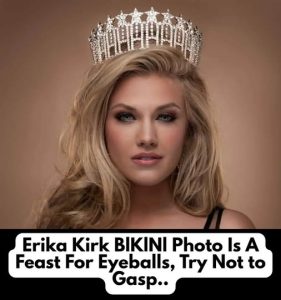
The image accompanying this article’s headline shows a blonde woman wearing a jeweled crown against a neutral background. It does not show a bikini, and the image alone does not establish that the woman pictured is Erika Kirk.
Consequently, that particular image should not be described as a verified bikini photograph of her. Doing so would confuse the promotional graphic with the subject suggested by the headline.
A reliable article should make that distinction clear rather than using an unrelated image to imply that a specific photograph has been authenticated.
Readers deserve to know whether they are looking at an original photograph, an illustrative image, an edited picture, or an AI-generated visual. That information is particularly important when a real person’s reputation is involved.
Erika Kirk’s Public Life Extends Beyond Photographs
Although photographs can attract considerable attention, they represent only one small part of Erika Kirk’s public profile.
Following the September 2025 killing of her husband, conservative activist Charlie Kirk, she assumed a leadership role at Turning Point USA. Her subsequent public appearances have focused on the organization, its political activities, and the continuation of its work.
Her position has brought increased media attention, along with discussion of her public statements, leadership decisions, fashion choices, and personal history.
That visibility makes her a subject of interest for political reporters and entertainment outlets alike. It also means that information about her can circulate rapidly across platforms, sometimes without sufficient context.
A balanced account should recognize both the public’s interest in her background and the importance of distinguishing documented events from speculation.
Photographs from her pageant career can help illustrate one chapter of her life, but they should not overshadow the broader circumstances that explain why she is now a prominent public figure.
The Final Word on the Viral Headline
The interest surrounding Erika Kirk’s earlier photographs demonstrates how quickly celebrity-style content can intersect with political news. Her Miss Arizona USA title and participation in the 2012 Miss USA competition are documented parts of her background, providing legitimate context for interest in her pageant photographs.
However, not every image shared under her name is necessarily genuine, recent, or correctly described. Reports of AI-generated bikini images circulating online make it especially important to verify the source and authenticity of any photograph before treating it as fact.
The accompanying crowned-woman image does not establish the existence of a new bikini photograph of Erika Kirk. Any article making that specific claim would need additional, reliable evidence.
Ultimately, the most interesting story is not simply whether an old photograph attracts attention. It is how public images change meaning as people move into new roles, how social media amplifies curiosity, and why careful verification remains essential in an era of increasingly convincing digital imagery.
For readers, the best approach is simple: enjoy legitimate celebrity and fashion coverage, remain curious about public figures’ histories, and check the evidence before accepting a sensational headline at face value.