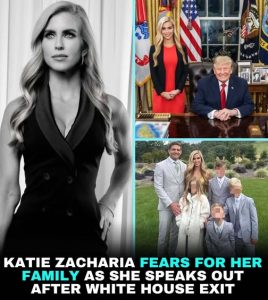
Katie Zacharia Fears for Her Family as She Speaks Out After White House Exit
Katie Zacharia is speaking out after a dramatic and unexpectedly short stint as White House press secretary, revealing concerns about her family’s privacy and safety as she adjusts to life outside one of the most visible jobs in American politics.
Zacharia, who served as President Donald Trump’s chief spokesperson for just five days in October 2026, has accused photographers of invading her privacy and warned that she will take action against anyone who targets her husband or their four children. Her comments have brought renewed attention to the circumstances surrounding her abrupt departure from the White House and the personal consequences of becoming a prominent political figure.
The former press secretary’s brief tenure attracted national attention almost immediately. Her first briefing faced criticism, questions emerged about her professional background, and reports of internal disagreements added to the controversy surrounding her appointment.
Now, with her time behind the White House podium over, Zacharia appears determined to protect her family while responding to the attention that has followed her into private life.
Her experience highlights the intense scrutiny that can accompany a high-profile government position, particularly in an administration that regularly attracts strong reactions from supporters and critics alike.
Katie Zacharia Speaks Out About Her Family’s Privacy
In comments reported by the Daily Mail and subsequently covered by other outlets, Zacharia expressed anger about photographers allegedly waiting outside locations where she was staying.
She said one photographer had appeared outside her location and invaded her privacy. She also issued a strong warning to anyone who might attempt to target her family or engage in harassment.
Zacharia emphasized that her husband, Tyler, and their four children should not become targets of unwanted attention because of her political career.
Her remarks suggested that the transition away from the White House has not immediately brought the privacy she might have expected. Instead, she has found herself dealing with photographers and public curiosity even after leaving the press secretary’s position.
According to reports, Zacharia also contacted police on three occasions over people allegedly lingering near her home. These accounts have not independently established that every incident involved criminal conduct, and the distinction between unwanted photography, persistent attention, and unlawful harassment remains important.
Nevertheless, Zacharia’s concerns are clear. She wants her family to be able to go about its daily life without feeling watched or pursued.
She has also warned that anyone who targets her family or violates their privacy should expect a firm response.
The comments represent a more personal side of a story that has largely focused on political controversy. While much of the attention surrounding Zacharia has centered on her performance and departure, her latest statements shift the focus toward her responsibilities as a wife and mother.
For Zacharia, the immediate priority appears to be establishing boundaries around her family’s private life.
A White House Tenure That Lasted Just Five Days
Zacharia’s appointment initially appeared to offer her an opportunity to become one of the most recognizable communicators in the Trump administration.
Trump announced her selection on October 9, 2026, after deciding to bring the conservative commentator into the White House press secretary role. She had previously worked in conservative media and served as a spokesperson at the Department of Homeland Security.
The position placed her at the center of the administration’s relationship with the press. The White House press secretary is responsible for communicating the president’s positions, responding to journalists’ questions, and explaining administration policies to the public.
It is a demanding job under any president, but the role has attracted particularly intense attention during Trump’s time in office.
Zacharia’s first days proved difficult. Her initial briefing on October 13 lasted approximately 14 minutes, during which she answered only a small number of questions. Her delivery and handling of the briefing attracted criticism from journalists and political commentators.
Questions about her legal background also emerged during the same period.
Zacharia had been described as an attorney when her appointment was announced. Subsequent reporting raised questions about her qualifications, and she later acknowledged that she had failed the California bar exam. She also clarified her past work at a law firm in China.
These questions quickly became part of the broader debate over her appointment.
On October 16, Trump publicly expressed uncertainty about whether she should remain in the position. He said he had advised her to reconsider the job and suggested that she did not need to endure the pressure associated with it.
Her departure was reported that same day, bringing her brief tenure to an end.
The speed of the transition made Zacharia’s appointment an unusual episode in the administration’s staffing history.
Why Her Departure Attracted So Much Attention
A White House press secretary is expected to handle difficult questions, manage competing demands, and maintain credibility while representing the president.
Zacharia faced questions about her qualifications and experience almost immediately. The scrutiny intensified after her first briefing, which was widely criticized.
According to reporting by The Washington Post, Trump had selected her without initially consulting several senior members of his staff. The appointment therefore became part of a wider discussion about decision-making and internal dynamics within the administration.
Reports also described disagreements among White House personnel about how Zacharia’s appointment had been handled.
Separate reporting suggested that she believed some colleagues had undermined her rather than helping her prepare for the role. Those allegations have largely come through sources familiar with the situation and should not be treated as independently established facts.
The circumstances surrounding her departure nevertheless raised questions about how much support she received during her short time in the position.
For someone entering a high-profile role, the first days can be especially important. A press secretary must understand policy details, anticipate difficult questions, and communicate effectively under pressure.
Zacharia’s experience demonstrated how quickly difficulties in those areas can become national news.
It also showed how personal and professional scrutiny can overlap when a government official becomes the subject of an intense media cycle.
Concerns About Security After Leaving Washington
One of the most concerning aspects of Zacharia’s latest statements involves questions about protection for her family.
A report citing a source familiar with her onboarding said she was not assigned a protective detail by the White House. The same reporting contrasted that arrangement with her earlier experience at the Department of Homeland Security, where she reportedly received security assistance.
The claims have not been fully confirmed by an official public explanation, and the precise security arrangements surrounding her departure remain unclear.
It is also important to distinguish between an official protective detail and ordinary law enforcement assistance. Not every former government spokesperson automatically receives continuing security protection, and arrangements depend on the circumstances and relevant assessments.
However, Zacharia’s concerns about people appearing near her home have brought the issue into focus.
For parents, unwanted attention can feel particularly intrusive when children are involved. Even when public figures accept that their professional responsibilities attract interest, they may reasonably want to keep their children’s routines, school lives, and family activities private.
Zacharia has made clear that she does not want her children to become part of the public controversy surrounding her departure.
Her position reflects a familiar dilemma for people who enter public life: the public may be interested in their work, but that interest does not automatically justify unrestricted access to their families.
Whether the attention she describes meets the legal definition of harassment depends on the specific circumstances of each incident.
Still, her comments underscore the importance of respecting personal boundaries and allowing families to live without unnecessary intrusion.
The Pressure of Being a Political Spokesperson
The White House press secretary’s job is among the most demanding communications positions in American government.
The person holding the role must respond to breaking developments, explain policy decisions, and address questions that may be uncomfortable for the president or senior officials.
Every answer can be scrutinized, quoted, clipped for social media, and debated across news outlets. A single difficult briefing can dominate headlines for days.
Zacharia entered the position at a time when political communication was already highly polarized. Supporters and opponents of the administration often interpret the same statements in sharply different ways.
That environment can make it difficult for a new spokesperson to establish credibility, particularly when questions about professional experience arise at the same time as criticism of public performances.
Her five-day tenure was too brief to establish how she might have developed with more time and preparation. What it did demonstrate was the speed with which a high-profile appointment can become a national controversy.
For Zacharia, the pressure has not necessarily ended with her departure. Her latest comments indicate that the public attention surrounding her political career has extended into her personal life.
That transition may require time, particularly as she and her family attempt to return to a more familiar routine.
Trump and Karoline Leavitt Respond to the Departure
Trump publicly expressed sympathy for Zacharia as questions about her future intensified.
He told reporters that he wanted her to have a good life and recalled advising her that she did not have to remain in a position that was causing her difficulty.
His remarks presented the departure as an opportunity for Zacharia to step away from a demanding public role rather than continue enduring the criticism.
Former press secretary Karoline Leavitt also expressed goodwill toward her successor.
According to published reports, Leavitt had offered Zacharia encouragement and advice before her first briefing. After Zacharia’s departure, Leavitt said she wished her and her family well.
These statements provided a more supportive public response amid the criticism surrounding the appointment.
However, they do not resolve every question about what happened behind the scenes. Accounts of internal disagreements continue to rely partly on anonymous sources, and the full sequence of conversations among White House officials has not been publicly established.
What is clear is that Zacharia’s departure quickly became a story extending beyond her brief performance at the podium.
It raised questions about the administration’s hiring process, the expectations placed on its communications team, and the personal cost of occupying a highly visible position.
Returning to Family Life
Following her departure, Zacharia reportedly returned to California with her husband and four children.
Reports described the family attempting to keep a lower profile after their time in Washington attracted attention from members of the public.
The return home offers the possibility of rebuilding a more ordinary routine, although the continued interest in Zacharia may make that transition difficult.
Her family life has been a prominent part of the public story surrounding her appointment. Reports identified her as a mother of four, and photographs from her time with Trump brought additional attention to her family.
Now, however, Zacharia appears to be drawing a clear line between her public responsibilities and her children’s privacy.
That boundary may become especially important if she pursues another public-facing position in the future.
The experience could also shape how she approaches media attention going forward. Public figures often learn that professional visibility brings a level of scrutiny that can be difficult to control, even after they leave office.
For Zacharia, the challenge is balancing her willingness to speak about what happened with her desire to prevent further intrusion into her family’s life.
What Comes Next for Katie Zacharia?
Zacharia’s next professional steps remain uncertain. Her departure from the press secretary role ended a brief and turbulent chapter, but it does not necessarily mark the end of her involvement in politics or conservative media.
Before joining the White House, she had established a presence as a conservative commentator and had experience working in government communications.
Those experiences could provide opportunities in media, political advocacy, or other communications roles. However, any future plans should be treated as uncertain until she or her representatives announce them.
For now, her public statements suggest that protecting her family and addressing the attention surrounding her departure are immediate concerns.
Her experience also serves as a reminder that political controversy has consequences beyond the individuals directly involved in government decisions. Family members can find themselves drawn into public attention without having chosen a political career themselves.
That does not mean public officials should be exempt from legitimate scrutiny. Questions about qualifications, professional performance, and government accountability remain important.
But scrutiny of a public official’s work is different from targeting family members or engaging in conduct that violates their privacy.
Zacharia’s situation has brought that distinction into sharper focus.
Ultimately, her brief time as White House press secretary will likely remain a notable episode because of how quickly it unfolded. Yet the latest chapter is less about the podium and more about what happens after the cameras follow a political figure home.
As Zacharia seeks to move forward, her central message is straightforward: whatever disagreements surround her departure, she does not want her husband and children caught in the middle.
Whether the public attention fades remains to be seen. For now, she is making clear that her family’s privacy is a boundary she intends to defend.