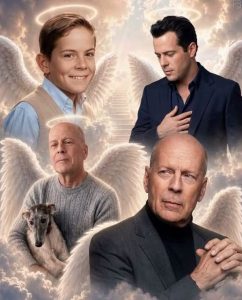
💔 GOODBYE TO A LEGEND: BRUCE WILLIS — THE HOLLYWOOD ICON WHOSE LEGACY WILL LIVE FOREVER
There are some actors who entertain us, some who inspire us, and a rare few who become part of our lives. Bruce Willis belongs to that extraordinary group. For decades, his face, his unforgettable performances, his humor, and his unmistakable screen presence have made him one of Hollywood’s most beloved action stars.
Today, fans around the world are reflecting on his remarkable career and the difficult health journey he and his family have faced. Although heartbreaking headlines can make people wonder whether the beloved actor has passed away, there is no confirmed report here that Bruce Willis has died. The tribute to his life and legacy is meaningful without suggesting otherwise.
His story is about more than movies. It is about determination, family, courage, and the lasting power of the characters he brought to life.
A Star Who Changed Hollywood Forever
Bruce Willis did not become a household name overnight. His journey to international stardom was built through years of work, auditions, performances, and the determination to establish himself in an intensely competitive industry.
Born on March 19, 1955, in Idar-Oberstein, West Germany, while his father was stationed there with the U.S. military, Willis grew up in New Jersey. Before Hollywood made him a household name, he worked ordinary jobs and pursued acting with the hope of building a career.
His early experiences helped shape the grounded, approachable quality that audiences would later recognize in his performances.
Willis had a distinctive ability to portray characters who seemed imperfect, funny, stubborn, and human. He could deliver a sarcastic one-liner in the middle of a dangerous situation, but he could also communicate fear, tenderness, and vulnerability.
That combination helped him stand apart from many traditional action heroes.
He was not simply a man who could fight villains on screen. He was an actor who could make audiences care about the person behind the action.
The Television Role That Made Him Famous
Before becoming an international action superstar, Willis gained widespread recognition through the television series Moonlighting.
Starring opposite Cybill Shepherd, he played David Addison, a witty private detective whose quick humor and playful arguments became a major part of the show’s appeal.
The series demonstrated that Willis possessed much more than physical screen presence. His comic timing, natural delivery, and ability to improvise made him memorable.
In 1987, he won an Emmy Award for his performance in the series, helping establish his reputation as a talented actor capable of balancing comedy and drama.
For viewers who discovered him through Moonlighting, his later transformation into a major action star was both surprising and exciting.
Hollywood had found an actor who could make audiences laugh one moment and hold them in suspense the next.
That versatility would become one of the defining characteristics of his career.
The Movie That Turned Him Into an Action Legend
In 1988, Willis starred as John McClane in Die Hard, the film that transformed his career and became one of the most influential action movies of its era.
McClane was not presented as an invincible superhero. He was an ordinary police officer caught in an extraordinary situation, forced to rely on his intelligence, determination, courage, and quick thinking.
The character was frightened, exhausted, injured, and frequently frustrated. Yet he continued fighting because innocent people were in danger.
That human quality helped audiences connect with him.
The movie’s success established Willis as a major Hollywood star and helped redefine the modern action hero. Instead of relying entirely on physical strength, McClane survived through persistence, improvisation, and a willingness to keep going when circumstances seemed impossible.
For millions of fans, the character became synonymous with courage under pressure.
The film also created one of cinema’s most recognizable action franchises, ensuring that Willis’s performance would be remembered by generations of movie lovers.
Even decades later, fans continue returning to Die Hard because its central character feels like someone who refuses to give up, regardless of how difficult the situation becomes.
That spirit became closely associated with Willis himself.
A Career Filled With Unforgettable Performances
Although Die Hard made Willis an action icon, his career extended far beyond explosive stunts and dramatic confrontations.
In Pulp Fiction, Quentin Tarantino’s celebrated 1994 film, Willis played Butch Coolidge, a boxer whose choices place him in a dangerous series of events. The performance showed his ability to work within a complex ensemble and a film that challenged traditional storytelling.
In The Fifth Element, he helped bring an imaginative science-fiction adventure to life through humor, action, and an unexpectedly warm portrayal of an ordinary man caught in extraordinary circumstances.
Then came Armageddon, the 1998 blockbuster in which Willis played Harry Stamper, a veteran oil driller recruited for an extraordinary mission to prevent a catastrophic asteroid impact.
The movie combined spectacular action with themes of sacrifice, responsibility, and love. His performance gave the story an emotional center, helping audiences connect with the characters beyond the special effects.
Another memorable role came in The Sixth Sense, the psychological thriller directed by M. Night Shyamalan. Willis played Dr. Malcolm Crowe, a child psychologist whose work with a troubled young boy leads to one of cinema’s most famous revelations.
The film revealed a quieter side of his talent and demonstrated that his performances could be powerful without relying on physical action.
Across these films and many others, Willis repeatedly showed that he could adapt to different genres while maintaining a recognizable screen presence.
His body of work includes comedy, crime dramas, science fiction, thrillers, and action adventures. Few actors manage to leave such a broad mark on popular entertainment.
The Man Behind the Tough-Guy Image
On screen, Willis often played characters who appeared confident, sarcastic, and nearly impossible to intimidate.
Off screen, however, his life included the same kinds of relationships, responsibilities, and personal experiences that shape any family.
He married actress Demi Moore in 1987, and they had three daughters: Rumer, Scout, and Tallulah. Although the marriage ended in divorce, they continued raising their children and have publicly demonstrated a commitment to family.
Willis later married Emma Heming Willis in 2009. Together, they have two daughters, Mabel and Evelyn.
Over the years, the blended family has remained an important part of his story.
The public has seen examples of warmth and mutual support among family members, particularly as Willis’s health challenges have changed their lives.
Their experience reminds us that fame cannot protect anyone from life’s most difficult circumstances.
A person may receive applause from millions of people and still face private struggles that cannot be solved through celebrity, money, or professional success.
In the end, the relationships we build may become more important than the achievements that once defined our public image.
The Health Diagnosis That Changed Everything
In March 2022, Willis’s family announced that he would step away from acting after he had been diagnosed with aphasia, a condition that can affect a person’s ability to communicate.
The announcement was difficult for fans, many of whom had watched him perform for decades.
Then, in February 2023, his family shared a more specific diagnosis: frontotemporal dementia, commonly known as FTD.
The condition affects areas of the brain associated with language, behavior, personality, and other functions. Its symptoms vary depending on the areas affected, and the disease can progress differently from one person to another.
For Willis, communication has been a particular challenge.
The diagnosis changed the family’s daily life and brought attention to a disease that many people knew very little about.
His family has spoken publicly about the realities of caregiving, the emotional challenges of watching a loved one change, and the importance of finding support.
Their openness has also helped people understand that dementia is not a single condition with identical symptoms for everyone.
In June 2026, Emma Heming Willis discussed a common misunderstanding about her husband’s diagnosis, explaining that the form of FTD he has affects language and does not necessarily eliminate his memory of loved ones.
In September 2026, she also described the importance of the family’s moments of connection and joy, even as they navigate a difficult illness.
These updates offer a more complete picture than headlines that focus only on sadness.
They remind us that a serious diagnosis does not erase a person’s worth, relationships, or capacity to experience meaningful moments.
A Family Standing Together Through Difficult Times
One of the most moving aspects of Willis’s story is the support surrounding him.
Emma Heming Willis has spoken openly about the emotional demands of caregiving and the importance of ensuring that families facing dementia are not left to navigate the experience alone.
His older daughters have also spoken about their relationship with their father and the importance of spending time with him.
Demi Moore has remained part of the wider family circle, demonstrating that relationships can continue to evolve and provide support long after a marriage ends.
For families facing a progressive illness, love often becomes something expressed through small, everyday actions.
It can mean sitting together quietly, sharing a familiar joke, holding a hand, listening to music, or finding comfort in a moment that others might overlook.
Not every meaningful moment needs to be captured by a camera or described in a public statement.
Sometimes, the most important memories are the ones shared privately between people who know and love one another.
The Willis family has helped make that reality visible to others who may be experiencing similar challenges.
Their story is not simply one of celebrity and illness. It is also a reminder that caregiving requires patience, practical assistance, emotional support, and compassion for everyone involved.
Turning a Personal Struggle Into a Larger Mission
Emma Heming Willis has also worked to increase public awareness of frontotemporal dementia and support families affected by the condition.
In 2026, she continued advocating for greater understanding, research, and assistance for caregivers.
Her efforts reflect an important lesson: a family’s difficult experience can help other people feel less isolated.
Many caregivers face exhaustion, uncertainty, grief, and difficult decisions. Some have limited access to professional help or do not know where to find reliable information.
Public discussion can help direct attention toward those needs.
It can encourage people to learn about symptoms, seek appropriate medical guidance, plan for care, and recognize that caregivers need support as well.
Willis’s family has made clear that they do not want his diagnosis to be reduced to a tragic headline. They want greater awareness and a better understanding of the people living with the disease.
That is an important part of his continuing legacy.
An actor’s influence does not have to end when he stops making films. Sometimes, the attention surrounding a public figure can help bring recognition to people and problems that have long been overlooked.
Why Fans Continue to Love Bruce Willis
Why do so many people feel connected to an actor they have never met?
Part of the answer lies in the characters he portrayed.
John McClane represented persistence in the face of overwhelming danger. Harry Stamper embodied sacrifice and responsibility. Dr. Malcolm Crowe demonstrated compassion and the importance of listening to someone who needs help.
These characters were fictional, but the emotions behind their stories were familiar.
Audiences saw fear, determination, humor, loss, courage, and love. They experienced suspense and laughter in movie theaters and later revisited those memories at home.
For many fans, a Bruce Willis film is connected to a particular period in life: a childhood memory, a family movie night, a friendship, or a favorite action scene watched again and again.
That is part of what makes a film career so enduring.
Movies can become woven into personal histories. An actor may never know the names of the millions of people whose lives his work has touched, but his performances can still leave a lasting impression.
And when that actor faces a serious illness, the public response can reflect something more meaningful than celebrity worship. It can be an expression of gratitude for the years of entertainment and emotion he helped create.
His Legacy Is Much Bigger Than a Single Role
Bruce Willis’s legacy cannot be reduced to one movie, one award, or one difficult chapter in his life.
It includes a body of work that has entertained audiences across generations. It includes performances that helped redefine action cinema and roles that demonstrated his dramatic range.
It also includes the people closest to him and the wider discussion his family has encouraged about dementia and caregiving.
His story reminds us that a person’s value is not measured only by productivity, fame, physical strength, or the ability to perform the tasks that once defined a career.
Willis spent decades playing characters who fought through impossible situations. Yet his real-life experience has shown another side of courage: the courage required to live with uncertainty, the courage of families who adapt to changing circumstances, and the courage to keep finding moments of connection during difficult times.
There is no need to invent a dramatic ending to appreciate what he has given the world.
His films remain available to audiences, his performances continue to be discussed, and his family’s advocacy continues to raise awareness of a serious condition.
That is a living legacy, one that can continue to grow.
A Heartfelt Tribute to a Hollywood Legend
Bruce Willis has given audiences decades of memorable performances, from the wisecracking detective of Moonlighting to the determined hero of Die Hard and the unforgettable characters in Pulp Fiction, Armageddon, and The Sixth Sense.
His career has brought laughter, suspense, excitement, and emotion to millions of people.
Today, the most meaningful way to honor him is not to spread an unverified death announcement, but to celebrate his achievements, respect his family’s privacy, and recognize the difficult realities of his health journey.
We can appreciate the films that made him famous while remembering that the man behind those performances deserves dignity and compassion.
We can celebrate his strength without pretending that illness is easy. We can admire his legacy while supporting the families who face similar challenges every day.
And we can remember that behind every legendary career is a human being whose greatest importance may be found not in the applause of strangers, but in the love shared with family and friends.
Bruce Willis remains a beloved figure in Hollywood history. His movies have given generations of fans memories that will endure, and his family’s openness has helped bring greater attention to frontotemporal dementia.
May his family continue to find strength, support, and moments of joy together.
And may his remarkable career continue to remind us why stories, laughter, courage, and human connection matter so much.
❤️ Thank you, Bruce Willis, for the unforgettable characters, the laughter, the excitement, and the memories. Your work has touched millions of hearts, and your legacy will continue to live on through the films you gave the world.
What is your favorite Bruce Willis movie? Was it Die Hard, The Sixth Sense, Armageddon, Pulp Fiction, or another unforgettable performance? Share your favorite memory in the comments and join us in celebrating a true Hollywood legend.