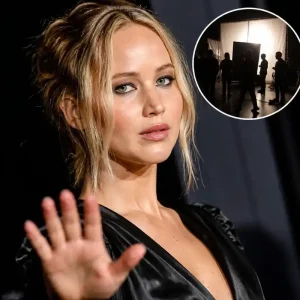
Jennifer Lawrence Reveals Why She Confronted Crew During Nude Scene: “That Was Not Okay”
Jennifer Lawrence is opening up about an uncomfortable experience on a film set, explaining why she felt compelled to confront the people responsible after discovering that unauthorized crew members were present while she was filming a nude scene. The Oscar-winning actress says her decision to speak out was about more than her own comfort. She also wanted to help protect younger performers who might feel powerless to challenge similar situations.
During an appearance on the Call Her Daddy podcast, released on October 28, 2026, Lawrence reflected on how her position in Hollywood has changed throughout her career. Having worked in the entertainment industry for years, she said she has become more willing to advocate for herself when a situation crosses a professional boundary.
Her comments have drawn attention to an important issue in filmmaking: the need to respect performers’ privacy and ensure that intimate scenes are handled professionally.
Lawrence, known around the world for The Hunger Games, Silver Linings Playbook, and American Hustle, has never been afraid to speak candidly about her experiences. This time, however, her remarks highlighted a concern that extends beyond one actress or one production.
Jennifer Lawrence Explains Why She Spoke Up
During her conversation with podcast host Alex Cooper, Lawrence described an incident in which crew members who had not been approved to attend were present while she was filming nudity.
The actress said she reacted strongly because she believed the situation needed to be addressed. She explained that experienced performers have an opportunity to establish professional standards that may benefit those who are only beginning their careers.
Lawrence’s concern centered on the position of an inexperienced actress arriving on a film set. A young performer might discover that people she had not agreed to have present were watching an intimate scene, yet hesitate to raise an objection because she feared damaging her reputation.
As Lawrence pointed out, an unknown actress could feel forced to choose between expressing discomfort and risking being described as difficult to work with.
That pressure can make it challenging for inexperienced performers to defend their own boundaries, particularly when they are working with established directors, producers, or other powerful industry figures.
For Lawrence, speaking up was therefore a way to make clear that professional expectations should apply regardless of an actor’s fame or experience.
She emphasized that it was important to explain to the people involved why the situation was unacceptable.
Her comments were not simply about personal embarrassment. They were about ensuring that performers could work in environments where their consent and privacy were respected.
Why the Situation Matters for Young Actors
Entering Hollywood can be an exciting opportunity, but the entertainment industry also presents challenges for performers who have little professional influence.
An inexperienced actor may be eager to impress a director, secure future employment, or avoid developing a reputation that could limit career opportunities. These concerns can make it difficult to question decisions made by people in positions of authority.
That imbalance becomes especially important when a production involves nudity or simulated sexual activity.
Actors should understand what a scene requires before filming begins. They should also know who will be present, how the scene will be staged, and what arrangements will be made to protect their privacy.
When agreed boundaries are not respected, performers may feel that they have lost control over a situation that should have been carefully planned.
Lawrence’s remarks underline why established actors can play an important role in setting expectations. When a respected performer raises a concern, it may become harder for others to dismiss the same concern when a less-experienced colleague expresses it.
The actress’s comments also encourage a broader discussion about workplace culture. Professionalism should not depend on whether an employee is famous enough to challenge a decision without fear of consequences.
A production should have clear procedures that protect every performer, including those who are new to the industry.
Filming Nude Scenes Is a Professional Process
Nudity in movies can be an important storytelling choice. Depending on the project, it may communicate vulnerability, intimacy, fear, freedom, or a character’s emotional state.
For actors, however, performing such scenes requires preparation and trust.
Filmmakers generally need to coordinate camera placement, lighting, costumes or modesty garments where applicable, choreography, and the presence of essential crew members. These details help ensure that the scene can be filmed efficiently while respecting the performer’s agreed boundaries.
A closed set is one way productions can protect privacy during intimate scenes. Access is limited to people whose presence is necessary and authorized.
The goal is not to prevent filmmakers from doing their jobs. Rather, it is to ensure that everyone understands their responsibilities and that unnecessary observers are excluded.
Lawrence’s account highlights the importance of maintaining those expectations in practice, not merely discussing them before filming begins.
A performer should not have to rely exclusively on personal influence to secure basic professional protections. Clear procedures and responsible leadership are important throughout the production process.
Jennifer Lawrence Says She Has Learned to Advocate for Herself
Lawrence also reflected on how she approaches her work today compared with earlier stages of her career.
She explained that she has become more comfortable speaking up because she understands the position she occupies in the entertainment industry.
The actress has spent years navigating major studio productions, award campaigns, public appearances, and demanding filming schedules. Her experience has given her a better understanding of when flexibility is part of the job and when a boundary needs to be defended.
Lawrence made an important distinction during the interview: being willing to adapt creatively does not mean accepting every situation without question.
Actors regularly make physical and emotional adjustments for their roles. They may change their hair, adopt a different accent, learn specialized skills, or work under challenging production conditions.
Those changes can be legitimate parts of the creative process.
However, agreeing to one aspect of a role does not automatically mean consenting to every other circumstance that might arise during filming.
Lawrence’s comments demonstrate how an actor can remain committed to a director’s vision while also insisting that professional standards be respected.
The Transformation Behind Die My Love
During the podcast conversation, Lawrence discussed another example of her willingness to adapt for a role: the physical transformation requested by director Lynne Ramsay for the film Die My Love.
Ramsay wanted Lawrence to cut her hair, dye it platinum blonde, and adopt a style featuring short, mullet-like bangs.
Lawrence acknowledged that she initially had reservations about the proposed look. Eventually, however, she embraced the transformation.
She explained that being adaptable is part of an actor’s job. A filmmaker may have a specific visual idea for a character, and changing one’s appearance can help bring that vision to life.
The experience illustrates the collaborative nature of filmmaking. Directors and actors often work together to develop the look, behavior, and emotional identity of a character.
In some cases, a physical transformation can help an actor move away from a familiar public image and inhabit a completely different personality.
Lawrence’s discussion of her hairstyle also provides context for her larger point: she is willing to make substantial creative adjustments, but that flexibility has limits when professional boundaries are involved.
The actress did not identify the project associated with the unauthorized crew members in her account, so the incident should not automatically be attributed to Die My Love.
Lawrence Has Previously Spoken About Nudity in Film
Lawrence has performed nude scenes during her career, including in the 2018 thriller Red Sparrow and the 2023 comedy No Hard Feelings.
Her willingness to discuss these experiences publicly has helped clarify that nudity itself is not necessarily the central issue.
In earlier interviews, she described how professional preparation and the behavior of the people involved affected her comfort during filming.
For No Hard Feelings, the actress performed a challenging nude beach sequence alongside costar Andrew Barth Feldman. The scene required the performers to approach an unusual situation in the context of a comedy.
In a previous interview reported by People, Feldman described the filming environment as supportive, explaining that members of the team regularly checked whether the actors were comfortable.
That account illustrates how a scene involving nudity can be approached with care when a production takes performers’ concerns seriously.
Lawrence’s latest comments reinforce the distinction between agreeing to perform a scene and agreeing to have unauthorized people present while doing so.
The two circumstances are not interchangeable. Consent to participate in a film’s creative content does not mean that every possible filming arrangement is automatically acceptable.
The Importance of Closed Sets and Clear Boundaries
The entertainment industry has increasingly discussed the procedures used to film intimate scenes, particularly following wider conversations about harassment, consent, and power imbalances in the workplace.
Closed sets, advance communication, and clearly defined access arrangements can help reduce uncertainty.
Intimacy coordinators may also assist productions by working with actors and directors to plan intimate choreography, communicate boundaries, and ensure that agreed procedures are followed.
Their responsibilities vary depending on the production and the requirements of the scene, but the broader objective is to help create a professional environment in which performers can communicate openly.
No single procedure can eliminate every possible problem. Effective safeguards also require cooperation from producers, directors, department heads, and crew members.
The people responsible for managing a production must ensure that established rules are followed consistently.
Lawrence’s account illustrates why those systems matter. Even a well-known performer may encounter circumstances that require intervention, while a newcomer might find it much harder to challenge a decision.
Clear standards can help prevent such situations from placing the entire burden on an individual actor.
A Conversation About Power in Hollywood
Lawrence’s remarks also raise questions about the relationship between celebrity status and workplace influence.
A successful actor may have more opportunities to challenge decisions because their reputation and professional standing give them a stronger negotiating position.
An emerging performer may not have the same freedom. They might worry that objecting to an uncomfortable situation could affect future casting opportunities or relationships with influential people.
This difference makes consistent workplace protections especially important.
Basic professional standards should not depend on an actor’s awards, box-office success, or ability to influence a production.
A newcomer deserves the same respect for their privacy as an established star.
Lawrence’s decision to speak publicly about the experience brings attention to that principle and encourages the industry to consider how its practices affect people with less power.
Her comments also demonstrate that advocacy can involve explaining why a situation is unacceptable rather than simply expressing anger in the moment.
Clear communication helps establish expectations and makes it easier for others to understand what needs to change.
Jennifer Lawrence Continues to Balance Artistic Freedom With Personal Boundaries
Throughout her career, Lawrence has taken on roles that require emotional intensity, physical transformation, and creative risk.
Her performance in Silver Linings Playbook earned her the Academy Award for Best Actress, while The Hunger Games franchise established her as the star of one of Hollywood’s most successful action series.
She has also pursued dramatic projects that explore complicated characters and uncomfortable subject matter.
Her willingness to take creative risks is part of what has made her such a prominent performer.
At the same time, her latest remarks show that artistic freedom and personal boundaries do not have to conflict.
A director can pursue a challenging vision while a production maintains respectful working conditions. Actors can make demanding creative choices without surrendering their right to understand and approve the circumstances in which intimate scenes are filmed.
That balance is essential to a professional working relationship.
For Lawrence, speaking up appears to be part of understanding her responsibilities as an experienced performer in an industry where younger colleagues may not always feel able to do the same.
Final Thoughts
Jennifer Lawrence’s account of confronting unauthorized crew members during a nude scene has brought renewed attention to privacy, consent, and professional conduct on film sets.
Her explanation was straightforward: she wanted to make clear that performers should not have to choose between protecting their personal boundaries and worrying about being labeled difficult.
By speaking up, Lawrence also highlighted the challenges facing young and relatively unknown actors who may have less influence when problems arise.
Her comments do not suggest that nudity is inherently inappropriate in filmmaking. Instead, they emphasize that intimate scenes require clear agreements, careful planning, and respect for the people involved.
As the entertainment industry continues to examine workplace standards, Lawrence’s experience serves as a reminder that professionalism should extend to every member of a production.
The most important lesson is that creative freedom works best when it exists alongside mutual respect. Every performer, regardless of experience or fame, deserves to have their boundaries taken seriously.