Giant Eagle Captured in Brazil? Viral Video Sparks Debate About an Extraordinary Bird
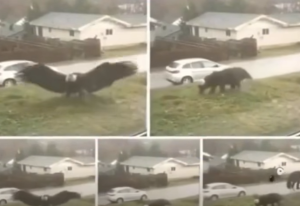
A blurry video circulating online appears to show an unusually large, dark-colored bird standing on a grassy roadside near parked cars and residential homes. The footage, presented in several frames, has prompted speculation that the animal could be a giant eagle. Its apparent size and broad wings have captured viewers’ attention, leading to questions about what kind of bird it might be and whether the recording shows a genuine wildlife encounter.
However, the image alone does not establish the bird’s species, exact size, or location. The headline is also incomplete, ending with “Bro…,” so the specific place where the encounter allegedly occurred cannot be confirmed from the information provided.
Even so, the image offers an opportunity to explore some fascinating facts about the world’s largest eagles, the way camera angles can distort an animal’s size, and why unusual wildlife footage can spread so quickly online.
What Can Be Seen in the Viral Image?
The image shows a large, dark bird on a patch of grass beside a residential street. A white car is parked nearby, and houses can be seen in the background. The footage appears to have been captured from a distance, possibly through a security camera or another fixed recording device.
In one frame, the bird appears to have its wings extended, creating an impressive silhouette. In other frames, its wings appear folded as it stands on the grass.
The bird’s dark coloring and broad wings may explain why some viewers have described it as an enormous eagle. However, the low image quality makes it difficult to identify distinctive features, such as the shape of its beak, the markings on its feathers, and the proportions of its legs.
These details are essential for identifying a bird accurately.
Could It Really Be a Giant Eagle?
Several eagle species are genuinely impressive in size. Some have enormous wingspans, powerful feet, and strong hooked beaks designed to capture prey.
The harpy eagle, native to Central and South American rainforests, is one of the most powerful forest-dwelling eagles. It has broad wings, large talons, and a distinctive feathered crest. Despite its imposing appearance, it is adapted to hunting in forests rather than soaring over open landscapes for long periods.
The Philippine eagle is another remarkable species. It has a large body, a prominent crest, and a wingspan that can reach approximately two meters. It is critically endangered, making conservation of its remaining habitat especially important.
The wedge-tailed eagle, found in Australia and nearby regions, is known for its long wings and ability to soar over open country.
These species demonstrate that exceptionally large eagles really do exist. Nevertheless, none can be confidently identified in the uploaded image.
Why Does the Bird Look So Enormous?
One reason unusual wildlife photographs attract attention is that the camera does not always communicate an object’s actual dimensions.
Several factors can make a bird appear much larger than it is.
Camera perspective: An animal closer to the camera may appear enormous compared with a car or building farther away.
Extended wings: When a large bird spreads its wings, its silhouette becomes dramatically wider. This can make its overall size difficult to judge.
Blurry footage: Low resolution can hide important details and make the bird’s outline appear larger or less clearly defined.
Lack of scale: Although the image includes a vehicle, the distance between the bird and the car is uncertain. Without knowing their positions, it is impossible to calculate the bird’s size reliably.
For these reasons, a photograph that looks extraordinary should not automatically be treated as proof that an animal is unusually large.
What Do Eagles Normally Eat?
Eagles are skilled predators, but their diets vary considerably according to their species and habitat.
Depending on the species, they may hunt fish, rabbits, rodents, birds, reptiles, and other small or medium-sized animals. Some exceptionally powerful eagles can capture prey larger than people might expect from observing them in flight.
Their success depends on sharp eyesight, strong feet, hooked talons, and the ability to assess opportunities while hunting.
However, eagles do not normally hunt people. Like most wild animals, they generally avoid unnecessary contact with humans. They may defend themselves if cornered or threatened, so maintaining a respectful distance is always advisable.
If the bird in the video is a genuine wild eagle, it should be allowed to move freely without being chased, surrounded, or deliberately approached.
Why Would a Large Bird Appear in a Residential Neighborhood?
Large birds sometimes appear in places where people do not expect to see them.
Possible explanations include searching for food, traveling between habitats, following prey, or being temporarily displaced by environmental conditions.
Some large raptors also live near agricultural land, rivers, and open spaces close to human settlements. Their presence in these areas does not necessarily mean that they are lost or dangerous.
If an eagle is injured, unable to fly, or behaving unusually, local wildlife authorities or licensed rescue organizations are generally better equipped to assess the situation than untrained members of the public.
The precise explanation for the bird’s appearance in this footage remains unknown.
How Can We Tell Whether the Video Is Genuine?
Viral wildlife footage deserves curiosity, but it also deserves careful examination.
A useful first step is to locate the original recording rather than relying on reposts with dramatic captions. The original uploader may provide the date, location, and additional footage that help establish the circumstances.
Viewers can also look for clear identifying features. The bird’s head shape, feather patterns, tail, feet, and wings can help experts distinguish between species.
Another useful question is whether a reliable wildlife organization, local authority, or experienced ornithologist has independently examined the footage.
A sensational caption alone is not sufficient evidence. Even when the video itself is authentic, its location, date, and description may be inaccurate.
Protecting These Magnificent Birds
Large eagles play important roles in their ecosystems by hunting prey and helping maintain natural food webs. Unfortunately, many raptor species face threats from habitat destruction, pollution, illegal hunting, and conflicts with human activities.
Protecting their habitats and reducing unnecessary disturbance can help these birds survive.
People who encounter a large raptor should avoid feeding it, attempting to capture it, or getting close enough to provoke a defensive response. If the animal appears injured, trained wildlife rescuers can determine what assistance is appropriate.
Responsible wildlife photography also means avoiding actions that disturb nesting birds or put animals under unnecessary stress.
Final Thoughts: A Fascinating Image, but an Unconfirmed Identification
The image presented as a “giant eagle captured in Bro…” certainly looks unusual. Its dark silhouette, extended wings, and appearance beside a residential street make it easy to understand why viewers are curious.
But there is not enough evidence in this image to confirm that the bird is a giant eagle, determine its species, or establish where the recording was made.
The world’s largest eagles are extraordinary animals, and genuine encounters with them can be memorable. At the same time, camera perspective and poor image quality can create misleading impressions.
Until clearer footage or reliable information becomes available, the most responsible conclusion is to treat the giant-eagle claim as unverified.
Sometimes, the most interesting part of a viral wildlife story is not the dramatic headline. It is the process of examining the evidence, learning about the animal, and discovering what the available facts can actually tell us.