Jodie Sweetin Opens Up About Her Struggles With Drugs and Alcohol — How Addiction Nearly Derailed Her College Years
Jodie Sweetin is sharing a deeply personal chapter of her life, revealing how her struggles with drugs and alcohol nearly destroyed her college experience. The actress, best known for playing Stephanie Tanner on the beloved television sitcom Full House, has never been afraid to discuss the difficult moments that shaped her journey. Now, she is looking back on a particularly challenging period when addiction, personal struggles, and the pressures of growing up threatened to take away opportunities she had worked hard to achieve.
For many fans, Sweetin will always be remembered as the cheerful young girl who brought humor and warmth to the Tanner family. However, behind the familiar television smile was a young woman facing challenges that were far more complicated than viewers could imagine. Her recent comments offer another glimpse into the difficult experiences she encountered as she transitioned from childhood fame into adulthood.
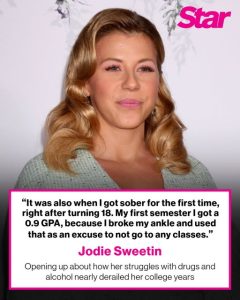
In the accompanying interview excerpt, Sweetin recalls getting sober for the first time shortly after turning 18. She also describes how her first semester of college went terribly wrong, explaining that she received a 0.9 grade-point average after breaking her ankle and using the injury as an excuse to avoid attending classes.
Her honesty highlights how addiction can affect more than a person’s physical health. It can interfere with education, relationships, confidence, opportunities, and the ability to imagine a positive future.
Growing Up in the Spotlight
Sweetin’s journey into the entertainment industry began when she was very young. She became a household name through Full House, appearing as Stephanie Tanner, the middle daughter of the Tanner family. The sitcom premiered in 1987 and quickly became one of the most recognizable family television shows of its generation.
As a child actress, Sweetin experienced a lifestyle that was very different from that of most children her age. She spent much of her childhood working on television sets, attending promotional events, and growing up in front of millions of viewers.
Although the show brought her fame and professional opportunities, leaving the series also meant facing an entirely different reality. When Full House ended in 1995, Sweetin was still young and had to figure out what her future would look like outside the familiar environment of the television industry.
Like many young adults, she wanted independence, new experiences, and the opportunity to discover who she really was.
However, the transition was not easy.
Sweetin has previously spoken about how alcohol became part of her life during her teenage years. What initially seemed like experimentation gradually developed into something much more serious. She struggled to manage her emotions and make decisions that supported her long-term happiness.
By the time she entered college, her relationship with alcohol and drugs had become increasingly problematic.
A College Experience That Quickly Went Off Track
After graduating from high school, Sweetin received a scholarship to attend Chapman University in Orange, California. It was an important opportunity, giving her the chance to pursue higher education and experience a relatively normal college lifestyle.
For someone who had spent much of her childhood working in Hollywood, college represented a fresh beginning.
Unfortunately, things did not unfold as she had hoped.
During her appearance on the We’re Still Here, Babe podcast, Sweetin spoke with host Natanya Ross about her college experience and the difficult period surrounding her substance use.
She explained that her drinking and drug use intensified around the same time she began attending university.
Her first semester became particularly difficult. Sweetin recalled breaking her ankle and using the injury as an excuse to stop attending classes.
Although she was struggling academically, she still managed to find time for parties.
The consequences eventually became impossible to ignore.
Sweetin revealed that she earned a shocking 0.9 GPA during her first semester. For a student who had received a scholarship and had the opportunity to build an exciting future, the result demonstrated just how much her personal struggles were affecting her education.
She later reflected that things deteriorated very quickly.
Her experience illustrates how addiction can gradually take control of everyday decisions. Responsibilities that once seemed manageable can become overwhelming, while activities that provide temporary escape begin to take priority.
For Sweetin, college was supposed to be a time of discovery and personal growth. Instead, it became a period when she struggled to find direction.
Getting Sober Shortly After Turning 18
One of the most significant parts of Sweetin’s recent revelation was her discussion of becoming sober for the first time shortly after her 18th birthday.
At an age when many young people are just beginning to explore independence, she was already confronting a serious personal challenge.
Getting sober was not simply about stopping alcohol or drug use. It also meant learning how to navigate everyday life without relying on substances.
Sweetin has described how difficult it was to understand herself during that period.
She had spent years being recognized as a television actress, but away from the cameras, she was trying to determine what kind of person she wanted to become.
College presented opportunities to meet new people, build friendships, and participate in activities. Yet fitting in was not always easy.
In the podcast conversation, she also discussed her desire to belong socially, including her attempt to participate in Greek life.
Even after becoming sober, she sometimes felt like an outsider.
That experience highlights an important part of recovery that people do not always understand. Becoming sober does not automatically solve every emotional or social difficulty. It can mean confronting feelings that were previously avoided and learning healthier ways to respond to them.
For Sweetin, those early years of sobriety represented an important opportunity to slow down and reconsider the direction of her life.
The Pressure of Trying to Fit In
Being a recognizable child actress created a unique situation for Sweetin.
While other college students were discovering themselves without much public attention, she had already spent years playing a character known by millions of television viewers.
The public knew Stephanie Tanner, but Sweetin was still working out who she was outside that role.
That distinction can be difficult for performers who grow up in the entertainment industry.
There is often pressure to maintain a familiar public image while privately dealing with the ordinary challenges of becoming an adult.
Sweetin’s experiences demonstrate that fame does not protect someone from loneliness, insecurity, or addiction.
In her podcast interview, she reflected on how she had been searching for a sense of identity through other people.
She wanted to understand where she belonged, but discovering that answer took time.
Her early sobriety also meant making choices that sometimes separated her from the social activities surrounding college life.
Nevertheless, she continued working toward her education.
Her story is a reminder that recovery is not always a straight line. It can involve uncomfortable adjustments, difficult decisions, and periods when a person feels uncertain about the future.
A New Chapter After Her First Recovery
Sweetin’s early recovery gave her an opportunity to rebuild parts of her life.
She explained that she remained sober through much of her early college experience, including her 21st birthday.
During those years, she continued pursuing her education and eventually graduated from Chapman University.
She also began building a more conventional adult life.
By the time she was around 21, she had accomplished several important milestones. She was married, had graduated from college, and had remodeled a home.
From the outside, those achievements might have suggested that everything was finally falling into place.
However, Sweetin’s story took another difficult turn.
After her 21st birthday, she began using substances again.
Looking back, she described reaching a point where she had already checked several of the boxes she associated with adulthood. She had an education, a marriage, and a home, but she was still struggling internally.
Her comments reveal how complicated addiction can be.
Even when someone appears successful, they may still be dealing with unresolved personal challenges.
The return to substance use eventually led to another difficult chapter in her life.
Sweetin has spoken openly over the years about experiencing relapses, seeking treatment, and repeatedly working toward recovery.
Her willingness to discuss these experiences has helped make her story about more than the challenges of being a former child star.
It has also become a story about resilience and the importance of asking for help.
The Challenges of Rebuilding Her Life
Sweetin’s struggles did not end with her college years.
In interviews over the years, she has discussed how substance use affected her relationships, career, finances, and personal stability.
After Full House ended, she faced the challenge of establishing herself outside the television show that had made her famous.
The entertainment industry can be unpredictable, especially for performers who become famous as children.
Opportunities may disappear, public attention can change, and finding a new professional identity can take considerable effort.
Sweetin has acknowledged that her addiction affected her ability to maintain stability during this period.
Eventually, she sought professional help and began taking meaningful steps toward recovery.
Her experiences also inspired her 2009 memoir, unSweetined, in which she shared details about her childhood fame, substance use, and journey toward sobriety.
Writing about such personal experiences required her to revisit painful memories.
However, it also allowed her to tell her story in her own words rather than allowing public assumptions to define her.
Over time, she became increasingly willing to speak with audiences about addiction and recovery.
Why Her Story Matters to Other People
One reason Sweetin’s recent comments are attracting attention is that they highlight an experience many people can relate to, even if they have never worked in Hollywood.
Addiction does not always look the way people expect.
Sometimes, someone can appear happy, successful, and surrounded by friends while privately struggling with serious problems.
Academic difficulties, missed responsibilities, strained relationships, and financial challenges can all become part of the experience.
Sweetin’s story also demonstrates that recovery can begin at a young age.
Getting sober shortly after turning 18 was a significant decision, especially when she was surrounded by the social pressures and uncertainties of college life.
Her experience was not perfect, and her later struggles demonstrate that an early recovery does not necessarily mean the battle is over.
However, every attempt to seek help can represent an important step toward a healthier future.
By speaking publicly about her experiences, Sweetin gives people an opportunity to understand addiction without reducing someone to their worst decisions.
Her story is particularly meaningful for families who may be watching someone they love struggle with alcohol or drugs.
It reminds them that compassion, professional support, and continued encouragement can make a difference.
From Stephanie Tanner to a Voice for Recovery
Despite the difficult chapters of her life, Sweetin continued pursuing her career.
Her return to the Tanner family universe through Netflix’s Fuller House introduced her to another generation of viewers.
The revival premiered in 2016 and allowed her to revisit the character that had made her famous.
This time, however, she returned as an adult with a much deeper understanding of life’s difficulties.
Rather than allowing her past to define her entire identity, she began using her experiences to encourage conversations about recovery and personal growth.
She has also spoken at universities and public events, sharing lessons from her journey with audiences who may be facing similar challenges.
Her willingness to discuss addiction has helped challenge the misconception that people who struggle with substance use are somehow less deserving of respect or understanding.
Sweetin’s experiences show that a person’s life can contain both painful mistakes and meaningful accomplishments.
The two do not cancel each other out.
Looking Ahead: A Story of Honesty and Resilience
Jodie Sweetin’s latest revelation about receiving a 0.9 GPA during her first college semester offers another reminder of how difficult her journey has been.
Behind the success of Full House was a young woman trying to navigate adulthood while confronting problems that threatened her education and future.
Her story includes moments of uncertainty, early recovery, relapse, and the difficult process of rebuilding her life.
What makes her willingness to speak about these experiences especially meaningful is her honesty.
She is not presenting her past as a perfect recovery story. Instead, she is acknowledging that progress can be complicated and that personal growth sometimes requires confronting uncomfortable truths.
Her college experience could easily have become a defining failure. Instead, it became one chapter in a much larger journey.
For fans who grew up watching her as Stephanie Tanner, hearing these details may change how they understand the actress behind the familiar character.
But perhaps the most important message is that a difficult beginning does not have to determine the rest of someone’s life.
Sweetin’s willingness to revisit her struggles shows the value of honesty, perseverance, and asking for support when life becomes overwhelming.
Her journey is still a powerful reminder that people are more than their mistakes, their lowest grades, or their darkest periods.
Sometimes, the most meaningful part of a person’s story is not how far they fell, but how they continued working to rebuild their life.