POWERFUL 6.8-MAGNITUDE EARTHQUAKE REPORTED IN SOUTHERN JAPAN AS AUTHORITIES ASSESS DAMAGE
A powerful earthquake reportedly measuring magnitude 6.8 has been reported in southern Japan, prompting emergency response efforts as officials work to assess the extent of damage and determine whether casualties have occurred.
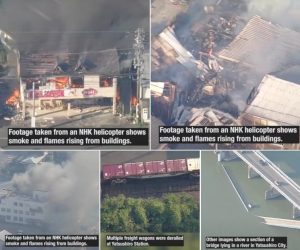
Images circulating online appear to show fires burning in multiple buildings, smoke rising over affected neighborhoods, a freight train derailment near Yatsushiro Station, and what appears to be a damaged bridge spanning a river. Television captions visible in the images reference helicopter footage from Japan’s public broadcaster NHK, although the authenticity and timing of every image should be independently verified.
Japan’s emergency management agencies routinely mobilize immediately after significant earthquakes, dispatching firefighters, police officers, medical teams, and search-and-rescue personnel to affected communities. Authorities also inspect roads, railways, bridges, ports, and public utilities for structural damage.
Southern Japan is among the world’s most seismically active regions because it lies near the boundaries of several tectonic plates. Earthquakes are relatively common, and the country has developed some of the world’s most advanced earthquake-resistant building standards and emergency preparedness systems. Even so, a strong earthquake can still cause significant disruption, particularly if it strikes near populated areas or at shallow depth.
Following a major quake, officials typically urge residents to remain alert for aftershocks, which can continue for hours or even days. Damaged buildings may become unstable after the initial shaking, increasing the risk to people who return too quickly. Emergency officials also inspect bridges, tunnels, rail lines, airports, and power infrastructure before restoring full operations.
Rail operators frequently suspend train services immediately after significant seismic activity while engineers examine tracks and overhead equipment. If reports of a derailment are confirmed, investigators will determine whether the earthquake directly caused the incident or whether additional factors were involved.
Firefighters face additional challenges following earthquakes because damaged water mains, blocked roads, and collapsed structures can make firefighting operations more difficult. Emergency crews prioritize rescuing trapped residents, containing fires, and restoring access to affected neighborhoods.
Hospitals activate emergency response plans to prepare for possible casualties, while local governments may open evacuation centers for residents whose homes have been damaged or who cannot safely remain indoors.
Authorities also evaluate the possibility of landslides in mountainous areas, particularly if the earthquake occurred after periods of heavy rainfall. Coastal agencies assess whether the quake generated any tsunami threat, although not every large earthquake results in dangerous sea waves.
Japan’s sophisticated earthquake early-warning system can provide seconds of advance notice before strong shaking reaches some areas, allowing trains to slow automatically, factories to halt sensitive operations, and individuals to take protective action.
As emergency assessments continue, officials typically advise the public to rely on verified information from government agencies and trusted news organizations rather than unverified social media posts or recycled images. In the hours following a disaster, inaccurate reports can spread quickly, making it especially important to confirm developments through authoritative sources.
At this stage, the images alone cannot confirm the scale of the damage or whether every scene shown is connected to the reported earthquake. Investigations and official damage assessments will provide a clearer picture as more information becomes available.
Residents in affected areas are generally encouraged to follow evacuation orders if issued, avoid damaged structures, prepare for possible aftershocks, and monitor official emergency communications for the latest safety guidance.
As response efforts continue, the focus remains on protecting lives, assisting affected communities, restoring critical infrastructure, and determining the full impact of the reported earthquake on southern Japan.