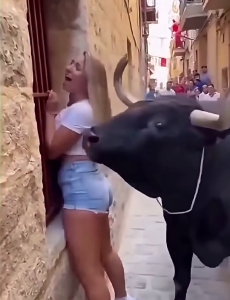
Bull Corners a Beautiful Tourist – Seconds Later, a Frightening Encounter Leaves Everyone Stunned
A peaceful sightseeing trip can turn into an unforgettable experience in a matter of seconds. That is the dramatic situation described in a story about a tourist who unexpectedly found herself face-to-face with a powerful bull. What began as an ordinary visit quickly became a tense encounter, leaving people nearby watching anxiously as the animal moved closer.
The headline has attracted attention because it captures one of the most unsettling possibilities travelers can face: an unexpected encounter with a large animal. Although the available account does not identify the woman or explain exactly where the incident happened, it describes a frightening moment that serves as a reminder that even familiar-looking environments can contain unpredictable dangers.
An Ordinary Tourist Visit Takes an Unexpected Turn
For many people, traveling is an opportunity to escape everyday routines, discover unfamiliar places, and collect memories that last a lifetime. Visitors often enjoy taking photographs, exploring local attractions, and experiencing the natural surroundings of a destination.
A peaceful outing can feel especially relaxing when the surroundings appear calm. People may become absorbed in the scenery and forget that animals living nearby are not necessarily accustomed to human visitors.
That is the atmosphere suggested by the account of the tourist and the bull. The visit reportedly began peacefully, without any indication that an alarming encounter was about to unfold.
Then the bull moved toward the woman.
The change was sudden enough to attract the attention of people nearby. A large animal approaching unexpectedly can transform a relaxed environment into a situation filled with uncertainty. Even when an animal does not immediately charge, its size and strength can make its movements intimidating.
The tourist reportedly found herself cornered, while witnesses watched to see what would happen next.
The Moment Everyone Began Paying Attention
There is something particularly frightening about being approached by an animal much stronger than oneself. Unlike an ordinary disagreement or an unexpected interruption, a close encounter with a large animal can involve risks that are difficult to predict.
A bull can weigh hundreds of kilograms. Its muscular body, powerful legs, and horns make it an animal that deserves considerable respect.
For someone who has little experience around cattle, even a bull standing quietly nearby can be intimidating. When it moves closer and limits the available space, the situation can become especially stressful.
According to the published account, the animal cornered the tourist and left her apparently caught off guard. People nearby reacted with concern as the encounter developed.
Those watching may have wondered whether the bull was curious, frightened, territorial, or responding to something in its surroundings. Without more information about the animal’s behavior or the location, it is impossible to know what prompted the encounter.
What is clear from the account is that the situation attracted attention and created several tense moments.
Why Bulls Should Never Be Underestimated
Cattle are sometimes viewed as peaceful farm animals because they spend much of their time grazing or resting. However, their calm appearance should never lead people to underestimate their strength.
Bulls can behave unpredictably, particularly when they feel threatened, startled, stressed, or protective. Their reactions may be influenced by unfamiliar people, sudden movements, noise, other animals, or environmental changes.
A bull does not need to be deliberately aggressive to create a dangerous situation. Its size alone can make an accidental collision or sudden movement extremely serious.
Tourists may not recognize the warning signs of discomfort or agitation. They might also misunderstand ordinary animal behavior because they are unfamiliar with the surroundings.
That is why visitors should follow local safety instructions and keep a safe distance from livestock.
Taking a photograph is never worth risking an encounter that could result in serious injury.
The Tourist’s Difficult Position
Being unexpectedly approached by a large animal can cause an immediate emotional reaction. Fear, confusion, and the desire to escape are natural responses.
However, reacting without thinking can sometimes make an encounter more dangerous.
Running, shouting, making sudden movements, or attempting to touch an unfamiliar animal may increase the risk. The safest response depends on the circumstances, the animal’s behavior, and the advice of trained local personnel.
In general, people should avoid approaching cattle, should never attempt to provoke them, and should follow barriers and warning signs. If an animal blocks a route, visitors should not try to squeeze past it or move closer for a better photograph.
The account does not provide enough detail to establish precisely what the tourist did during the encounter. It also does not explain whether anyone intervened or whether the bull eventually moved away.
Those missing details matter. A dramatic headline can make an incident sound complete, but responsible reporting requires distinguishing between what has actually been described and what remains unknown.
The Witnesses Who Watched in Suspense
An unexpected animal encounter can affect more than the person directly involved.
People standing nearby may feel frightened or helpless as they watch a situation develop. Some might instinctively look for a safe place, while others may try to alert staff or contact someone trained to handle livestock.
The published account describes witnesses reacting with shock as the bull stood near the tourist. It does not provide their names or direct statements, but the description suggests that the encounter became a memorable moment for those present.
In situations involving large animals, spectators should resist the temptation to crowd around or interfere. A group of people shouting, waving their arms, or approaching from different directions can make an already tense situation harder to manage.
The best response is generally to maintain a safe distance, keep other visitors away, and alert the responsible staff or animal handlers.
What Happened Seconds Later?
The headline promises an unexpected development, suggesting that the final moments surprised those watching.
However, the available article does not explain what that development was. It does not confirm whether the bull suddenly moved away, whether the tourist escaped, whether a handler intervened, or whether anyone was injured.
Without verified information, it would be misleading to invent a dramatic rescue or claim that the woman was unharmed.
What can be said is that the encounter illustrates how quickly an ordinary tourist experience can become frightening. A situation that appears harmless at first may require immediate caution when a powerful animal is involved.
The uncertainty surrounding the final moments also highlights why complete reporting matters. Readers deserve to know what happened, not simply be drawn in by a dramatic headline.
Important Safety Lessons for Travelers
The story offers several useful reminders for anyone visiting rural areas, farms, countryside attractions, or destinations where livestock may be present.
1. Keep a safe distance. Never approach a bull simply because it appears calm. Give cattle plenty of room and respect any barriers or marked restricted areas.
2. Do not attempt to feed unfamiliar animals. Feeding can encourage animals to approach people and may create unpredictable situations. Only feed animals when the property or attraction explicitly permits it and provides instructions.
3. Avoid sudden movements. Running toward or away from cattle, shouting, or waving objects can increase tension. Follow guidance from trained handlers.
4. Never position yourself between animals. Cattle can move quickly, and being caught between animals or between an animal and a solid obstacle can be dangerous.
5. Follow local instructions. Farms, parks, and tourist attractions may have specific safety procedures. Visitors should take warning signs seriously.
6. Do not prioritize photographs over safety. A memorable picture is not worth standing too close to a powerful animal.
These precautions are useful even for people who have visited farms or rural attractions many times. Familiarity should never replace caution.
Why Animal Encounters Capture Public Attention
Stories involving unexpected encounters with wildlife and livestock often attract attention because they combine familiar settings with unpredictable events.
People enjoy seeing animals, especially when traveling somewhere new. Photographs and videos can make an encounter look exciting or harmless, but they may not show the risks outside the camera frame.
A short clip can also leave viewers with more questions than answers. They may wonder what happened immediately before recording began, whether the person involved was in danger, and how the situation ended.
That is why context is so important.
A responsible discussion should avoid assuming that an animal was malicious or that a tourist behaved carelessly. Without verified information, neither conclusion is fair.
Animals respond to their surroundings in ways that may not be obvious to humans. People, meanwhile, sometimes underestimate the risks because they see livestock as familiar and manageable.
Understanding both sides encourages safer and more respectful interactions.
Respecting Animals and Protecting People
The incident described in the headline also raises a broader question about how tourist attractions manage interactions between visitors and animals.
Places that welcome the public around livestock should provide clear instructions, suitable barriers, and enough space to prevent visitors from entering dangerous areas. Staff should be prepared to respond if an animal approaches someone unexpectedly.
Visitors also have responsibilities. They should avoid teasing animals, entering restricted areas, or ignoring warnings for the sake of photographs.
Respecting animals means recognizing that they are not props for entertainment. They have their own instincts, needs, and reactions. A responsible visitor observes from a safe distance rather than demanding close contact.
When people and animals share the same environment, safety depends on awareness and sensible boundaries.
A Reminder That Travel Requires Awareness
The story of the tourist and the bull is a reminder that travel does not always unfold according to plan. A peaceful afternoon can become stressful when something unexpected happens, and the people involved may have only moments to respond carefully.
The published account describes a woman being cornered by a bull and witnesses reacting with shock. Beyond those basic details, however, the exact location, the identities involved, and the final outcome remain unconfirmed.
That does not make the safety lesson any less important.
Travelers should enjoy discovering new places, but they should also remain aware of their surroundings. Whether visiting a farm, walking through a rural community, or exploring a countryside attraction, keeping a respectful distance from large animals is essential.
Ultimately, the most important part of any tourist experience is returning home safely. Beautiful photographs and exciting memories are wonderful, but they should never come at the expense of personal safety or the well-being of animals.
The encounter may have lasted only moments, yet its message is worth remembering: nature deserves respect, caution is never unnecessary, and no photograph is worth taking an avoidable risk.