US Navy Deploys Unmanned Surface Vessels During RIMPAC 2026, Showcasing the Future of Maritime Warfare
The United States Navy has taken another significant step toward the future of naval operations by deploying unmanned surface vessels (USVs) during Exercise Rim of the Pacific (RIMPAC) 2026, the world’s largest international maritime exercise. The deployment reflects a growing emphasis on integrating autonomous and remotely operated systems alongside traditional warships, aircraft, and submarines as navies prepare for an increasingly complex security environment in the Indo-Pacific.
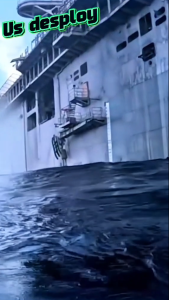
The image accompanying reports of the exercise appears to show a large naval vessel at sea, with the text “US deploy.” While the image itself does not reveal specific operational details, it is consistent with coverage highlighting the U.S. Navy’s expanding use of unmanned technologies during multinational training events. The exact vessel or platform shown cannot be confirmed from the image alone.
Held every two years under the leadership of the U.S. Navy’s Indo-Pacific Fleet, RIMPAC brings together dozens of nations to strengthen maritime cooperation, improve interoperability, and test new technologies under realistic operational conditions. Since its inception in 1971, the exercise has grown into the largest multinational naval event in the world, attracting thousands of personnel, numerous surface ships, submarines, aircraft, and increasingly, autonomous systems.
One of the most closely watched aspects of RIMPAC 2026 has been the deployment of unmanned surface vessels. Unlike conventional warships that require crews onboard, USVs can operate either remotely under human supervision or autonomously using sophisticated navigation systems, sensors, and artificial intelligence. These vessels are designed to undertake missions that may be dangerous, repetitive, or require extended endurance beyond what is practical for crewed ships.
Military planners increasingly view unmanned systems as force multipliers. Rather than replacing traditional destroyers, frigates, amphibious ships, or aircraft carriers, USVs are intended to complement them by expanding surveillance capabilities, improving reconnaissance, and supporting distributed maritime operations across vast ocean regions.
Modern unmanned surface vessels can perform a wide range of missions. Depending on their configuration, they may conduct intelligence gathering, maritime surveillance, electronic warfare, mine countermeasures, anti-submarine operations, logistics support, or act as communication relay platforms. Their modular design allows equipment packages to be changed depending on mission requirements.
One major advantage of unmanned vessels is their ability to remain at sea for prolonged periods without the logistical demands associated with supporting large crews. Reduced personnel requirements can lower operational costs while allowing sailors to focus on missions requiring human judgment and decision-making.
The Indo-Pacific presents unique challenges that make autonomous technologies particularly valuable. The region encompasses millions of square miles of ocean, numerous strategic shipping lanes, and diverse maritime environments. Monitoring such an expansive area requires persistent surveillance, rapid information sharing, and flexible deployment options.
Exercises such as RIMPAC provide an ideal opportunity to evaluate how unmanned systems integrate with existing naval forces. Rather than operating independently, USVs typically work alongside destroyers, cruisers, patrol vessels, maritime patrol aircraft, helicopters, and allied naval units to create a comprehensive operational picture.
Interoperability remains one of RIMPAC’s central objectives. Participating nations practice coordinated responses to humanitarian disasters, maritime security threats, search-and-rescue missions, anti-submarine warfare, air defense, and amphibious operations. Adding autonomous platforms introduces new considerations involving command-and-control procedures, data sharing, communications security, and tactical coordination.
Technology continues advancing rapidly within the unmanned maritime sector. Modern USVs incorporate sophisticated radar, electro-optical cameras, infrared sensors, satellite communications, collision-avoidance systems, and increasingly capable onboard computing. Artificial intelligence assists with navigation, obstacle detection, route planning, and sensor management, while human operators retain authority over mission-critical decisions.
Another important benefit of autonomous vessels is risk reduction. Certain missions expose crews to significant danger, including mine detection, surveillance in contested waters, or operations near hazardous environments. Sending an unmanned platform instead of a crewed vessel can reduce the risk to personnel while still collecting valuable operational information.
The U.S. Navy is not alone in exploring autonomous maritime capabilities. Allied nations participating in RIMPAC are also investing heavily in unmanned technologies, recognizing their growing importance in future naval operations. Exercises involving multinational partners help establish common procedures for safely integrating these systems into coalition missions.
Despite their advantages, unmanned surface vessels are not without challenges. Reliable communications remain essential, particularly over long distances or in contested electromagnetic environments. Engineers continue improving cybersecurity protections to defend against unauthorized access or interference. Navigation systems must also operate safely around commercial shipping, fishing vessels, and other maritime traffic while complying with international collision regulations.
Legal and ethical considerations accompany the expansion of autonomous military technology. Most current systems maintain meaningful human oversight, particularly when decisions involving the potential use of force are concerned. Military planners generally emphasize that autonomous systems should support, rather than replace, human decision-making in critical situations.
RIMPAC also provides opportunities to evaluate maintenance requirements and logistical support for unmanned platforms. Engineers monitor mechanical performance, software reliability, fuel consumption, sensor effectiveness, and overall operational readiness throughout the exercise. Lessons learned help refine future designs and operational concepts.
The broader strategic significance of unmanned maritime systems extends beyond military applications. Similar technologies are increasingly employed in scientific research, environmental monitoring, hydrographic surveying, offshore energy support, and disaster response. Advances driven by defense research often contribute to civilian maritime innovation as technologies mature.
As naval warfare evolves, many analysts anticipate a future fleet composed of both traditional crewed ships and networks of autonomous systems working together. Large warships may serve as command centers while smaller unmanned vessels extend surveillance, conduct reconnaissance, or perform specialized missions across wide geographic areas.
The deployment of unmanned surface vessels during RIMPAC 2026 therefore represents more than a technological demonstration. It reflects an ongoing transformation in how modern navies approach maritime security, emphasizing distributed operations, advanced networking, and increased operational flexibility. Testing these concepts during large multinational exercises allows participating nations to identify strengths, address limitations, and improve coordination before such capabilities might be required during real-world operations.
Ultimately, RIMPAC 2026 demonstrates that the future of naval operations will likely depend on effective collaboration between sailors and increasingly capable autonomous technologies. While crewed ships will remain the foundation of naval power for the foreseeable future, unmanned surface vessels are becoming an increasingly important component of modern maritime strategy. By integrating these systems into one of the world’s largest international naval exercises, participating nations are helping shape the next generation of maritime operations while reinforcing cooperation, readiness, and innovation across the Indo-Pacific region.