Meryl Streep and Goldie Hawn in Death Becomes Her: The Deliciously Wicked Comedy That Made Vanity Immortal
Released on July 31, 1992, Death Becomes Her remains one of Hollywood’s most inventive and unforgettable black comedies. Equal parts fantasy, satire, horror and slapstick, the film took one of humanity’s oldest dreams—eternal youth—and transformed it into a gleefully macabre cautionary tale. Featuring dazzling visual effects that were revolutionary for their time, razor-sharp dialogue and fearless performances from Meryl Streep, Goldie Hawn and Bruce Willis, the film has grown from an initially divisive release into one of the defining cult classics of the early 1990s.
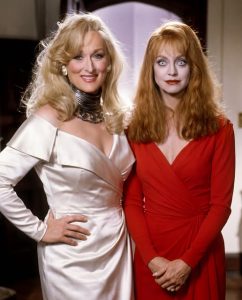
The publicity image shown here captures the film’s central rivals. Meryl Streep appears as the glamorous but ruthless Madeline Ashton, while Goldie Hawn plays the once-sweet writer Helen Sharp, whose simmering jealousy eventually explodes into a supernatural battle that neither woman can ever truly win.
A Brilliantly Twisted Premise
At first glance, Death Becomes Her seems like a Hollywood satire about aging actresses competing for beauty and fame. Yet within minutes, it reveals itself to be something much stranger.
Madeline Ashton is a narcissistic Broadway performer who has a habit of stealing the men in Helen Sharp’s life. After Madeline marries Helen’s fiancé, renowned plastic surgeon Ernest Menville (Bruce Willis), Helen suffers a devastating emotional collapse and spends years plotting revenge.
Time passes.
Madeline begins noticing wrinkles, fading beauty and the inevitable effects of aging. Desperate to remain young forever, she encounters the mysterious Lisle Von Rhuman, played with seductive elegance by Isabella Rossellini.
Lisle offers Madeline an irresistible bargain: drink a magical potion and remain forever young.
The catch?
You’ll never truly die.
Helen soon drinks the same potion, setting the stage for one of cinema’s most outrageous rivalries.
Meryl Streep’s Deliciously Wicked Performance
Although Meryl Streep had already established herself as one of the greatest dramatic actresses in film history through movies like Kramer vs. Kramer, Sophie’s Choice and Out of Africa, Death Becomes Her allowed audiences to see an entirely different side of her talent.
Her Madeline Ashton is vain, manipulative, hilariously self-absorbed and endlessly entertaining.
Streep fully commits to the absurdity, delivering every line with impeccable comic timing while embracing the physical comedy demanded by director Robert Zemeckis.
Whether she’s screaming in horror as her body literally falls apart or smugly admiring herself in a mirror, Streep demonstrates that great comedy requires just as much precision as great drama.
Many critics now consider Madeline one of the funniest performances of her remarkable career.
Goldie Hawn’s Scene-Stealing Helen
Goldie Hawn was already a comedy legend by 1992 thanks to films such as Private Benjamin, Overboard, Bird on a Wire and Seems Like Old Times.
In Death Becomes Her, she brilliantly transforms Helen Sharp from shy, heartbroken novelist into Madeline’s equally ruthless immortal rival.
The transition is one of the film’s greatest pleasures.
Early Helen appears emotionally shattered and almost unrecognizable after years in a psychiatric hospital.
Later, after drinking the potion, she returns with radiant confidence, impossible beauty and a thirst for revenge that matches Madeline’s own ambition.
Hawn balances broad comedy with genuine vulnerability, making Helen sympathetic even while she becomes increasingly obsessed with defeating her lifelong enemy.
Bruce Willis Against Type
One of the film’s biggest surprises was Bruce Willis.
Known primarily as the action hero of the Die Hard series, Willis deliberately chose to play against expectations.
Instead of another fearless tough guy, he portrays Ernest Menville as an insecure, nervous plastic surgeon trapped between two impossible women.
Complete with thinning hair, slouched posture and endless anxiety, Ernest becomes the unwilling referee in Madeline and Helen’s supernatural feud.
The performance showcased Willis’ underrated comedic talent and remains one of the most distinctive roles of his career.
Groundbreaking Visual Effects
When Death Becomes Her premiered, audiences had never seen anything quite like it.
Characters twist their heads completely backward.
Massive holes appear through stomachs.
Broken necks remain functional.
Bodies shatter and reassemble themselves.
These astonishing illusions combined practical makeup effects with cutting-edge digital technology.
The groundbreaking visual work earned the film the Academy Award for Best Visual Effects, demonstrating how computer-generated imagery could support storytelling rather than simply provide spectacle.
Many of those sequences still look remarkably convincing more than three decades later.
Robert Zemeckis at His Most Inventive
Director Robert Zemeckis had already enjoyed enormous success with Back to the Future and Who Framed Roger Rabbit before tackling Death Becomes Her.
His talent for blending fantasy, comedy and technical innovation proved perfectly suited to the material.
Rather than treating immortality as noble or romantic, Zemeckis embraces its grotesque possibilities.
The result is a film that constantly shifts between glamour and horror, elegance and absurdity.
One moment resembles an old Hollywood melodrama.
The next features characters casually carrying detached body parts around a mansion.
That tonal balancing act is one reason the movie has remained so distinctive.
A Satire That Still Feels Modern
Although released in 1992, Death Becomes Her feels surprisingly contemporary.
Its themes resonate even more strongly today, in an era dominated by social media, celebrity culture and endless pressure to appear forever young.
Madeline and Helen become consumed by cosmetic perfection.
They sacrifice relationships, happiness and eventually even their humanity in pursuit of eternal beauty.
The film exaggerates these desires for comic effect, but its central message remains timeless.
Physical appearance inevitably changes.
Trying to escape that reality at any cost ultimately becomes destructive.
From Mixed Reviews to Cult Classic
Interestingly, Death Becomes Her did not receive universal acclaim upon release.
Some critics admired its technical brilliance but found its blend of comedy, horror and fantasy difficult to categorize.
Audiences, however, gradually embraced its uniqueness.
Television broadcasts introduced the film to new generations.
Home video and DVD helped build an enthusiastic fan base.
Today, Death Becomes Her is celebrated as one of the great cult comedies of the 1990s.
Its unforgettable quotes, outrageous visual gags and fearless performances have inspired countless memes, stage adaptations and retrospective essays.
Many younger viewers now discover the film decades after its original release and are surprised by just how modern and inventive it feels.
Fashion, Glamour and Camp
Part of the film’s enduring appeal lies in its extraordinary visual style.
Costume designer Joanna Johnston filled the movie with extravagant gowns, dazzling jewelry and glamorous hairstyles that perfectly reflected Madeline and Helen’s obsession with appearance.
The production design embraces luxurious mansions, dramatic staircases and lavish interiors worthy of classic Hollywood melodramas.
Combined with Alan Silvestri’s sweeping musical score, the film creates a world that is simultaneously elegant and deliciously over-the-top.
That blend of glamour and camp has made Death Becomes Her especially beloved within cult cinema circles.
An Enduring Legacy
More than thirty years after its release, Death Becomes Her continues to captivate audiences because it offers far more than outrageous special effects and dark humor.
It is a clever satire about vanity, insecurity, rivalry and society’s relentless obsession with youth. Meryl Streep and Goldie Hawn throw themselves wholeheartedly into the film’s absurd premise, creating two unforgettable characters whose toxic friendship drives every outrageous twist. Bruce Willis provides the perfect comic counterbalance, while Robert Zemeckis’ imaginative direction ensures that every bizarre moment lands with style.
The image above perfectly captures the contrast at the heart of the story: Madeline Ashton, dazzling in white and radiating confidence, standing beside Helen Sharp in vivid red, whose wide-eyed stare hints that something is wonderfully, unnervingly wrong. Together, they transformed a wicked fantasy about eternal youth into one of Hollywood’s most beloved black comedies—a film that proved beauty may be forever, but immortality comes with a very high price indeed.