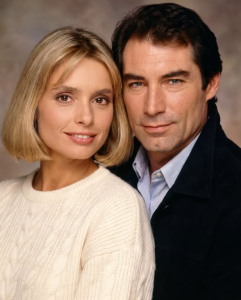
NAME THE 1987 BOND FILM THAT BROUGHT IN A NEW 007!
🎻 Released on this day in 1987, The Living Daylights ushered in a bold new era for James Bond, introducing Timothy Dalton as the world’s most famous secret agent and steering the franchise back toward the tougher, more grounded spirit of Ian Fleming’s original novels.
After more than a decade of Roger Moore’s suave, witty and often lighthearted interpretation of 007, audiences were about to meet a Bond who was colder, more intense and far more dangerous. The Living Daylights marked not only a changing of the guard but also a shift in tone, blending Cold War espionage, international intrigue and high-octane action into one of the most respected Bond adventures of the 1980s.
For many fans, it remains one of the franchise’s most underrated entries—a film that successfully reinvented Bond without abandoning the glamour, excitement and spectacle that had made the series a worldwide phenomenon.
A New Bond for a Changing World
By the mid-1980s, the James Bond franchise stood at a crossroads. Roger Moore had portrayed Bond in seven films between 1973 and 1985, bringing humor, charm and a raised eyebrow to every mission. His version of 007 was immensely popular, but after A View to a Kill, many felt the series needed a fresh direction.
Enter Timothy Dalton.
Interestingly, Dalton had been considered for the role years earlier but believed he was too young to replace Sean Connery. When the opportunity came again in 1986, he accepted, determined to portray Bond much closer to Ian Fleming’s literary creation.
His Bond wasn’t interested in delivering constant one-liners.
He was a professional intelligence officer.
Quiet.
Calculating.
Emotionally guarded.
Deadly when necessary.
From his opening sequence, Dalton immediately established that this Bond operated differently. His performance emphasized discipline, intelligence and moral conflict, creating a believable spy rather than an indestructible superhero.
The Story
The adventure begins during a training exercise for British intelligence agents that suddenly turns deadly.
Soon afterward, Bond is assigned to help arrange the defection of Soviet General Georgi Koskov during a concert in Bratislava.
Watching through his sniper scope, Bond prepares to eliminate a mysterious female sniper protecting the general.
Instead, he notices something unexpected.
She’s a frightened young woman rather than a trained assassin.
Choosing not to kill her, Bond wounds her rifle instead.
That young woman is Kara Milovy, played by Maryam d’Abo.
A talented cellist unknowingly caught in a web of international espionage, Kara quickly becomes one of the film’s central characters.
As Bond uncovers layers of deception involving Soviet intelligence, rogue arms dealers and massive weapons transactions, Kara proves far more courageous than she initially appears.
Together they travel across Europe, Austria, Morocco and Afghanistan while racing to uncover a conspiracy that threatens global stability.
Timothy Dalton’s Bond
Dalton’s portrayal remains one of the closest interpretations of Fleming’s original novels.
Rather than relying on gadgets or exaggerated humor, his Bond often succeeds through observation, intelligence and sheer determination.
He appears genuinely affected by violence.
He forms authentic emotional connections.
He questions those around him.
This realism gave The Living Daylights a noticeably different atmosphere from several earlier Bond adventures.
Although some viewers initially needed time to adjust, many modern fans now consider Dalton’s performance among the finest in the franchise.
His influence can even be seen in Daniel Craig’s later interpretation, which similarly emphasized Bond’s humanity and psychological complexity.
Maryam d’Abo as Kara Milovy
Maryam d’Abo brought warmth and sincerity to Kara, making her one of the franchise’s more relatable Bond heroines.
Unlike many previous Bond girls, Kara isn’t introduced as a glamorous spy or femme fatale.
She’s a gifted musician who finds herself manipulated by powerful men.
Her innocence contrasts beautifully with Bond’s hardened professionalism.
Yet she is far from helpless.
As the story unfolds, Kara repeatedly demonstrates bravery, loyalty and resilience.
Her growing relationship with Bond develops naturally, becoming one of the film’s strongest emotional threads.
The chemistry between d’Abo and Dalton gives the movie genuine heart.
Villains Without Superpowers
One of the film’s greatest strengths lies in its grounded antagonists.
Rather than world-conquering madmen, the villains are motivated primarily by greed.
General Koskov, portrayed by Jeroen Krabbé, initially appears to be a heroic defector before revealing his true loyalties.
Working alongside him is wealthy American arms dealer Brad Whitaker, played with theatrical confidence by Joe Don Baker.
Whitaker imagines himself as one of history’s greatest military commanders, filling his mansion with statues and battlefield recreations.
His delusions provide subtle humor while keeping the overall story rooted in believable Cold War politics.
Spectacular Action
Despite its more serious tone, The Living Daylights delivers several unforgettable action sequences.
The opening Gibraltar mission immediately establishes excitement.
Bond’s dramatic escape involving a Land Rover and parachute remains thrilling decades later.
A tense chase through Bratislava combines espionage with suspense.
The Aston Martin V8 becomes one of the franchise’s most beloved Bond cars, equipped with missiles, lasers, ski attachments and hidden weaponry while still feeling surprisingly realistic.
The frozen lake pursuit is another standout sequence.
Bond’s Aston Martin races across ice under heavy enemy fire before narrowly escaping destruction.
Later, the movie shifts to Afghanistan, where Bond joins resistance fighters battling Soviet forces.
The climactic battle aboard a cargo plane combines aerial stunts, explosions and hand-to-hand combat in spectacular fashion.
Even today, many fans regard it as one of the series’ finest finales.
John Barry’s Final Bond Score
Legendary composer John Barry returned once again to provide the film’s music.
His sweeping orchestral score beautifully balances romance, suspense and action.
The title song, performed by the Norwegian pop group a-ha, became an international hit and remains one of the franchise’s most recognizable theme songs.
Barry also incorporated classical influences reflecting Kara’s musical background, giving the soundtrack unusual elegance.
It would ultimately become Barry’s final score for a Bond film, closing an extraordinary chapter in the series’ musical history.
Cold War Authenticity
Released during the closing years of the Cold War, The Living Daylights captured contemporary geopolitical tensions without becoming overly political.
Rather than presenting simplistic East-versus-West conflict, the screenplay explored corruption, shifting loyalties and international arms trafficking.
This complexity helped distinguish it from many earlier Bond adventures.
The espionage feels surprisingly plausible, reflecting real-world intelligence operations more closely than some of the franchise’s more fantastical entries.
Critical Reception
Upon release in 1987, The Living Daylights received largely positive reviews.
Critics praised Dalton’s serious performance, the stronger emphasis on espionage and the film’s return to Ian Fleming’s spirit.
It also performed well at the global box office, demonstrating that audiences were ready to embrace a new interpretation of Bond.
Although Dalton would appear in only one additional Bond film—1989’s Licence to Kill—his influence would continue to shape the franchise for decades.
A Reappraisal Over Time
In the years since its release, The Living Daylights has enjoyed something of a critical renaissance.
Many viewers who initially preferred Roger Moore’s lighter style have come to appreciate Dalton’s more realistic approach.
The film now frequently appears on lists of the franchise’s most underrated entries.
Its combination of believable espionage, memorable action, engaging romance and intelligent storytelling has aged remarkably well.
Modern audiences often find that Dalton’s Bond feels surprisingly contemporary.
His emotional restraint, professional competence and willingness to question authority anticipated many elements later embraced by the Daniel Craig era.
A Lasting Legacy
Nearly four decades after its release, The Living Daylights remains an important turning point in James Bond history.
It proved that the character could evolve with changing times while remaining faithful to his literary origins.
Timothy Dalton successfully introduced a tougher, more vulnerable and more believable 007, while Maryam d’Abo’s Kara Milovy brought warmth, intelligence and emotional depth to one of the franchise’s most memorable romances.
Combined with spectacular practical stunts, beautiful international locations, John Barry’s unforgettable score and an engaging Cold War thriller, the film stands as one of the finest Bond adventures of the 1980s.
Today, The Living Daylights is remembered not simply as the movie that introduced a new James Bond, but as the film that reminded audiences that beneath the tuxedo, Aston Martin and gadgets was a highly trained intelligence officer navigating a dangerous world where trust was rare, loyalties shifted without warning and survival depended as much on judgment as on firepower.
For fans of the world’s most famous secret agent, it remains a stylish, intelligent and thrilling chapter in the enduring legacy of 007.