FICTIONAL NEWS STORY
BREAKING NEWS: Massive Category 5 Hurricane “Melissa” Forms Over the Atlantic
Editor’s Note: The following is a fictional disaster story created for entertainment purposes. It is not based on real events.
The Atlantic Ocean became the focus of worldwide attention today after meteorologists announced that Hurricane Melissa had rapidly intensified into a powerful Category 5 storm, packing sustained winds exceeding 180 mph and posing a potentially catastrophic threat to islands and coastal communities across the Atlantic basin.
The National Hurricane Center reported that the hurricane developed under exceptionally favorable atmospheric conditions, drawing energy from unusually warm ocean waters while encountering minimal wind shear. Within just 36 hours, the storm strengthened from a tropical storm into one of the most intense hurricanes ever observed.
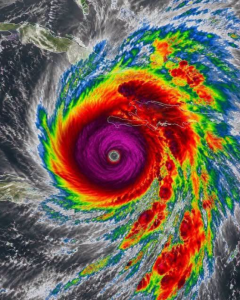
Satellite imagery revealed a nearly perfect eye surrounded by towering thunderstorms extending hundreds of miles from the center. Meteorologists described the storm as “textbook in appearance but extraordinary in intensity.”
Emergency management agencies across the Caribbean immediately activated hurricane response plans.
Governments urged residents in vulnerable coastal regions to review evacuation routes, secure homes and prepare emergency supplies.
Supermarkets quickly filled with shoppers purchasing bottled water, batteries, canned food and emergency medical supplies.
Airlines began canceling flights to several island destinations as ports prepared to suspend operations.
Cruise ships altered itineraries to avoid the projected path.
Weather experts emphasized that forecasting beyond several days remains uncertain.
Although long-range computer models suggested several possible tracks, officials stressed that even small shifts could dramatically change which communities might experience the strongest winds, storm surge and flooding.
Emergency managers repeatedly urged residents not to focus solely on the forecast line.
Dangerous impacts from hurricanes often extend far from the center.
Heavy rainfall capable of producing flash flooding could affect areas hundreds of miles away.
Large ocean swells were already expected to generate dangerous surf and life-threatening rip currents well before the storm approached land.
Scientists noted that rapid intensification has become one of the greatest forecasting challenges in tropical meteorology.
Storms can strengthen dramatically within a single day, leaving communities with less time to prepare.
Meteorologists explained that warm ocean temperatures, abundant atmospheric moisture and weak upper-level winds can combine to produce explosive development.
As Melissa continued moving westward, reconnaissance aircraft flew repeated missions into the storm to measure wind speeds, atmospheric pressure and rainfall intensity.
These specially equipped aircraft transmitted real-time observations back to forecasting centers, allowing scientists to improve track and intensity predictions.
Officials warned that a storm of this strength could produce catastrophic storm surge if it made landfall.
Storm surge—the abnormal rise of seawater driven ashore by hurricane winds—has historically caused many hurricane-related fatalities.
Combined with destructive waves, coastal flooding could inundate neighborhoods, damage infrastructure and isolate communities.
Heavy rainfall posed another significant concern.
Slow-moving hurricanes can produce prolonged periods of intense rain capable of overwhelming drainage systems and triggering widespread flooding, particularly in mountainous regions where landslides become an additional hazard.
Power companies mobilized repair crews while utility workers from neighboring regions prepared to assist with recovery efforts if needed.
Hospitals reviewed emergency procedures and stocked additional medical supplies.
Schools in potentially affected areas announced contingency plans should evacuations become necessary.
Emergency shelters began preparing to receive residents unable to remain safely in their homes.
Meteorologists continued emphasizing that preparation saves lives.
Residents were encouraged to assemble emergency kits containing food, water, medications, flashlights, batteries, important documents and supplies for pets.
Officials reminded families to have multiple ways of receiving weather alerts, including battery-powered radios and smartphone emergency notifications.
As darkness fell across the Atlantic, satellite images showed the massive hurricane maintaining its impressive symmetry.
Forecasters continued around-the-clock monitoring, updating advisories every few hours while urging the public to rely only on official weather agencies for the latest information.
Whether Melissa ultimately curved harmlessly into the open Atlantic or threatened populated coastlines, experts agreed on one point: preparedness remains the most effective defense against hurricanes. Careful planning, timely evacuations and attention to official warnings have repeatedly proven to be the difference between safety and tragedy when powerful tropical cyclones approach land.