Why Are Some Electrical Outlets Installed Upside Down? The Surprising Reason Behind the Ground Pin
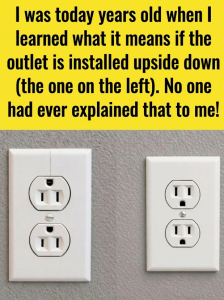
At first glance, the two electrical outlets in the picture look almost identical. Both are ordinary-looking wall receptacles, both accept the same standard household plugs, and both appear to perform exactly the same job.
But there is one obvious difference: one outlet has the round ground opening above the two vertical slots, while the other has it below them.
That small difference has puzzled homeowners, renters, electricians, and curious observers for decades. If you grew up seeing the ground hole at the bottom, an outlet with the ground hole at the top can look as though an electrician simply installed it upside down.
But that isn’t necessarily what happened.
In fact, both orientations can be intentional, and there are several reasons why an electrician, contractor, or facility might choose one orientation over the other. The explanation involves electrical safety, installation practices, local preferences, and even the design of plugs themselves.
First: Is an Upside-Down Outlet Actually Upside Down?
The short answer is no.
For ordinary U.S. residential receptacles, there generally isn’t a universal rule requiring the ground opening to be either above or below the two slots. The National Electrical Code does not simply say that every standard wall receptacle must have the ground pin facing downward.
That means an electrician can install a conventional receptacle with the ground slot on top or on the bottom, provided the installation otherwise meets the applicable electrical requirements.
So when you see an outlet with the ground hole on top, it isn’t necessarily an error.
The orientation can be a matter of preference or a deliberate safety choice.
And that’s where the story gets interesting.
The Ground Pin Is There for a Very Important Reason
Before discussing orientation, it helps to understand what that mysterious round opening actually does.
A typical modern three-prong plug has three electrical connections:
- Hot
- Neutral
- Ground
The two flat blades carry the normal electrical circuit. The third, usually rounded or U-shaped pin is the equipment grounding connection.
The ground conductor is designed primarily as a safety pathway.
Under normal circumstances, electricity travels through the hot and neutral conductors to operate an appliance. The grounding conductor normally carries no current.
But imagine that a fault occurs inside an appliance.
A damaged wire could accidentally touch the metal case of a toaster, washing machine, computer, lamp, or power tool. Without an effective grounding path, that metal case could potentially become energized.
If someone then touches it, their body could become part of the path to ground.
The grounding system is designed to help prevent that dangerous situation.
When a properly grounded appliance develops a fault, the grounding conductor provides a low-impedance path for fault current. That can help cause the circuit’s overcurrent protection—such as a circuit breaker—to operate and disconnect power.
So the third pin isn’t decorative.
It’s an important part of the electrical safety system.
Why Would Anyone Put the Ground Pin on Top?
One of the most frequently cited reasons is mechanical safety.
Imagine a three-prong plug partially inserted into an outlet. Now imagine a conductive metal object—perhaps a small tool, piece of hardware, or metal object—falling onto the plug.
If the ground pin is positioned at the top, the theory is that the object is more likely to encounter the grounding pin before reaching the energized blades.
Because the ground pin is connected to the grounding system rather than being the normal energized conductor, this arrangement can potentially reduce the risk of a dangerous short circuit.
This is one reason you may encounter ground-up receptacles in commercial, industrial, institutional, or other environments where electrical safety practices are particularly deliberate.
However, this doesn’t mean that every electrician agrees that ground-up is automatically safer in every situation.
The exact geometry of the plug, receptacle, object involved, and how far the plug is inserted all matter.
In other words, the popular explanation is based on a legitimate safety concept, but it shouldn’t be treated as an absolute rule that ground-up is always safer.
The Famous “Falling Object” Argument
The falling-object explanation is probably the most fascinating reason behind the orientation debate.
Consider the standard three-prong plug.
With the ground pin on top, the ground pin is physically above the two energized blades.
If something metallic falls vertically onto a partially inserted plug, it could encounter the ground pin first.
With the ground pin on the bottom, the hot and neutral blades are positioned above the ground pin. A conductive object falling from above could potentially make contact with an energized blade and another conductive surface.
The danger depends heavily on the object and circumstances, but the basic principle is simple:
Why not position the grounded part where it is more likely to be encountered first?
That logic has led some electricians and facilities to deliberately install receptacles ground-up.
It is particularly noticeable in places where safety-conscious electrical installation practices are emphasized.
Hospitals and Commercial Buildings Can Look Different
If you’ve ever walked through a hospital, laboratory, workshop, office building, or industrial facility and noticed that many receptacles have their ground pins facing upward, there’s a good chance you’re seeing an intentional installation practice.
Certain facilities may adopt their own standards for receptacle orientation.
An organization might decide that every receptacle in a particular building should be installed ground-up. Another might use ground-down. Some facilities may even use different orientations for different types of circuits or equipment.
This is why you can walk into one building and see dozens of ground-up outlets while your home has almost nothing but ground-down outlets.
It doesn’t necessarily mean one building is wired correctly and the other incorrectly.
It may simply reflect different installation conventions.
What About the Outlet in Your Home?
If the outlets in your house have the ground opening at the bottom, there’s generally no reason to panic.
Your receptacles aren’t automatically unsafe simply because they are ground-down.
Likewise, if you discover that an outlet has the ground opening at the top, that doesn’t mean somebody made a mistake.
The more important questions are whether the receptacle is correctly wired, properly grounded where required, securely mounted, appropriately rated, and protected by the required circuit protection.
Orientation is only one small part of the overall electrical installation.
And importantly, don’t assume that rotating a receptacle yourself is a harmless cosmetic modification.
Although changing orientation may sound simple, working inside an electrical box exposes you to potentially lethal voltage. If a receptacle needs to be changed, an appropriately qualified person should handle the work.
There’s Another Reason Outlets Sometimes Appear “Upside Down”
There is also a practical installation reason.
Some receptacles are connected to switched circuits or special wiring arrangements. In certain installations, an electrician may use orientation or receptacle configuration as a visual clue that the receptacle has a particular function.
For example, an outlet might be controlled by a wall switch, connected to a dedicated circuit, or configured differently from ordinary receptacles.
However, orientation isn’t a universal code for identifying these conditions.
You shouldn’t assume that a ground-up outlet means it is switched or dedicated—or that a ground-down outlet means it isn’t.
The actual wiring and labeling determine the circuit’s function.
What About Polarization?
The two flat slots aren’t identical.
On a standard polarized receptacle, one slot is designated hot and the other neutral. The wider slot is normally the neutral side, while the narrower slot is the hot side.
This is another important safety feature.
Older two-prong plugs may not have had a grounding pin, but modern three-prong plugs add the equipment grounding connection.
Together, polarization and grounding help ensure that appliances operate in a predictable and safer electrical configuration.
The orientation of the receptacle itself doesn’t change which slot is hot or neutral.
Turning the receptacle 180 degrees simply changes where the physical openings are positioned relative to the floor.
So Which Way Is “Correct”?
Here’s the surprising answer:
There isn’t one universal “right-side-up” orientation for ordinary receptacles in every U.S. installation.
Ground-down is extremely common in residential construction.
Ground-up is also used intentionally in many installations.
Neither orientation, by itself, tells you whether an outlet was installed correctly.
What matters far more is the electrical integrity of the installation.
A properly wired ground-down receptacle can be perfectly safe. A poorly wired ground-up receptacle can still be dangerous.
That distinction is important because social-media posts sometimes make it sound as though every outlet with the ground pin on top is evidence of superior electrical work.
That’s an oversimplification.
The Little Detail Most People Never Notice
The funny thing about electrical outlets is that we interact with them constantly without really thinking about them.
We plug in phones, lamps, televisions, refrigerators, computers, vacuum cleaners, and countless other devices. Yet most people rarely stop to wonder why the receptacle has three openings, why one slot is wider, or why the ground pin sometimes appears at the top.
That tiny third opening represents decades of electrical-safety development.
And the fact that it can appear either above or below the blades is a reminder that electrical design often involves practical choices rather than a single universal visual standard.
So the next time you see an outlet that looks “upside down,” don’t immediately assume the electrician made a mistake.
It may have been installed deliberately.
The ground pin could be positioned at the top as part of a safety-oriented installation philosophy, particularly to reduce the possibility of a falling conductive object contacting an energized blade on a partially inserted plug. Or it may simply reflect the electrician’s or facility’s preferred convention.
Either way, that little round hole has a big job.
It is there to help keep fault current on a safer path—and potentially keep you from becoming that path.
And perhaps that’s the real lesson behind the seemingly upside-down outlet: sometimes the smallest details hiding on the walls of our homes have surprisingly important stories behind them.