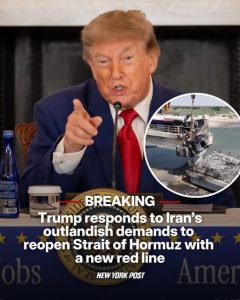
The confrontation over the Strait of Hormuz has entered another tense phase after Iran laid out sweeping conditions for reopening the strategic waterway—and President Donald Trump responded by drawing a new line of his own. The exchange highlights just how far apart Washington and Tehran remain, even as both sides face mounting economic and strategic pressure to find a way forward.
According to reports published Monday, Iran has insisted that the Strait will not fully reopen unless the United States accepts a broad package of demands. Those conditions reportedly include compensation for damage from the conflict, the lifting of U.S. sanctions, the release of frozen Iranian assets, an end to American military pressure around Iran, and a halt to fighting involving Iran and its regional allies.
Trump, however, rejected the idea that Washington should be the side making concessions simply to restore freedom of navigation. Instead, he countered with demands of his own, including compensation from Iran for American deaths and injuries linked to Iranian-backed attacks and other grievances accumulated over decades.
The result is a diplomatic standoff centered on one of the world’s most strategically important waterways.
Why the Strait of Hormuz matters
The Strait of Hormuz is a narrow maritime passage connecting the Persian Gulf with the Gulf of Oman and the Arabian Sea. Its importance goes far beyond the countries immediately surrounding it.
For decades, it has served as a major artery for international energy markets. Oil and liquefied natural gas produced by Gulf states depend heavily on access through the waterway, making any prolonged disruption capable of sending shock waves through global markets.
That is why the current confrontation has attracted attention far beyond Washington and Tehran.
When commercial traffic through Hormuz is restricted, the consequences can spread rapidly. Tankers face longer routes, insurance costs rise, energy companies reassess supplies, and traders price additional geopolitical risk into oil and gas contracts.
The situation has already contributed to severe uncertainty in energy markets during the wider conflict. Earlier U.S. government and congressional documents described the disruption as an extraordinary shock to global energy supplies, with oil prices rising above $100 per barrel during the crisis.
In other words, Hormuz is not merely an Iranian-American dispute.
It is a global economic pressure point.
Iran’s sweeping demands
Iran’s latest position represents a significant attempt to turn control over the waterway into leverage at the negotiating table.
Iranian officials have argued that reopening the Strait cannot be separated from the broader conflict. Tehran has reportedly demanded that Washington end military actions, lift sanctions, release frozen assets and provide compensation for wartime damage.
Iran has also connected the issue to conflicts involving its regional partners in places such as Lebanon, Gaza, Yemen and Iraq.
From Tehran’s perspective, these demands can be viewed as part of a larger argument: if the United States wants normal shipping through Hormuz, Washington must address what Iran considers the underlying causes of the crisis.
But from Washington’s perspective, accepting such conditions could create an extraordinary precedent.
It could effectively mean that Iran gains substantial political and economic concessions in exchange for restoring access to a waterway upon which the international economy depends.
That is precisely the situation Trump appears unwilling to accept.
Trump’s counterattack
Trump’s response was notable because he did not simply reject Iran’s demands.
Instead, he turned the argument around.
The president argued that if compensation is going to be discussed, Iran should also face American demands for compensation connected to deaths and injuries caused by Iranian-backed attacks and other actions attributed to Tehran over the years.
Trump also referenced Iran’s treatment of protesters and broader grievances stretching back decades.
The message was clear: Washington does not accept the premise that Iran can dictate the price of reopening Hormuz.
That has effectively produced two competing negotiating frameworks.
Iran says:
Meet our conditions, and the Strait can reopen.
Trump’s response is essentially:
Those conditions are unacceptable, and if compensation and concessions are being discussed, the United States has demands too.
That is why the latest exchange matters.
The disagreement is no longer simply about ships.
It is about who gets to establish the terms of the postwar order.
A new red line
Trump’s response has been described as establishing a new “red line” because the president has made the reopening of Hormuz central to any future settlement.
Earlier in the conflict, Trump repeatedly demanded that the waterway be reopened and threatened severe consequences if Iran refused. At one point, his administration imposed deadlines and warned that continued restrictions on shipping could trigger additional military action.
But the current phase appears somewhat different.
Recent reporting indicates Trump has been more willing to rely on economic pressure rather than immediately launch new strikes aimed at forcing the Strait open.
That could represent a strategic calculation.
Military action might reopen portions of the waterway temporarily, but it could also produce further escalation, damage infrastructure, threaten commercial vessels and deepen the economic crisis.
Sanctions and economic pressure, by contrast, can be sustained for longer periods.
The danger is that economic pressure may also take time to work.
The danger of a prolonged closure
The longer Hormuz remains restricted, the more complicated the situation becomes.
Shipping companies need predictable conditions. They cannot operate efficiently when they do not know whether vessels will be allowed to pass, whether insurance will remain available or whether a ship could suddenly become involved in a military confrontation.
Energy markets respond to this uncertainty even before an actual shortage occurs.
A tanker does not necessarily need to be attacked for prices to rise. The mere possibility of disruption can cause traders and companies to build a risk premium into prices.
That affects transportation, manufacturing, electricity generation and household expenses.
The consequences can therefore reach consumers thousands of miles from the Persian Gulf.
For major Asian economies, the stakes are especially high because many depend heavily on Gulf energy supplies.
For European countries, the crisis adds another layer of vulnerability to already complicated energy markets.
And for Gulf producers themselves, the Strait represents an economic lifeline.
That is why countries throughout the region have a strong interest in preventing the current confrontation from becoming permanent.
The Oman factor
One potentially important development is the emergence of Oman as a possible intermediary.
Reports indicate that Iran and Oman have been moving toward an arrangement that could permit at least restricted vessel movement through the waterway.
This distinction is important.
A limited shipping corridor is not necessarily the same thing as a full reopening.
Iran may be willing to permit carefully controlled traffic while maintaining political leverage over the larger question of unrestricted navigation.
That could provide breathing room for diplomats without requiring either Washington or Tehran to immediately surrender its broader position.
Oman has historically played a valuable diplomatic role between Iran and Western governments, making it a potentially useful channel for quiet negotiations.
If a limited arrangement can be established, it could reduce immediate pressure on energy markets while giving negotiators more time.
Why neither side wants to appear weak
The political dimension may be just as important as the economic one.
For Trump, accepting Iran’s demands could be portrayed by opponents as surrendering to pressure.
The president has repeatedly emphasized strength and leverage in dealing with Iran. A settlement in which Tehran appears to dictate terms would therefore carry political costs.
For Iranian leaders, the situation is equally complicated.
Backing down after publicly declaring that the Strait will remain closed until Washington accepts Iranian conditions could be interpreted domestically as weakness.
Iran’s leadership has spent decades emphasizing resistance to American pressure.
That makes compromise difficult even when compromise would serve Iran’s economic interests.
Both sides therefore have incentives to negotiate—but also incentives to avoid looking as though they are capitulating.
That is one of the most dangerous characteristics of the current standoff.
What happens next?
There are several possible paths.
The first is diplomacy.
The United States and Iran could gradually separate the Hormuz issue from their most difficult disputes and negotiate a limited reopening arrangement. Oman or another intermediary could help establish the framework.
The second possibility is a partial reopening.
Iran could allow certain vessels to pass while maintaining restrictions on others. Such an arrangement would relieve some pressure without resolving the political dispute.
The third possibility is continued economic pressure.
Trump could continue relying on sanctions and other measures while waiting for Iran’s economic and political calculations to change. Recent reporting suggests this approach is currently receiving serious consideration.
The fourth possibility is renewed military escalation.
That would be the most dangerous outcome.
Any confrontation involving naval forces, commercial tankers, mines, missiles or critical energy infrastructure could quickly become difficult to control.
The larger issue
At its core, the Hormuz dispute is about leverage.
Iran possesses geographic leverage because the Strait sits beside its territory and because Tehran has demonstrated its ability to disrupt maritime traffic.
The United States possesses military and economic leverage, including sanctions and a powerful military presence in the region.
Neither side wants to surrender its advantage.
That is why the rhetoric has become so intense.
Iran’s demands are designed to maximize the value of its control over Hormuz.
Trump’s counter-demands are designed to prevent Iran from turning that control into a mechanism for extracting unilateral concessions.
And behind both positions lies the same reality: neither Washington nor Tehran can easily ignore the enormous economic consequences of keeping the waterway restricted.
A high-stakes waiting game
The latest exchange between Trump and Iran should therefore be viewed as more than another round of inflammatory statements.
It is part of a larger struggle over what the eventual settlement will look like.
Iran wants the reopening of Hormuz tied to sanctions relief, compensation, military withdrawals and broader regional issues.
Trump is signaling that the United States will not simply accept that framework.
At the same time, neither side appears to have an easy path to forcing the other into submission.
That leaves diplomacy as the most practical route, even if public rhetoric makes compromise sound impossible.
The possibility of a limited Oman-mediated shipping arrangement offers one potential opening. If commercial traffic can begin moving again, even partially, it could reduce pressure on global energy markets and create space for broader negotiations.
But the fundamental dispute remains unresolved.
The question is no longer simply whether ships can pass through the Strait of Hormuz.
The question is who will decide the conditions under which they pass—and what price the other side must pay for that access.
For Trump, accepting Iran’s demands would cross a political and strategic line.
For Iran, abandoning its conditions could mean surrendering one of its strongest bargaining tools.
That is why the coming negotiations could prove far more consequential than the latest exchange of statements suggests.
The Strait of Hormuz has become a symbol of the wider conflict itself: narrow geographically, but enormous in global consequences. As long as it remains restricted, Washington, Tehran and the rest of the world will have a powerful incentive to find a way out.
And until that happens, Trump’s new red line and Iran’s demands will remain locked in a high-stakes contest over diplomacy, economic power and control of one of the world’s most important maritime gateways.