This Egg Puzzle Looks Easy at First—Until You Realize There May Not Be One Certain Answer
At first glance, this looks like one of those wonderfully simple internet puzzles that should take only a few seconds to solve. The question printed above the photograph is straightforward: How many eggs are in this pan?
Most people will immediately start counting the bright yellow yolks.
And that seems perfectly reasonable.
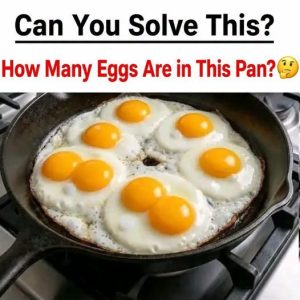
But look a little closer, and the puzzle becomes much more interesting. The photograph appears to show eight visible yolks, yet the number of eggs actually used to create the dish cannot necessarily be established with complete certainty from the picture alone.
That distinction is what makes this seemingly easy puzzle surprisingly tricky.
The obvious answer: eight
If the puzzle is asking you to count the eggs represented by the visible yolks, the natural answer is eight.
There are eight distinct yellow yolks visible in the pan. They are spread across several overlapping areas of cooked egg white, with some of the whites running together as they cook.
Counting from the top of the pan downward, you can identify individual yolks at different positions. There is one near the upper portion, others toward the upper-left and upper-right, several across the middle, and two more toward the lower portion of the pan.
Put simply:
Eight yolks are visible.
If every yolk represents one ordinary chicken egg, then the answer is eight eggs.
For a normal visual puzzle, that would probably be the intended solution.
But there is a catch.
Yolks aren’t necessarily the same thing as eggs
The question does not technically ask, “How many yolks can you see?”
It asks, “How many eggs are in this pan?”
Those two questions are not always identical.
Under ordinary circumstances, one chicken egg contains one yolk. So counting yolks is an excellent way to estimate the number of eggs.
However, a photograph of cooked eggs cannot prove exactly how many individual raw eggs were cracked into the pan.
That’s where the ambiguity begins.
Imagine, for example, that one of the yolks came from a double-yolk egg. In that situation, one egg could produce two yolks.
If two visible yolks came from a single double-yolk egg, then eight yolks could theoretically represent seven eggs rather than eight.
And if more than one double-yolk egg were involved, the total number of eggs could be even lower.
The photograph itself does not provide enough information to rule out that possibility.
What about the egg whites?
The cooked whites create another layer of uncertainty.
Several of the whites appear to overlap or merge together. Once egg whites are poured into a hot skillet, they spread across the cooking surface and can run into one another.
As a result, it isn’t always possible to draw a perfect boundary around every individual egg.
You might look at the pan and think you can see eight separate eggs because there are eight yolks. But the whites don’t necessarily provide eight clearly separated outlines.
This is important because the yolk is the easiest part to count, while the white is much harder to use as an individual identifier after cooking.
The photograph therefore gives us strong evidence for eight yolks but weaker evidence about the exact number of original eggs.
Could there be fewer than eight eggs?
Technically, yes.
The most obvious possibility is the double-yolk scenario.
A double-yolk egg is a single egg containing two yolks. If one such egg was cracked into the pan, it could produce two yellow centers while still representing only one egg.
So, if the image contains eight yolks, the number of eggs could potentially be fewer than eight.
For example, suppose one pair of yolks came from a double-yolk egg while the other six yolks came from ordinary eggs. That would mean seven eggs produced eight yolks.
If two pairs came from double-yolk eggs, eight yolks could represent six eggs.
The image doesn’t give us enough information to determine whether that happened.
Of course, this is probably not what the creator of the puzzle intended. Most visual puzzles assume ordinary one-yolk eggs unless the image specifically provides evidence of something unusual.
Could there be more than eight eggs?
This is where the puzzle becomes even more interesting.
Could there have been more than eight eggs in the pan?
If every egg has a visible yolk, then no—the image appears to show eight yolks, so eight would be the obvious upper limit under normal assumptions.
But photographs can conceal information.
A yolk could potentially be broken, hidden underneath another cooked egg white, or otherwise obscured. The visible image doesn’t allow us to inspect the entire cooking process.
Therefore, if the question is interpreted extremely literally, the photograph alone cannot prove that every egg used remains represented by a clearly visible yolk.
However, that interpretation goes beyond what most people expect from a puzzle like this.
The intended game is almost certainly visual counting, not forensic reconstruction of the cooking process.
Why the puzzle works so well
This type of puzzle is effective because it takes advantage of a basic human habit: we tend to accept the most obvious visual relationship without questioning it.
We see a yolk.
We think, “That’s an egg.”
Then we count them.
Eight yolks equals eight eggs.
Done.
But puzzles like this encourage us to ask whether the evidence actually supports the conclusion.
It’s similar to the classic question, “How many people are in the room?” when several people might be hidden behind a door. The challenge isn’t necessarily arithmetic. It’s recognizing the assumptions behind the arithmetic.
Here, the hidden assumption is:
One visible yolk = one egg.
Usually, that’s a perfectly sensible assumption.
But it isn’t an absolute rule.
The practical answer versus the technically correct answer
There’s a useful distinction between the puzzle answer and the scientifically certain answer.
If someone showed you this photograph at a party and asked, “How many eggs do you see?” you’d almost certainly answer eight.
If they asked, “How many eggs were definitely cracked into the pan?” you’d have to be more cautious.
The photograph establishes that there are eight visible yolks.
It strongly suggests that eight eggs were cooked.
But it cannot establish with absolute certainty that exactly eight individual eggs were used.
That’s why the headline’s wording—“There may not be one certain answer”—is so appropriate.
The image encourages a simple answer, while the wording allows for a more careful interpretation.
Don’t let the overlapping whites fool you
Another reason people may hesitate is the way the egg whites are arranged.
The pan is crowded, and several cooked whites appear to touch each other. This can make the dish look like fewer large eggs rather than multiple individual eggs.
But the yolks provide the easiest visual markers.
Even where the whites overlap, each visible yolk can be treated as an individual egg for purposes of the puzzle.
That means you shouldn’t try to count large white shapes. Doing so could lead to a completely different answer.
Instead, count the distinct yolks.
The result is eight.
A good puzzle-solving lesson
There’s a broader lesson hidden inside this breakfast photograph.
When solving visual puzzles, it’s useful to distinguish between what is directly observable and what you infer from it.
What can we directly observe?
We can see eight yellow yolks.
What do we infer?
We infer that there were eight eggs.
That inference is reasonable because ordinary chicken eggs generally contain one yolk each.
But an inference is not necessarily proof.
The same principle appears in everyday reasoning. We constantly make assumptions based on familiar patterns. Most of the time, those assumptions are useful and efficient. Occasionally, however, a puzzle deliberately introduces an unusual possibility to see whether we’ll notice it.
This egg picture does exactly that.
So, what’s the final answer?
If you’re playing the puzzle according to its intended rules, the answer is:
8 eggs.
There are eight visible yolks, and the straightforward assumption is that each came from a separate egg.
But if the question is interpreted with absolute literal precision, the photograph doesn’t provide enough information to guarantee that exactly eight individual eggs were used.
Double-yolk eggs alone are enough to demonstrate why.
So the best answer depends on how the question is being asked.
Puzzle answer: 8.
Strictly provable answer: 8 visible yolks, but the exact number of original eggs cannot be confirmed from the photograph alone.
And that is precisely what makes this little breakfast puzzle more clever than it first appears.
At first, it looks like nothing more than a quick counting exercise.
Look at the yolks.
Count to eight.
Move on.
But once you notice that the question asks about eggs rather than yolks, the entire problem changes. Suddenly, you’re no longer simply counting objects in a photograph—you’re examining the assumptions that connect what you can see with what you believe happened before the picture was taken.
So the next time someone shows you this image and confidently says, “Easy—eight!” you can agree with them while adding one small qualification:
Eight is the obvious answer, but the picture proves eight yolks—not necessarily eight individual eggs.
And that tiny distinction is what turns an ordinary breakfast photo into a surprisingly effective brain teaser.