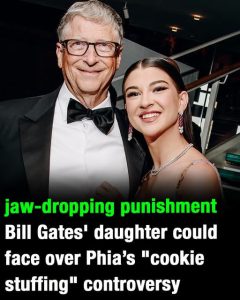
Bill Gates’ Daughter Draws Attention Amid Phia’s “Cookie Stuffing” Controversy
Phoebe Gates, the youngest daughter of Bill and Melinda Gates, has found herself at the center of an unexpected technology controversy involving Phia, the shopping startup she co-founded with Sophia Kianni. What began as an ambitious effort to make online fashion shopping easier has turned into a much more complicated story involving affiliate marketing, browser technology, alleged “cookie stuffing,” and questions about how digital businesses receive credit for online sales.
The controversy has also attracted intense attention because of Gates’ famous family background. Phoebe has spent much of her young career trying to establish herself as an entrepreneur in her own right, while openly acknowledging that being the daughter of one of the world’s best-known technology billionaires gives her an unusual starting point. Now, scrutiny of Phia is putting that distinction under a microscope.
What is Phia?
Phia was founded in 2025 by Gates and her Stanford University friend Sophia Kianni. The company presents itself as an AI-powered shopping assistant designed to help consumers find better prices, discount codes and alternative products online.
Its business model is connected to affiliate marketing. In a conventional affiliate arrangement, a shopper clicks a legitimate referral link from a publisher or shopping service, makes a purchase, and the affiliate receives a commission for helping generate that sale.
That system depends heavily on accurate attribution. Retailers need to know which website, publisher or service actually referred the customer.
According to a Bloomberg investigation, however, testing of Phia’s mobile browser extension found instances in which the software allegedly opened a background tab and inserted Phia’s referral code during the checkout process without meaningful action from the shopper. The effect could be that Phia received credit for a sale that another publisher—or nobody—had actually generated.
That practice is commonly described as “cookie stuffing,” although the exact technical mechanisms can vary.
Why does “cookie stuffing” matter?
A browser cookie can be used to remember information about a user’s activity. In affiliate marketing, tracking cookies can help identify which affiliate deserves a commission when a customer eventually buys something.
The problem occurs when an affiliate places or refreshes its tracking information without a genuine qualifying referral. Instead of earning money because it sent a customer to a retailer, the affiliate can potentially insert itself into the transaction after the customer is already shopping.
In Phia’s case, investigators reported finding behavior in which the extension could automatically load an affiliate link in the background. Bloomberg said it tested the extension across more than 50 websites and observed behavior that could replace another publisher’s referral with Phia’s. Independent testing by affiliate-marketing researcher Ben Edelman and Capital One Shopping reportedly produced similar concerns.
That distinction is important because the current controversy is not simply about whether Phia’s software contained a technical problem. The larger question is why the behavior existed, how long it existed, who knew about it, and whether anyone intentionally benefited from it.
Those are ultimately questions that require evidence and, if necessary, formal investigation—not social-media speculation.
Phia’s explanation
When the issue first became public in July, Phia said it had discovered a problem in its code and moved quickly to fix it.
A company spokesperson told Bloomberg that Phia had become aware of “misattributions” affecting a subset of users and that its team worked to identify and resolve the problem. The company said the problematic behavior had been eliminated, and Bloomberg’s subsequent testing reportedly found that the automatic referral behavior had stopped.
Phia has also said it is reviewing affected transactions and taking steps to reverse sales that were incorrectly attributed.
More recent reporting says the company has committed to additional compliance measures, including bringing in compliance personnel.
Those responses matter because affiliate networks and retailers can impose their own contractual penalties when they determine that a partner violated their rules.
Impact.com, one of the major affiliate platforms involved in the ecosystem, reportedly suspended Phia after identifying behavior it considered inconsistent with its policies. It also said it was reviewing potentially affected transactions.
The later allegations changed the story
The controversy became more serious after subsequent reporting examined internal communications and the history of the relevant software features.
According to reports published in August, internal Slack messages and software records allegedly suggested that people inside Phia were aware of the controversial behavior earlier than the company’s initial public explanation appeared to indicate. Some reporting places the development of relevant features as far back as December 2025.
That does not automatically establish criminal wrongdoing by Phoebe Gates or her co-founder.
There is an enormous difference between a company containing problematic code, executives knowing that a technical feature exists, executives understanding precisely how it works, and prosecutors proving that an individual knowingly participated in an intentional scheme to defraud someone.
That distinction is especially important because headlines about potential prison sentences have circulated widely.
Could Phoebe Gates actually go to prison?
Some recent reports have highlighted that certain forms of wire fraud under U.S. federal law can carry a maximum sentence of up to 20 years. That is a statutory maximum—not an indication that Gates has been charged, convicted or is likely to receive such a sentence.
As of the latest reporting, there is no indication that Phoebe Gates has been convicted of a crime related to Phia’s affiliate practices. Reports have instead focused on possible financial, contractual and civil consequences, as well as the question of whether any criminal investigation could eventually follow.
For criminal liability, prosecutors would generally need to establish considerably more than the existence of questionable software behavior. Questions of intent, knowledge, participation and evidence would become central.
So the dramatic claim that Bill Gates’ daughter is automatically facing decades in prison goes far beyond what has actually been established.
Why the Gates name makes the story bigger
Phoebe Gates’ family background inevitably magnifies the controversy.
Her father, Bill Gates, is one of the most recognizable figures in technology history. That means almost anything involving his daughter is likely to attract considerably more attention than a similar dispute involving an unknown startup founder.
Phia had also attracted substantial celebrity and venture-capital interest. Reports say the company raised a total of $43.5 million from investors that include major venture firms and celebrities such as Sydney Sweeney, Khloé Kardashian and Hailey Bieber.
That investment history raises another important question: how do investors evaluate technology companies whose business models depend on complicated technical systems?
Affiliate attribution can appear straightforward from a consumer’s perspective, but behind the scenes it involves tracking systems, referral codes, browser behavior, network rules and contracts between multiple companies.
A relatively small change in software can therefore have a significant financial impact.
The business consequences could be substantial
Even without a criminal prosecution, the controversy could be costly for Phia.
Potential consequences include returning commissions, losing affiliate partnerships, dealing with contractual disputes, facing civil claims and rebuilding relationships with retailers and publishers.
There is also the reputational damage.
For a young company, reputation can be as important as technology. Phia’s value proposition depends on users believing that it is helping them find good deals rather than manipulating the shopping process for its own financial benefit.
Recent reports indicate that Phia’s revenue declined sharply after the disputed features were disabled, although the company has disputed some of the reported figures and attributed the change to disabling several monetization tools rather than cookie stuffing alone.
That disagreement itself illustrates why the situation remains complicated.
Phoebe Gates’ next challenge
For Gates personally, the controversy represents a major test of leadership.
She and Kianni built Phia around the idea of using technology and artificial intelligence to modernize online shopping. The startup’s rapid fundraising and celebrity backing gave it considerable visibility while Gates was still in her early twenties.
Now the company has to demonstrate that it can operate with the same level of sophistication when it comes to compliance, transparency and accountability.
The most important issue is not simply whether Phia can restore lost revenue. It is whether customers, retailers, affiliate networks, investors and other partners can trust the company again.
That will require clear explanations, credible internal controls and evidence that disputed transactions are being properly reviewed.
A controversy still unfolding
The image of Phoebe Gates beside her father at a glamorous event may seem far removed from the technical world of affiliate tracking and browser extensions. Yet that contrast helps explain why the story has attracted so much attention.
Phoebe is trying to establish herself as a technology entrepreneur, while Phia is facing questions about the technology underpinning part of its business model.
At this stage, the fairest conclusion is that Phia is facing serious allegations and scrutiny, but allegations are not the same as a criminal conviction. The company says it removed the problematic functionality, is reviewing transactions and is taking compliance measures. Meanwhile, reporting based on internal communications has raised additional questions about what company personnel knew and when.
For Phoebe Gates, the coming months may therefore be less about celebrity headlines and more about proving that Phia can meet the standards expected of a modern technology company.
The biggest story is not the sensational possibility of a “20-year sentence.” It is the much more consequential question of whether Phia can explain what happened, make affected partners whole where appropriate, strengthen its controls and rebuild confidence.
Until further evidence or official legal action emerges, that is where the story should remain: a serious and evolving business controversy—not a predetermined criminal case.