How Many 9s Are Shown in the Picture? A Simple Visual Puzzle That Tests Your Attention to Detail
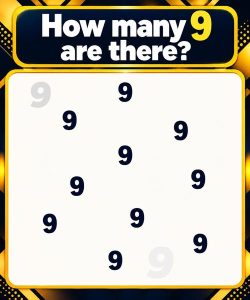
At first glance, the picture looks like a simple counting challenge. The question at the top asks, “How many 9 are there?” Inside the large white box, several number 9s are scattered across different positions. Some are dark blue and easy to notice, while others are light gray and blend into the background. There is also a bright yellow 9 in the headline itself.
Although the challenge may appear easy, it can be surprisingly tricky. Many people begin counting the dark numbers inside the box and forget to include the pale numbers or the 9 in the heading. Others count quickly and accidentally count the same number twice or overlook one hidden among the others.
So, how many 9s are actually shown?
The answer is 12, if you count every visible digit 9 in the entire image, including the headline. There are 11 in the large white box and one additional 9 in the yellow headline.
Let’s explore the puzzle, explain how to count the numbers accurately, and look at what this small challenge can teach us about attention, observation, and careful thinking.
1. Understanding the Visual Challenge
The image contains numbers in different colors and positions.
The puzzle uses a simple design. A dark blue background surrounds a large white rectangle, which is outlined in yellow. The question appears at the top in large white letters, with a yellow number 9 standing out from the rest of the text.
Inside the white rectangle, the numbers are distributed unevenly. They do not appear in a straight line or an organized grid. Instead, they are scattered across the space, requiring the viewer to move their eyes around the image.
The dark blue numbers are relatively easy to identify because they contrast strongly with the white background. The two light gray numbers are more difficult to notice because their color is much closer to the background.
This difference in visibility is an important part of the challenge. Your task is not simply to recognize the number 9. You must also pay attention to where it appears and whether its color makes it easy to overlook.
2. Counting the Numbers Inside the White Box
The most reliable way to solve the puzzle is to count the digits systematically rather than relying on a quick glance.
Start at the top of the white box and move from left to right. Then continue downward, checking each section before moving to the next.
Here is the count:
|
Location
|
Number of 9s
|
| — | — |
|
Upper-left corner, light gray
|
1
|
|
Upper area, dark blue
|
3
|
|
Middle area, dark blue
|
3
|
|
Lower area, dark blue
|
3
|
|
Bottom area, light gray
|
1
|
|
Total inside the white box
|
11
|
The positions are not perfectly aligned, so this method is more useful than trying to count by rows alone. The important point is to check each visible digit once.
There are nine dark blue 9s and two light gray 9s inside the white rectangle.
Therefore:
9 dark blue digits + 2 light gray digits = 11 digits.
Once you have counted the numbers inside the main box, the next step is to examine the rest of the image.
3. Don’t Forget the Yellow 9 in the Headline
One of the easiest details to overlook is the large yellow 9 at the top.
The headline reads, “How many 9 are there?” The yellow digit is clearly visible, but people often focus exclusively on the numbers inside the white rectangle because that is where most of the puzzle is located.
However, the question asks how many 9s are shown in the picture. It does not specifically say to count only the digits inside the white box.
If the entire image is included, the yellow 9 must also be counted.
That gives us the following calculation:
- Numbers inside the white box: 11
- Number in the headline: 1
- Grand total: 12
This illustrates a useful lesson: the wording of a question matters just as much as the visual information.
If the question had specifically asked how many 9s were inside the white rectangle, the answer would be 11. Because it asks how many are shown in the picture, counting the headline produces a total of 12.
4. Why Are Some Numbers Difficult to Notice?
The two pale gray digits create the main visual distraction.
Our eyes naturally notice strong contrasts. A dark blue number on a white background stands out immediately, while a light gray number can blend into the surrounding space.
This means that someone scanning the image quickly might count only the nine dark blue digits inside the rectangle. They might then include the yellow digit in the headline and arrive at 10, missing both gray digits.
Another person might count the 11 numbers inside the box but forget the yellow digit above it.
These mistakes are understandable because people often focus on the most prominent objects first. The brain quickly identifies the obvious shapes and may move on before every small detail has been checked.
The solution is to slow down and use a consistent counting method.
5. What This Puzzle Teaches Us About Attention
A simple number puzzle can demonstrate the importance of careful observation.
In everyday life, we often make quick judgments based on the information that is easiest to see. This is useful when we need to make decisions quickly, but it can also cause us to overlook details.
For example, a person checking a document might notice the large headline but miss a small number in the text. Someone reviewing a shopping receipt might focus on the total while overlooking an incorrect item. A student answering a question might remember the main information but miss an important word such as “not,” “except,” or “only.”
The number puzzle encourages a different approach: observe first, organize the information, and then reach a conclusion.
Instead of immediately announcing an answer, take a few seconds to inspect the whole image. Check the main area, examine the less noticeable details, and read the question again.
This approach is useful far beyond puzzles.
6. A Simple Method for Solving Similar Puzzles
If you enjoy visual challenges, the following method can help you solve them more accurately.
Step one: Read the question carefully.
Determine exactly what you are being asked to count. Is it the number inside a box, the number across the entire image, or the number of a particular color?
Step two: Divide the image into sections.
Imagine horizontal bands or vertical columns. Count each section before moving to the next one.
Step three: Look for differences in color and size.
Pay attention to faded numbers, small symbols, and objects that blend into the background.
Step four: Check the surrounding areas.
Do not assume the objects inside the largest shape are the only ones that count. Look at the headline, borders, corners, and other parts of the image.
Step five: Verify your total.
Count the objects a second time using a different route. If you counted from top to bottom the first time, try checking from left to right.
Step six: Match your answer to the wording.
A correct count can still produce the wrong answer if you misunderstand the question’s boundaries.
These steps make visual puzzles easier to approach without requiring special mathematical knowledge.
7. Challenge Your Friends
This puzzle is also a fun way to start a conversation with friends or family.
Show someone the image and ask them to count the 9s without giving away the answer. Ask them to provide their total before explaining how you counted the digits.
Some people may count only the dark blue digits. Others may notice the gray numbers but overlook the headline. A careful observer may include every digit from the beginning.
You can make the challenge more interesting by asking everyone to explain their counting method. Rather than simply comparing answers, discuss which parts of the image were easiest to overlook.
Remember that the wording matters. If someone answers 11, they may have counted all the digits inside the white rectangle correctly. If the task includes the headline, however, the total is 12.
8. The Final Answer
After examining the entire image, the count is straightforward.
There are nine dark blue 9s inside the white box, two light gray 9s inside the same box, and one yellow 9 in the headline.
The calculation is:
9+2+1=129+2+1=\boxed{12}9+2+1=12
Final answer: 12 visible digits of the number 9.
The main lesson is that small details can change the answer. Taking a moment to inspect the entire picture, rather than focusing only on its most prominent section, helps prevent simple counting mistakes.
Now it is your turn: did you count all 12 on your first attempt, or did one of the light gray numbers or the yellow headline digit escape your attention?