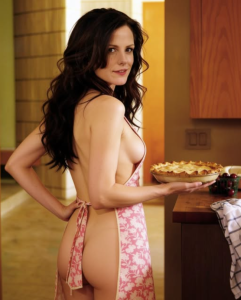
The Weeds star serving pie with a side of trouble is Mary-Louise Parker.
That clue is a deliciously layered one. “Weeds” points directly to the Emmy-winning dark comedy series that made Mary-Louise Parker a television icon, while “serving pie with a side of trouble” evokes the kind of sharp, complicated, quietly rebellious characters she has played throughout her career. Few actresses can balance sweetness and danger quite like Parker. She can appear warm, witty, and approachable one moment, then reveal an edge that makes a scene crackle with tension the next.
The woman behind Nancy Botwin
When Weeds premiered in 2005, television was in the middle of a transformation. Antiheroes were becoming the most fascinating characters on screen, but most of them were men. Then came Nancy Botwin, a suburban widow who begins selling marijuana to maintain her family’s lifestyle after her husband’s death.


6
Played by Mary-Louise Parker, Nancy was unlike almost any television protagonist audiences had seen before. She was funny, reckless, intelligent, selfish, loving, manipulative, vulnerable, and strangely relatable. Parker’s performance turned what could have been a gimmicky premise into a nuanced portrait of a woman improvising her way through chaos.
The show ran for eight seasons, and Parker became inseparable from the role. She won a Golden Globe for Best Actress in a Television Series – Musical or Comedy and received multiple Emmy nominations. More importantly, she helped redefine what a female lead in a cable drama-comedy could be.
Why the “pie” clue fits perfectly
The phrase “serving pie with a side of trouble” sounds almost like a scene from one of Parker’s projects. Her characters often inhabit spaces that look comforting on the surface—suburban kitchens, family gatherings, small-town diners—but beneath that surface lies conflict, secrecy, and unpredictability.
Nancy Botwin could smile at a neighbor while simultaneously managing a criminal enterprise. That contrast became the essence of Weeds: the collision between domestic normality and escalating danger. Parker played that contradiction with extraordinary precision. She never winked at the audience or treated Nancy as a cartoon. Instead, she made every questionable decision feel emotionally motivated, even when it was objectively disastrous.
Before Weeds: a respected stage and screen actress
Long before television audiences knew her as Nancy, Mary-Louise Parker had already built an impressive career in theater and film.
Born on August 2, 1964, in Fort Jackson, South Carolina, Parker spent part of her childhood moving frequently because her father served in the U.S. Army. That nomadic upbringing may have contributed to the adaptability she later showed as an actress.
After graduating from the University of North Carolina School of the Arts, she moved to New York and quickly established herself on stage. Theater critics were struck by her ability to convey deep emotion with remarkable subtlety.


5
Her breakthrough came with Proof, for which she won the Tony Award for Best Actress in a Play. The role required intelligence, vulnerability, and emotional volatility—the very qualities that would later make Nancy Botwin so compelling.
The film years
Parker also became a familiar face in acclaimed films throughout the 1990s and early 2000s. She appeared in Fried Green Tomatoes, The Client, Bullets over Broadway, and Boys on the Side.


4
What distinguished her from many contemporaries was her refusal to chase obvious glamour roles. She gravitated toward characters with psychological texture: women who were funny without being manic, attractive without being reduced to their looks, and flawed without losing audience sympathy.
The art of controlled chaos
One of Parker’s greatest strengths is her control. Even when her characters are falling apart, the performance itself is meticulously calibrated. Watch almost any episode of Weeds and you’ll notice how much she communicates through tiny shifts in expression: a half-smile, a delayed reaction, a glance that suggests calculation beneath apparent spontaneity.
That restraint made the show’s wildest moments believable. Nancy often found herself in absurd situations involving drug cartels, corrupt officials, and increasingly dangerous schemes, yet Parker grounded the comedy in recognizable human behavior. She understood that the funniest moments usually emerge from characters taking ridiculous circumstances completely seriously.
A voice made for dark comedy
Just as Tippi Hedren was known for her husky voice, Mary-Louise Parker possesses a distinctive vocal quality of her own. Her voice is soft but incisive, capable of sounding affectionate, sarcastic, exhausted, or threatening within the span of a single conversation.
That vocal flexibility was essential to Weeds. Nancy frequently used charm as a survival strategy, and Parker’s delivery could make even a manipulative line sound disarmingly sincere. It is one reason audiences continued rooting for Nancy long after she had made decisions that would normally alienate viewers.
Beyond Nancy Botwin
After Weeds, Parker could easily have been trapped by the role that made her famous, but she continued taking diverse projects.
She joined the action-comedy franchise RED alongside Bruce Willis, Helen Mirren, and John Malkovich. As Sarah Ross, an ordinary woman suddenly pulled into the world of spies and assassins, she brought the same blend of bewilderment and wit that had made Nancy so entertaining.


5
She also returned repeatedly to theater, proving that her artistic identity was never limited to television. Many actors who achieve massive TV fame struggle to maintain credibility on stage, but Parker had earned that credibility long before Weeds existed.
The memoir that surprised people
In 2015, Parker published Dear Mr. You, an unconventional memoir written as a series of letters to men who had influenced her life. Rather than offering a straightforward celebrity autobiography, the book revealed her literary sensibility: introspective, poetic, funny, and occasionally heartbreaking.
Readers discovered that the intelligence evident in her performances extended to her writing. The memoir reinforced an impression many directors and co-stars had long expressed: Mary-Louise Parker is not merely a performer but a deeply thoughtful artist.
Why audiences connected with Weeds
Looking back, Weeds arrived at exactly the right cultural moment. It sat between the polished network sitcom era and the explosion of prestige streaming television. The show could be outrageous, but it was also genuinely interested in questions about class, motherhood, privilege, and the lengths people go to preserve an image of normality.
Parker’s performance was the anchor that allowed the series to evolve from suburban satire into something much stranger and more ambitious. Even when plots became increasingly improbable, audiences stayed invested because they wanted to know what Nancy would do next.
That is a rare achievement. Many television characters are memorable; very few become unpredictable in a way that feels organic rather than arbitrary.
The enduring image
Ask fans to picture Mary-Louise Parker, and many will imagine Nancy Botwin standing in a kitchen, coffee in hand, looking simultaneously composed and one bad decision away from disaster. That image captures the essence of her star persona: elegance under pressure, humor in the middle of chaos, and trouble lurking just beneath the surface.
It is also why the clue works so well. A woman “serving pie” suggests domestic comfort; “a side of trouble” hints at the darker currents running underneath. That combination is practically the definition of Weeds.
The answer
So the answer is Mary-Louise Parker — the acclaimed actress who transformed Nancy Botwin into one of television’s most unforgettable antiheroines.
She is the Weeds star who could make suburban life look deceptively sweet while hiding a recipe for chaos underneath. Whether on Broadway, in acclaimed films, or at the center of a groundbreaking television series, Mary-Louise Parker has spent decades proving that the most interesting characters are rarely the purely good or purely bad ones. They are the ones who, like Nancy Botwin, can offer you a slice of pie with a smile while trouble is already baking in the oven.