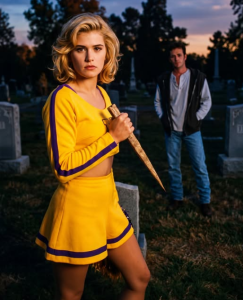
NAME THE 1992 VAMPIRE-CHEERLEADER COMEDY THAT STAKED OUT CULT STATUS!
Released on this day in 1992, Buffy the Vampire Slayer arrived in cinemas as a gleefully offbeat blend of horror, comedy and high-school satire. Long before the television series became one of the defining cult hits of the late 1990s and early 2000s, there was this quirky, colorful feature film that introduced audiences to the unlikely heroine destined to battle vampires while juggling cheerleading practice, shopping trips and teenage drama.
At first glance, the movie looked like another sunny California teen comedy. Buffy Summers was exactly the kind of popular Valley Girl audiences had come to expect from early-1990s cinema. She was fashionable, bubbly, more concerned with cheerleading routines than saving the world, and surrounded by equally image-conscious friends. Yet hidden beneath the glossy exterior was a supernatural destiny that would soon turn her perfectly ordered life upside down.
Kristy Swanson brought Buffy to life with infectious charm and surprising physicality. Rather than portraying the character as an instant action hero, Swanson leaned into Buffy’s initial shallowness, allowing audiences to watch her gradually mature into someone capable of extraordinary courage. That transformation became the heart of the film. Buffy wasn’t born fearless—she became fearless through necessity.
The premise itself was wonderfully absurd. Buffy learns from the mysterious Merrick, played by Donald Sutherland, that she belongs to a long line of Vampire Slayers, young women chosen to protect humanity from the undead. Naturally, Buffy thinks Merrick is completely insane. Why would a high-school cheerleader suddenly be expected to hunt vampires?
Of course, the truth soon becomes impossible to ignore.
As strange murders begin occurring around town, Buffy realizes that vampires really are stalking Los Angeles. Under Merrick’s guidance she begins training with stakes, martial arts and ancient lore, discovering strength and confidence she never knew she possessed.
Standing beside Buffy throughout much of the adventure is Oliver Pike, played by Luke Perry. Fresh from becoming one of television’s biggest stars thanks to Beverly Hills, 90210, Perry brought effortless cool to Pike. Unlike Buffy’s wealthy classmates, Pike was the misunderstood outsider—a motorcycle-riding rebel with a sarcastic wit and hidden intelligence.
The chemistry between Swanson and Perry gives the movie much of its enduring appeal. Pike quickly realizes Buffy is different, believing her extraordinary story when almost nobody else will. Rather than simply serving as a love interest, Pike becomes Buffy’s ally in her increasingly dangerous battle against the undead.
The villains are led by Lothos, portrayed with eerie theatrical flair by Rutger Hauer. Hauer’s performance contrasts sharply with the film’s lighthearted tone, giving the vampires genuine menace despite the comedy surrounding them. Lothos isn’t simply another monster—he is an ancient predator determined to eliminate the Slayer before she reaches her full potential.
One of the film’s greatest strengths is its refusal to take itself too seriously. Director Fran Rubel Kuzui embraces exaggerated comedy alongside horror elements, resulting in scenes that bounce effortlessly between laughs and scares. Vampires burst into flames, graveyards become battlegrounds, and shopping malls sit only minutes away from ancient supernatural conflicts.
The screenplay came from a relatively unknown writer named Joss Whedon. His original concept was actually intended as a much darker satire of horror clichés. Whedon wanted audiences to question why blonde cheerleaders in horror movies were always the first victims.
His solution?
Make the blonde cheerleader the monster hunter instead.
Although the finished movie leaned more heavily into broad comedy than Whedon originally envisioned, many of his ideas remained intact. Buffy was resourceful, compassionate and increasingly capable, proving that appearances could be wonderfully deceptive.
That central concept eventually evolved into one of television’s greatest cult series.
Five years later, Buffy the Vampire Slayer returned as a television show starring Sarah Michelle Gellar. While the series dramatically expanded the mythology, deepened the emotional storytelling and developed far more complex characters, it never abandoned the central premise introduced by the 1992 film: ordinary teenage life colliding spectacularly with supernatural destiny.
Interestingly, the television series largely ignored the continuity of the movie, effectively reinventing much of the mythology. Yet many fans eventually came to appreciate both versions for different reasons.
The film captures early-1990s pop culture in glorious fashion. Bright colors, oversized fashion, high-school stereotypes, pop soundtrack choices and tongue-in-cheek humor make it an entertaining time capsule. Watching it today is like stepping back into the era of malls, pagers, cassette tapes and carefree California teen movies.
Its supporting cast is equally impressive.
Donald Sutherland lends unexpected gravitas as Merrick, treating the Slayer mythology with complete seriousness despite the surrounding comedy.
Rutger Hauer provides genuine menace as Lothos, elevating the supernatural conflict whenever he appears.
Paul Reubens nearly steals the entire movie with his delightfully eccentric performance as vampire henchman Amilyn. His famously over-the-top death scene became one of the film’s most quoted moments, stretching on hilariously as he continued groaning, stumbling and complaining long after suffering what should have been a fatal wound.
The cast also includes several familiar faces early in their careers, making revisits especially enjoyable for movie fans.
Commercially, the film earned respectable box-office returns but wasn’t considered a major blockbuster. Critics were divided, with some appreciating its playful tone while others found it uneven. Nevertheless, audiences gradually embraced it through home video, cable television and repeat viewings.
That slow-burning popularity transformed the movie into a genuine cult favorite.
Much of its lasting appeal comes from how confidently it embraces its own silliness. Rather than pretending to be terrifying, it revels in campy fun while still delivering enough action to satisfy horror fans. The balance isn’t always perfect, but it remains endlessly entertaining.
Looking back, it’s remarkable how influential the movie ultimately became. Without this modest horror-comedy, there might never have been the television phenomenon that inspired countless writers, filmmakers and television creators. The idea of combining supernatural adventure with genuine coming-of-age storytelling would go on to shape numerous genre series over the following decades.
Modern audiences can also appreciate how ahead of its time Buffy was as an action heroine. At a point when female leads in genre films were still comparatively rare, Buffy demonstrated that a young woman could headline an action-packed supernatural adventure without sacrificing humor, vulnerability or personality.
She wasn’t trying to imitate male action heroes.
She fought in her own way.
The movie also cleverly subverted expectations. The fashionable cheerleader wasn’t helpless. The brooding rebel wasn’t simply a bad boy. Even the vampires blended classic Gothic traditions with contemporary California style.
Thirty-four years after its release, Buffy the Vampire Slayer continues to enjoy affection from genre fans who appreciate its unique mixture of horror, comedy and teen romance. It may not possess the emotional depth or serialized storytelling of its television successor, but it laid the foundation for everything that followed.
For many fans, revisiting the original film is like opening a nostalgic time capsule—a reminder of an era when horror could be colorful, funny and gloriously camp without losing its bite.
So if you recognized the image, congratulations.
The answer is Buffy the Vampire Slayer (1992), starring Kristy Swanson as vampire-slaying cheerleader Buffy Summers, alongside Luke Perry as the rebellious Oliver Pike—a wonderfully quirky pairing that helped launch one of popular culture’s most beloved supernatural franchises.