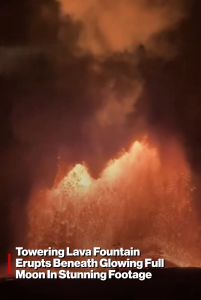
Towering Lava Fountain Erupts Beneath Glowing Full Moon in Stunning Footage
A breathtaking volcanic spectacle has captivated viewers around the world after dramatic footage captured a towering fountain of molten lava erupting into the night sky beneath the glow of a brilliant full moon. The remarkable scene, filmed during an active eruption, showcases nature at its most powerful and mesmerizing, with incandescent lava soaring hundreds of feet into the air while thick plumes of volcanic gas and ash drift overhead.
The stunning video quickly spread across social media platforms, drawing millions of views from people amazed by the fiery display. Scientists, photographers, and volcano enthusiasts alike praised the footage for capturing one of Earth’s most extraordinary natural phenomena—a lava fountain illuminated against the backdrop of a moonlit sky.
A Rare Natural Spectacle
Volcanic eruptions have fascinated humanity for thousands of years, but witnessing an active lava fountain at night offers an entirely different perspective. In darkness, the glowing streams of molten rock become even more vivid, creating dramatic contrasts between brilliant orange lava and the surrounding black volcanic landscape.
The full moon added another layer of beauty to the scene, softly lighting the surrounding terrain while the eruption dominated the horizon with explosive bursts of molten material.
Experts note that such moments remind us of the immense geological forces continually shaping our planet.
What Is a Lava Fountain?
A lava fountain occurs when gas-rich magma rises rapidly through a volcanic vent. As pressure decreases near the surface, dissolved volcanic gases expand violently, propelling molten rock high into the atmosphere.
Depending on the eruption, lava fountains may range from a few meters tall to more than 500 meters (over 1,600 feet).
Unlike explosive eruptions that send ash clouds into the upper atmosphere, lava fountains are often associated with relatively fluid basaltic magma, which allows spectacular jets of glowing lava to form.
The molten fragments eventually cool and fall back to Earth, building cones around the volcanic vent or flowing away as lava rivers.
The Science Behind the Glow
Fresh lava typically reaches temperatures between 700°C and 1,200°C (1,300°F to 2,200°F).
At these temperatures, molten rock emits its own intense light, producing the brilliant orange and yellow colors visible during nighttime eruptions.
As lava cools, its color gradually changes from bright yellow to orange, then deep red before eventually turning black as it solidifies into volcanic rock.
The intense heat can often be felt hundreds of meters away, depending on wind conditions and the size of the eruption.
Why the Full Moon Made the Scene Special
Nighttime volcanic photography is already visually striking, but the presence of a full moon elevated the spectacle.
Moonlight softly illuminated nearby volcanic slopes, smoke clouds, and surrounding landscapes, providing detail that would otherwise disappear into darkness.
Photographers often seek nights with a bright moon because it allows them to capture both the eruption and its surroundings in a single image without relying entirely on artificial lighting.
The combination of moonlight and incandescent lava produced a dramatic balance between cool and warm tones, making the footage especially captivating.
Volcanic Gas and Smoke
The towering plume visible above the lava fountain consisted primarily of volcanic gases, steam, and fine particles.
Active volcanoes commonly release:
- Water vapor
- Carbon dioxide
- Sulfur dioxide
- Hydrogen sulfide
- Other volcanic gases
These emissions can affect local air quality and, in some cases, create volcanic haze known as “vog.”
Scientists carefully monitor gas emissions because changes in gas composition can provide valuable clues about volcanic activity occurring beneath the surface.
Monitoring Active Volcanoes
Modern volcano observatories employ sophisticated technology to monitor eruptions around the clock.
These tools include:
- Seismometers that detect earthquakes beneath volcanoes.
- GPS stations that measure ground deformation.
- Satellite imagery that identifies heat signatures.
- Gas sensors that monitor volcanic emissions.
- Thermal cameras that observe lava movement.
By combining these data sources, scientists can better understand volcanic behavior and issue timely warnings when necessary.
Hazards Despite the Beauty
Although lava fountains create spectacular images, active eruptions remain dangerous.
Potential hazards include:
Lava Flows
Molten rock can destroy roads, homes, forests, and infrastructure as it slowly advances downhill.
Volcanic Gas
High concentrations of sulfur dioxide and carbon dioxide can pose health risks, especially near active vents.
Falling Lava Fragments
Exploding lava can eject molten rocks over considerable distances, making areas near erupting vents extremely hazardous.
Ashfall
Depending on eruption style, volcanic ash may disrupt transportation, contaminate water supplies, and affect air travel.
Authorities typically establish exclusion zones around active eruptions to protect both residents and visitors.
Why People Are Fascinated by Volcanoes
Volcanoes represent one of Earth’s most dramatic natural processes.
Unlike hurricanes or earthquakes, eruptions often provide visible evidence of the tremendous energy hidden beneath the planet’s surface.
Watching lava emerge directly from Earth’s interior offers a rare glimpse into geological processes that have shaped continents and created new land for billions of years.
This combination of beauty and danger has inspired artists, scientists, photographers, and travelers for generations.
The Role of Social Media
Advances in camera technology have transformed how volcanic eruptions are documented.
High-resolution smartphones, drones, and professional cameras now allow observers to capture extraordinary footage from safe viewing areas.
Videos that once required expensive television crews can now reach millions of viewers within hours through social media.
Scientists also benefit from public observations, as photographs and videos sometimes help document changes occurring during eruptions.
However, experts continue to emphasize that no photograph is worth risking personal safety.
Visitors should always obey official restrictions around active volcanoes.
Tourism Around Active Volcanoes
Many volcanic regions have become popular tourist destinations because of their unique landscapes and geological significance.
Guided tours often allow visitors to safely observe volcanic activity from approved viewing locations while learning about local geology and eruption history.
Tourism associated with volcanoes contributes significantly to local economies in many countries.
However, conditions can change rapidly.
Authorities may close parks or viewing areas with little notice if volcanic activity intensifies.
Safety always takes priority over sightseeing.
Nature’s Constant Transformation
Volcanoes remind us that Earth is a dynamic planet.
New islands occasionally emerge from the sea.
Fresh lava creates new coastlines.
Entire landscapes can change within hours during major eruptions.
Although destructive in the short term, volcanic activity also plays an important role in Earth’s natural systems.
Over time, weathered volcanic rock produces fertile soils that support forests, agriculture, and diverse ecosystems.
Some of the world’s most productive farmland exists because of ancient volcanic eruptions.
Scientific Importance
Studying active eruptions helps researchers improve eruption forecasting and understand Earth’s interior.
Every eruption provides new information about magma movement, volcanic gases, seismic activity, and lava chemistry.
This knowledge helps scientists better assess hazards and improve emergency planning for communities living near active volcanoes.
Research conducted during eruptions also advances our understanding of similar geological processes occurring on other planets and moons throughout the solar system.
A Reminder of Earth’s Power
The now-viral footage of the towering lava fountain beneath the glowing full moon serves as a powerful reminder of both the beauty and the immense force of nature. While the eruption created unforgettable images that captivated audiences worldwide, it also highlighted the importance of respecting active volcanic environments and following guidance from local authorities and scientific agencies.
As molten rock surged skyward against the moonlit night, viewers were treated to one of nature’s most awe-inspiring displays—a vivid illustration of the dynamic forces continuously reshaping our planet. The combination of fire, smoke, and moonlight created a scene that was both mesmerizing and humbling, reminding us that beneath Earth’s seemingly stable surface lies extraordinary energy capable of producing breathtaking beauty as well as significant natural hazards.
For scientists, photographers, and nature enthusiasts alike, such moments offer a rare opportunity to witness the remarkable processes that have shaped our world for millions of years. As monitoring efforts continue and researchers learn more from each eruption, these spectacular events not only inspire wonder but also deepen our understanding of the powerful geological forces that continue to mold the Earth today.