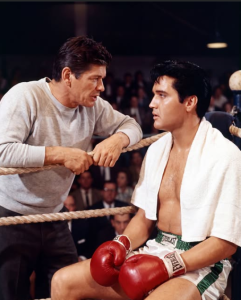
The tough-guy actor in Elvis Presley’s corner is Charles Bronson.


Released on August 2, 1962, Kid Galahad teamed Elvis Presley with Charles Bronson, who played Lew Nyack, the seasoned boxing trainer responsible for shaping Elvis’s character, Walter Gulick, into a promising prizefighter. Years before Bronson became one of Hollywood’s most recognizable action heroes and the iconic face of the Death Wish series, he was already earning admiration for his rugged screen presence, stoic performances, and ability to portray hardened men whose actions spoke louder than words.
Charles Bronson: Hollywood’s Future Ultimate Tough Guy
Looking at the publicity photograph, Bronson perfectly embodies the role that would define much of his career. Leaning against the ropes, calmly instructing his young boxer between rounds, he radiates quiet authority. There are no dramatic gestures or theatrical expressions. Instead, his weathered face and focused gaze tell audiences everything they need to know. He is a man who has spent a lifetime in boxing gyms, understands the sacrifices required, and recognizes both the promise and dangers facing his fighter.
This understated style became Bronson’s trademark throughout a career spanning more than five decades.
Kid Galahad Gives Elvis a Different Kind of Role
Unlike many Elvis Presley musicals filled with exotic locations, endless romances, and upbeat musical numbers, Kid Galahad offered a more grounded dramatic setting.
Elvis played Walter Gulick, a recently discharged serviceman who drifts into the world of professional boxing. Though initially uninterested in fighting, his incredible punching power soon attracts attention from promoters eager to profit from his natural talent.
Walter’s greatest ally becomes Lew Nyack, portrayed by Charles Bronson.
Nyack serves as far more than a boxing trainer. He becomes a mentor, teacher, protector, and moral compass, helping Walter navigate the temptations surrounding fame, money, and the often ruthless business of prizefighting.
Their relationship provides the emotional backbone of the film.
A Character Built on Experience
Bronson’s Lew Nyack isn’t flashy.
He doesn’t shout.
He doesn’t deliver long inspirational speeches.
Instead, he teaches through experience.
Every scene between Bronson and Presley feels authentic because Nyack understands that boxing isn’t merely about throwing punches. It’s about discipline, patience, conditioning, timing, and emotional control.
Bronson’s restrained performance gives Elvis someone believable to play against, creating chemistry built on mutual respect rather than conflict.
Many critics at the time noted that Kid Galahad contained stronger dramatic performances than several of Elvis’s other early 1960s films.
Charles Bronson Before Worldwide Fame
When Kid Galahad premiered in 1962, Charles Bronson was hardly an overnight sensation.
He had spent years paying his dues in Hollywood.
Born Charles Dennis Buchinsky in Pennsylvania, Bronson came from an immigrant coal-mining family and knew genuine hardship growing up during the Great Depression.
He worked in coal mines before serving in the United States Army Air Forces during World War II.
Those real-life experiences shaped his unmistakable screen persona.
Audiences believed Bronson could survive almost anything because, in many ways, he already had.
Throughout the 1950s he appeared in numerous westerns, war pictures, crime dramas, and television series, gradually building a reputation as one of Hollywood’s most dependable character actors.
A Face Made for Westerns
Long before Death Wish, Bronson excelled in westerns.
His craggy features, piercing eyes, and economical acting style made him ideal for frontier stories populated by soldiers, gunslingers, scouts, and lawmen.
Unlike many leading men of the era, Bronson didn’t possess polished movie-star glamour.
Instead, he looked like someone who had genuinely lived a difficult life.
That authenticity became his greatest strength.
Directors recognized they could cast Bronson as almost any hard-edged character and audiences would immediately accept him.
The War Film Specialist
War movies also became an important part of Bronson’s early career.
Whether portraying soldiers, resistance fighters, or military officers, he projected toughness without arrogance.
He rarely overplayed emotion.
Instead, he conveyed courage through determination and quiet resilience.
This subtle approach distinguished him from many more theatrical performers of the period.
It also laid the foundation for the screen image that would later make him an international superstar.
Working Alongside Elvis Presley
Sharing the screen with Elvis Presley presented unique challenges.
By 1962, Elvis was already one of the world’s biggest entertainment stars.
Most audiences attended his movies primarily to hear the songs and watch his magnetic screen presence.
Supporting actors needed enough charisma to hold their own without overwhelming the film.
Bronson achieved exactly that.
His calm authority balanced Elvis’s youthful energy beautifully.
Whenever the two appeared together, Bronson grounded the story while Elvis supplied its heart and charm.
Their mentor-student relationship remains one of the strongest elements of Kid Galahad.
Elvis as an Underdog
Walter Gulick differs from many Elvis characters.
Rather than beginning as a confident ladies’ man, Walter starts as an uncertain young veteran searching for direction.
His journey into boxing becomes one of self-discovery.
Bronson’s Nyack recognizes Walter’s physical gifts but also understands that natural talent alone cannot create a champion.
Through careful guidance, training, and honest advice, Nyack helps transform Walter into a disciplined fighter.
This dynamic gives the movie emotional weight beyond its musical performances.
Memorable Songs
Although more dramatic than some Elvis films, Kid Galahad still features several memorable songs.
Among them are:
- “King of the Whole Wide World”
- “Home Is Where the Heart Is”
- “This Is Living”
- “Riding the Rainbow”
These songs helped maintain Elvis’s musical appeal while allowing the film to explore a more serious storyline centered on ambition, loyalty, romance, and professional boxing.
Bronson’s International Breakthrough
Only a few years after Kid Galahad, Bronson’s career reached another level.
His performances in ensemble classics like The Great Escape and The Magnificent Seven introduced him to even wider audiences.
Interestingly, European viewers—particularly in France and Italy—embraced Bronson even before Hollywood fully recognized his leading-man potential.
His rugged individuality appealed strongly to international audiences.
Eventually, American studios followed suit.
Becoming Cinema’s Ultimate Vigilante
The role that permanently cemented Bronson’s legend arrived in 1974 with Death Wish.
Playing architect Paul Kersey, Bronson transformed into cinema’s defining vigilante figure.
His quiet intensity, already visible in Kid Galahad, became the central force behind one of the decade’s most talked-about action films.
Unlike traditional superheroes, Kersey relied on determination, intelligence, and relentless resolve rather than extraordinary abilities.
The character made Bronson one of the biggest action stars in the world.
Why Kid Galahad Still Matters
Today, Kid Galahad occupies an interesting place in both Elvis Presley’s and Charles Bronson’s careers.
For Elvis fans, it represents one of his stronger dramatic vehicles, blending music with a believable sports story.
For Bronson admirers, it offers a fascinating glimpse of the actor just before superstardom.
Watching him mentor Elvis in the boxing ring, audiences can already see the qualities that would later define his legendary career:
- Quiet confidence
- Unshakable toughness
- Emotional restraint
- Natural authority
- Authentic screen presence
These characteristics never went out of style.
A Lasting Hollywood Partnership
The image of Charles Bronson speaking quietly to Elvis Presley between rounds perfectly captures what made both performers memorable.
Elvis brought charisma, vulnerability, and musical talent.
Bronson contributed experience, grit, and unwavering credibility.
Together they created one of the more engaging boxing dramas of Elvis’s film career.
More than sixty years after its release, Kid Galahad remains a rewarding watch—not only for Presley fans but also for anyone interested in seeing Charles Bronson before he evolved into Hollywood’s definitive tough guy. Even then, the future action legend already possessed the granite-faced determination, understated confidence, and commanding presence that would soon make him one of cinema’s most enduring icons.